







The silent e rule: how to teach it in five minutes
What the silent e rule is, the words to start with, the words that break it, and a simple way to teach it.
In short
- A silent e at the end makes the vowel before it say its name.
- Teach one vowel at a time: a_e, i_e, o_e, then u_e.
- Have, give, love, come, some, done, none and gone break the rule.
Silent e is often the first long-vowel pattern children meet. It is also one of the most satisfying to teach, because one small letter changes a word they can already read into a new one.
What the rule says
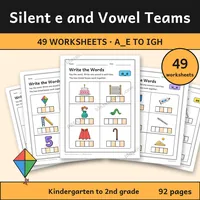
When a short word ends in a vowel, then one consonant, then e, the e is silent and the first vowel usually says its name. Cap becomes cape. Pin becomes pine. Not becomes note. Cub becomes cube.
How to teach it
- Start with a word the child can read. Write pin and read it together.
- Add the e. Write an e at the end and say: this e makes no sound, but it tells the i to say its name. Read pine.
- Swap back and forth. Cover and uncover the e: pin, pine, pin, pine. Then try kit and kite, tap and tape, hop and hope.
- Teach one vowel at a time. Most programs go a_e, i_e, o_e, then u_e and e_e. Words with e_e, such as these, are rare, so that lesson can be short.
Words that break the rule
A few very common words end in silent e but keep a short vowel sound: have, give, love, come, some, done, none and gone. Tell children these are words to learn by heart. Meeting them early stops the rule from feeling broken later.
A common mix-up
Children often read hope as hop, or spell cake as cak. The fix is the same both ways: point to the last letter first. If it is an e after one consonant, the vowel says its name.
Common questions
- What is the silent e rule?
- When a short word ends in a vowel, one consonant and an e, the e is silent and the first vowel usually says its name, as in cape, pine, note and cube.
- Is magic e the same as silent e?
- Yes. Magic e, silent e, bossy e and the name vowel-consonant-e all describe the same pattern.
- When should children learn silent e?
- After they can read short vowel words and common digraphs, usually in the second half of Kindergarten or early in first grade.
Ready-made pages for this skill
A poster, a practice page and an answer key, already made.
See the set