














Homeschool Kindergarten: A 36-Week Plan You Can Follow Every Day
Most kindergarten homeschool guides give you a list of subjects. This one gives you the order: which letters and skills to teach in which week, how long each part of the day takes, and which pages to print. Follow it as written, or use it as a map.
How many hours a day?
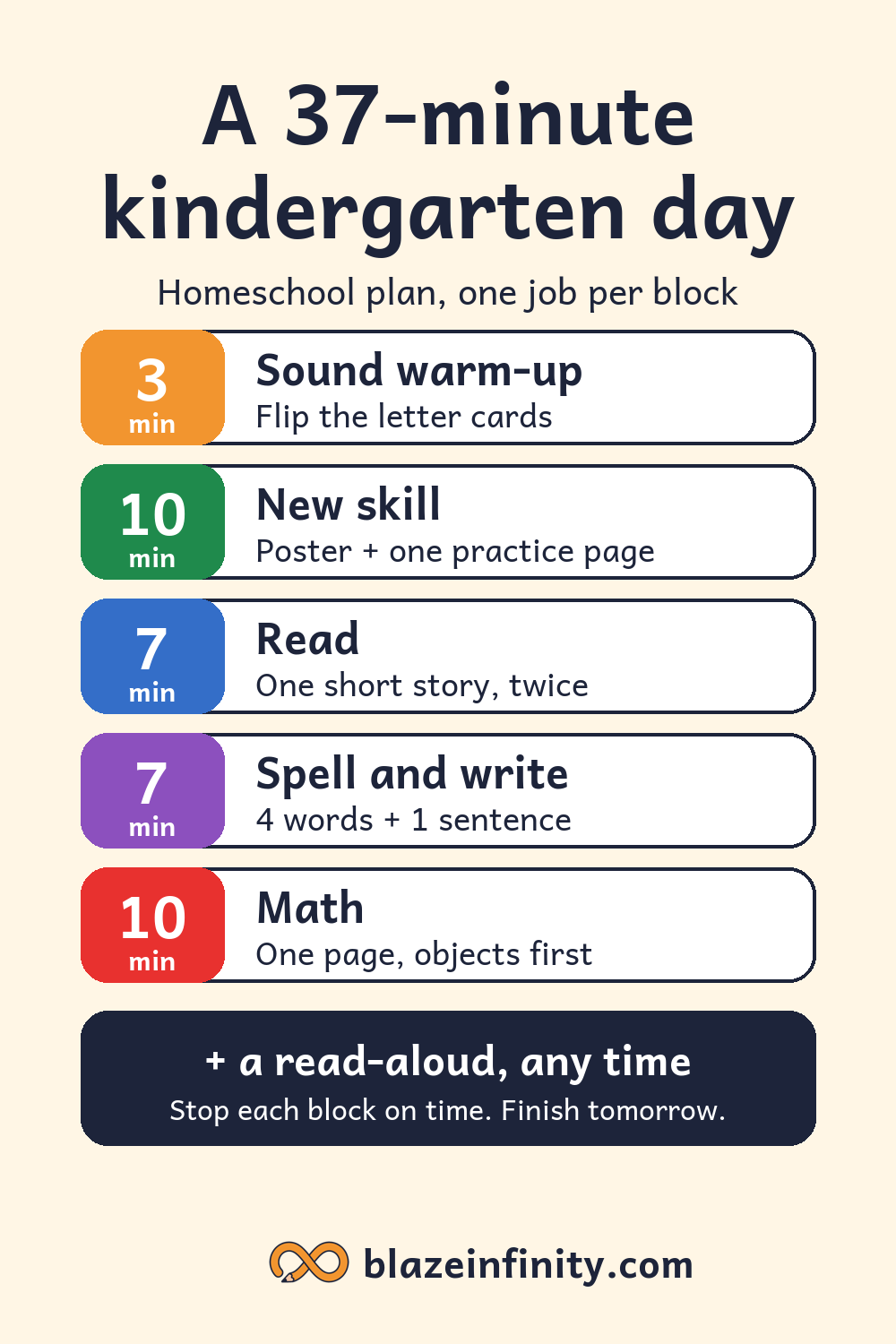
About 35 to 40 minutes at the table, plus a read-aloud whenever it suits you. That is enough when the time is short and focused. Our day is split into short blocks with one job each, because five-year-olds focus best in short bursts. Common phonics programs use about 20 minutes for the reading lesson; we keep phonics, reading and spelling to about 20 minutes together, then add math.
A done-for-you day (week 20, short i)
Print the night before: one practice page, one story page, one dictation page and one math page.
| Time | Block | What you do |
|---|---|---|
| 3 min | Sound warm-up | Flip the letter cards learned so far. Your child says each sound. Cards missed twice go in a "tomorrow" pile. |
| 10 min | New skill | Show the short i poster. Read the rule together, name each picture and tap one finger per sound. Your child does the practice page; check it together with the answer key. |
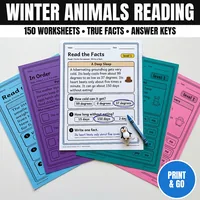
| 7 min | Read | The short i story: read it twice, first pointing under each word, then smoother. Answer the three questions. |
| 7 min | Spell and write | Say a word; your child taps the sounds, then writes it. Four words, then one short sentence. Check: capital, spaces, period. |
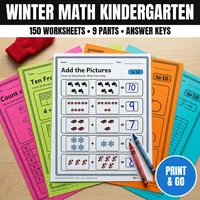
| 10 min | Math | One Adding to 10 page. Use real objects first. |
| 15 to 20 min | Read-aloud | Any picture book, any time of day. Talk about one new word. Ask "what happened first?" |
Three rules make this work:
- Stop each block on time, even if it isn't finished. Finish tomorrow.
- One new thing a day.
- If your child misses 2 of the 3 story questions, reread the story tomorrow before moving on.
The week (from week 19 on)
| Day | Phonics | Read | Spell and write | Math |
|---|---|---|---|---|
| Mon | New skill: poster and practice page | Mini book for the skill | Spelling list: read, tap, trace | Math page |
| Tue | Letter cards and answer-key review | Decodable story (twice, 3 questions) | Dictation: 4 words and 1 sentence | Math page |
| Wed | Fluency word grid | Fluency sentences | Read, write and draw page | Math page |
| Thu | Second lesson, or a word game | Reread the mini book to someone | Handwriting page | Math page |
| Fri | Check-up: the record says what to do next | One-minute reading chart | One sentence about the week's book | Beat-your-score math sheet |
The year, week by week
Each week has one or two phonics lessons, one math unit stretch and writing every day. Weeks 1 to 18 teach every letter sound, starting with a, m, s, t and blending by week 3. Weeks 19 to 36 add reading stories, spelling and digraphs.
| Weeks | Phonics and reading | Writing | Math |
|---|---|---|---|
| 1 | Rhyming and clapping syllables | Cutting and tracing lines, writing their name | Numbers 0 to 5 |
| 2-3 | a, m, s, t; blending the first words (am, at, sat) | Aa, Mm, Ss, Tt | Numbers 0 to 5 |
| 4-6 | p, f, i, n; first three-letter words with a and i | Pp, Ff, Ii, Nn, Oo | Numbers 6 to 10 |
| 7-9 | o, d, c, u, g, b (d and b in different weeks) | Dd, Cc, Uu, Gg, Bb | Numbers 11 to 20 |
| 10-11 | e; blending practice; ending -s | Ee; words beside pictures | Counting and order |
| 12-14 | k, h, r, l, and blends with r and l | Kk, Hh, Rr, Ll | More and less |
| 15-17 | w, j, y, x, qu, v, z: the whole alphabet done | Ww to Zz | Making 5 and 10 |
| 18 | Review week: sounds and short a words | Numbers 0 to 9 | Adding to 5 game sheets |
| 19-23 | Short a, i, o, u, e, each with a story, a mini book and a check-up | Weekly spelling and dictation | Adding to 10, taking away |
| 24 | All short vowels | First sentences | Taking away |
| 25 | Double letters at the end: ff, ll, ss, zz (puff, bell) | Spelling and dictation | Shapes |
| 26-30 | ck, sh, th, ch, wh | Spelling, sentence scrambles | Shapes, measuring and sorting |
| 31-32 | ng, nk; digraph review | Spelling; draw-and-write pages | First word problems |
| 33-34 | Review with word chains and word sorts | Read, write and draw sentences | Counting to 100; picture math |
| 35-36 | Final check-ups; reread the year's mini books | "My best sentence" page | Math games; last beat-your-score level |
Fast reader? In week 35 you can start silent e (cake, bike), the first skill of 1st grade.
Why this order
- Sounds with letters, and blending early. The National Reading Panel found that practicing sounds with letters worked better than without, and that blending and segmenting had a larger effect on reading than mixed-skill practice.
- Start with sounds you can stretch. In a 2021 study (Gonzalez-Frey and Ehri), kindergartners who blended by holding the sounds ("mmmaaannn") did better than those who broke them apart. That's why the first weeks use letters you can hold, like m, s, f and n.
- Systematic phonics from kindergarten. The same report found systematic phonics helped kindergartners' reading and spelling.
- Spelling and handwriting are taught, not left to chance. A review of 53 studies found direct spelling teaching beat "pick it up as you go" (Graham and Santangelo, 2014), and handwriting teaching improved both neatness and the length of children's writing (Santangelo and Graham, 2016).
- The end-of-year goals follow the kindergarten standards most US schools use: name every letter, give one sound for each consonant, read and spell simple three-letter words, read common words by sight, count to 100, add and subtract within 5.
What to print, and where it comes from
Every block in the plan uses one of these sets, and every set has a free sample page to try first.
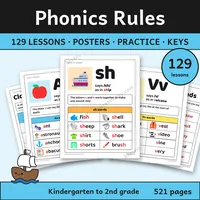
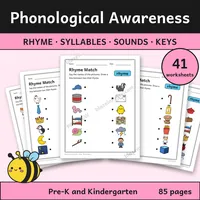
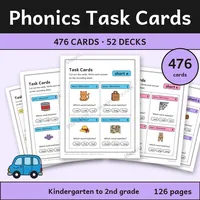
- Phonics lessons: Phonics Rules (lessons 1 to 53 in kindergarten), with Phonological Awareness for week 1 and warm-ups.
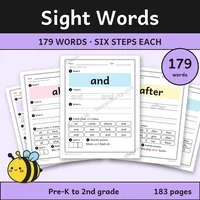
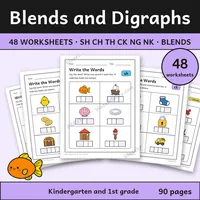
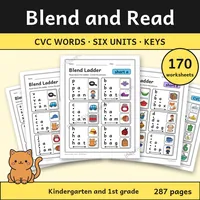
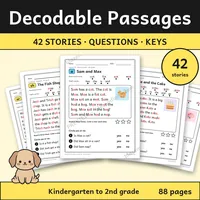
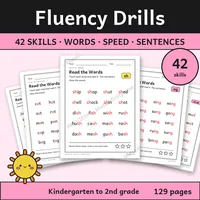
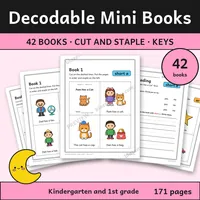
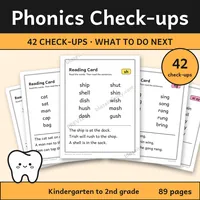
- Reading: Decodable Passages, Decodable Mini Books, Fluency Drills, Phonics Check-ups, Blend and Read, Sight Words.
- Writing and spelling: Handwriting and Writing, Spelling and Dictation, Sentence Building, Directed Drawing and Writing.
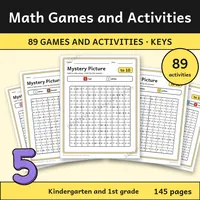
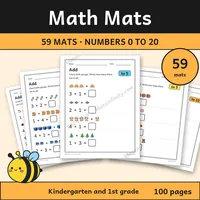
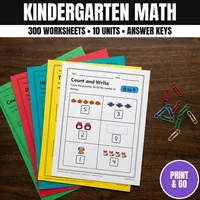
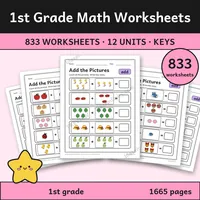
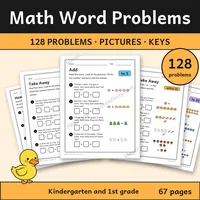
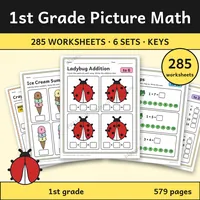
- Math: Kindergarten Math Worksheets, Math Word Problems, Kindergarten Picture Math, Math Games and Activities, Beat Your Score.
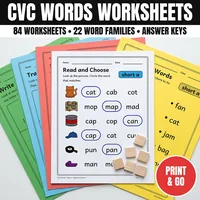
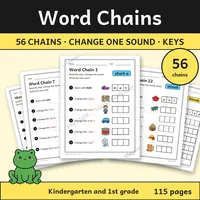
- Extras: Kindergarten Morning Work for weeks 25 to 32, Word Chains, Phonics Word Sorts, Word Family Games.
- Free tools: name tracing for week 1, the hundreds chart for week 33.
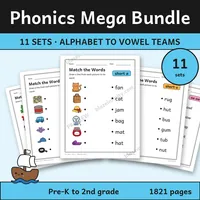
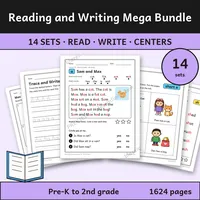
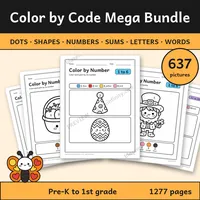
Want it all at once? The Phonics, Math and Reading and Writing Mega Bundles hold every set above except Beat Your Score.
Is kindergarten required where you live?
It depends on your state. In 2018, kindergarten attendance was required in only about 17 to 18 states and DC (National Center for Education Statistics, Table 5.3). The age when school becomes required also differs: 6 in Texas, California, Florida and New York, 8 in Pennsylvania and Washington (NCES Table 5.1, 2017). Homeschool rules range from no notice at all to notice, testing and evaluations. This is not legal advice: check your own state's rules with your state department of education or HSLDA.
Questions parents ask
How many hours a day should I homeschool kindergarten?
About 35 to 40 minutes of table work, split into short blocks, plus a read-aloud. Short and every day beats long and occasional.
What should I teach first?
Letter sounds and blending, starting with a, m, s and t, so your child reads real words in week 3.
Do I have to do all five days?
The plan is built for five short days. Four days works if you drop the Thursday game and keep the Friday check-up.
What about science and social studies?
Read-alouds cover a lot in kindergarten. Choose picture books on topics your child loves; the plan leaves 15 to 20 minutes a day for them.
What comes after kindergarten?
First grade continues the same lessons: silent e, word endings, syllables, then vowel teams. A 1st grade plan is coming next.