




Teaching letter formation: start dots, strokes and lines
How to teach children to form letters the same way every time, and why the starting point matters most.
In short
- The starting point matters most: begin at the top or the middle.
- Say the strokes out loud as the child writes.
- Three writing lines show how tall each letter is.
Children who form each letter the same way every time write faster and reverse fewer letters. The habit is easiest to build at the very start.
The starting point matters most
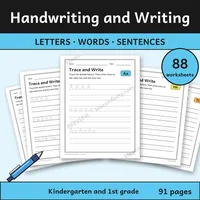
Almost every letter starts at the top or the middle and moves down. A child who starts at the bottom will still make a readable letter, but writing will stay slow. A start dot on the page shows where the pencil goes first.
Say the strokes out loud
Short phrases help: for b, “straight down, go around.” For d, “go around, straight down.” Because the two letters begin differently, saying the strokes helps children stop mixing them up.
Use three lines
A top line, a dashed middle line and a bottom line show how tall each letter is. Tall letters such as h and l touch the top. Small letters such as a and c stay under the middle line. Letters with tails, such as g and p, drop below the bottom.
A good order of practice
- Trace big letters first, where the movement is large.
- Trace smaller letters next.
- Write alone last, with a model nearby.
Teaching letters in groups with the same first stroke also helps. The letters c, a, d, g, o and q all begin with the same curve.
Common questions
- Should children learn uppercase or lowercase first?
- Many programs start with uppercase because the shapes are simpler, then move to lowercase, which children read far more often.
- How do I stop b and d reversals?
- Teach the two letters with different first strokes: b starts with a line down, d starts with the curve.
- How long should handwriting practice last?
- Five to ten focused minutes a day works better for young children than one long session.
Ready-made pages for this skill
A poster, a practice page and an answer key, already made.
See the set