









Phonemic Awareness Activities for Kindergarten, Step by Step
Oral phonemic awareness activities for kindergarten in the order skills develop, with the words to say, the mistakes to fix and a 10-minute daily routine.
In short
- Teach the skills in order: first sounds, last sounds, blending, segmenting, then adding, taking away and swapping.
- Focus each day on one or two skills, in a 10-minute routine that ends with a short link to letters.
- Clip stop sounds so /b/ never becomes "buh", and start with sounds you can hold, like /m/ and /s/.
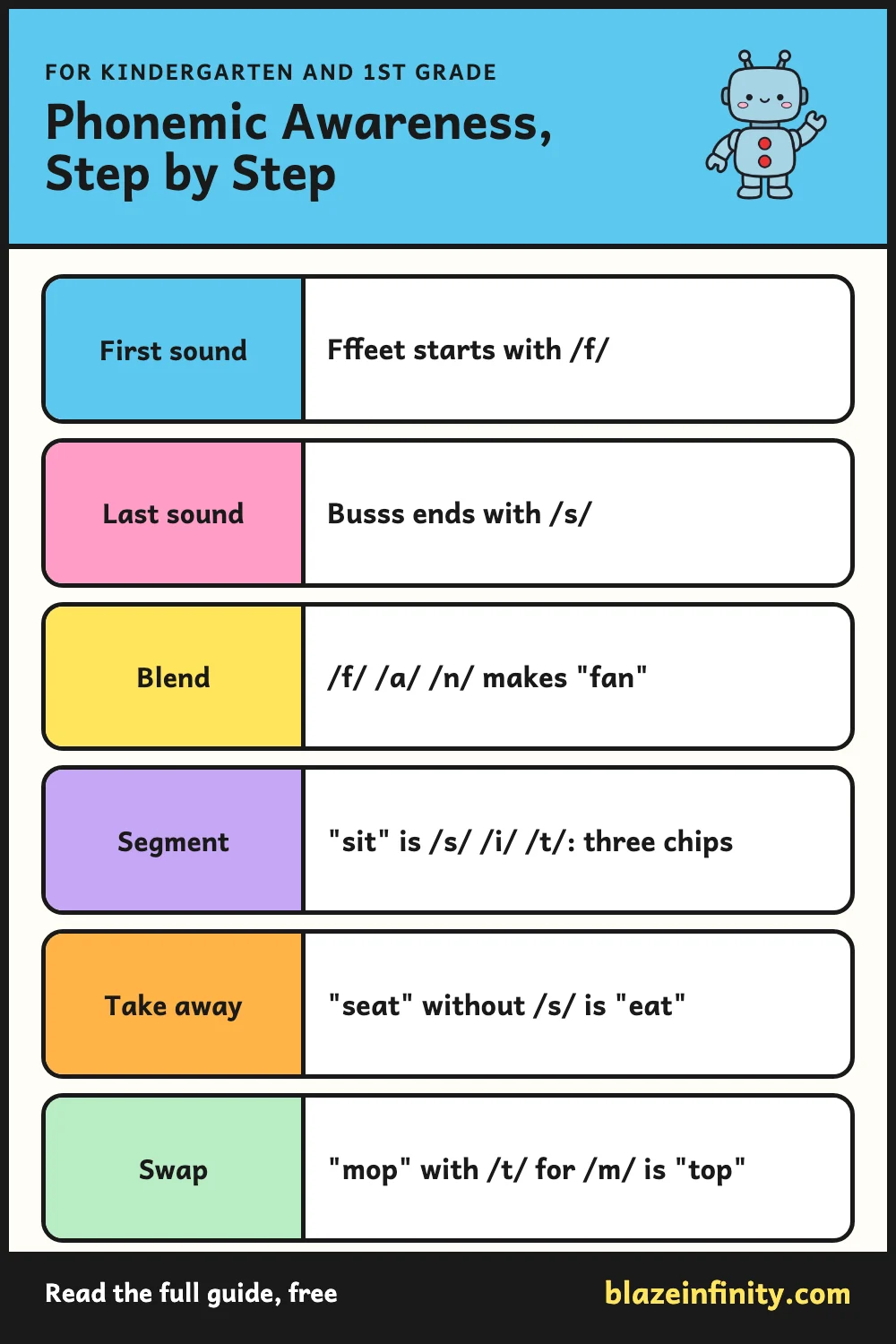
The best phonemic awareness activities for kindergarten are short spoken games. You say a word, children listen for one sound in it, and they answer with their voice, their fingers or a chip. Teach them in the order the skills usually develop: first sounds, then last sounds, then blending sounds into a word, then pulling a word apart into its sounds, and finally adding, taking away and swapping sounds for children who are ready. Each game below takes 2 to 5 minutes and comes with the words to say and the mistakes to listen for.
If you want the definitions first, or how phonemic awareness differs from phonics, start with phonemic awareness vs phonics. This guide is the classroom part: what to do on the rug tomorrow morning.
Before you start: say each sound cleanly
Every game here depends on how you say a sound on its own. Some sounds can be held for as long as you have breath, such as /m/, /s/, /f/, /l/ and /n/. Others are stop sounds that are over the moment you say them, such as /b/, /t/ and /p/. Hold the first kind. Keep the second kind short and crisp. Put your hand under your chin and say /b/: if your jaw drops for a second beat, you said "buh". Try again with no voice after the pop.
Start with words whose sounds you can hold. The panel behind the federal practice guide for kindergarten through 3rd grade gives the same advice for sound box work: use words with continuous sounds until children can hear the separate sounds. A word like "fan" is easier to pull apart than "bug".
How children show you the sounds
A child who only answers out loud can hide behind the loudest voice on the rug, so give every child a way to show each sound.
- Voice, on a signal. "Keep the answer in your mouth until my hand drops." Everyone answers together, and you hear who is late.
- Fingers or arm taps. One finger up for each sound, or tap your shoulder, elbow and wrist for three sounds, then slide your hand down your arm to say the whole word.
- Chips. One counter pushed forward for each sound.
- Sound boxes (Elkonin boxes). A row of boxes on a card, one box for each sound. Children push a chip into a box as they say each sound, then run a finger under the boxes and say the word. Later the chips become letter tiles, then written letters. That is the bridge from listening to spelling.
When you face the class, tap in mirror image so your first sound lands on the children's left, the way sounds run on paper.
Five phonemic awareness games, in the order to teach them
Move to the next skill when most of the class answers correctly most of the time. Keep earlier skills going as a warm-up.
1. First Sound Echo
Teaches: hearing the first sound in a wordYou need: nothing2 to 3 minutes
Say: "I'm going to say a word slowly. Listen for the very first sound. Fffeet. My first sound is /f/. Your turn. Lllamp. Think. Show me." Drop your hand, and children say /l/ together. Do six to eight words with held first sounds, then mix in a stop sound.
When they are steady, change the question to same or different: "Does 'fox' start like 'feet'? Thumbs up or thumbs down." Names work too: "Stand up if your name starts with /m/."
2. Last Sound Detective
Teaches: hearing the ending soundYou need: nothing2 to 3 minutes
Ending sounds are harder, because children tend to stop listening once the word has started. Stretch the end instead of the start: "Listen to the end of this word. Busss. What sound do you hear at the very end?" Begin with words that end in a sound you can hold, like "bus" or "ham", then move to clipped stop sounds, as in "cup".
Once both are steady, ask two questions about one word: "Say 'map'. First sound? Last sound?" The middle vowel comes after this and is the hardest of the three, so stretch it hard: "Muuud. What sound is in the middle?"
3. Robot Talk
Teaches: blending sounds into a wordYou need: nothing3 minutes
Say: "My robot only talks in sounds. Listen. /f/ /a/ /n/. What word did my robot say?" Children answer "fan" together. Start with two parts, the first sound and the rest of the word, as in /r/ and "ug", before moving to three single sounds.
At first, run held sounds together with no gap, "rrruuug", sliding your hand down your arm. Add small gaps as children improve. Children who can blend by ear are ready to blend with letters, and our guide on how to teach blending covers that step.
4. Tap It, Push It
Teaches: segmenting a word into its soundsYou need: three chips and a card with two or three boxes per child4 to 5 minutes
Segmenting is blending in reverse, and harder. Say: "Say 'sit'. Now say it in robot talk and tap each sound. /s/ on your shoulder, /i/ on your elbow, /t/ on your wrist. How many sounds?"
Then move to the boxes. Children say the word slowly, push one chip into a box for each sound, then run a finger under the boxes and say the word again. Start with two-sound words such as "up", then three. When the count is wrong, do not give the answer. Say the word again slowly and ask, "Did you push a chip for /i/?"
5. Take Away, Add On, Swap
Teaches: deleting, adding and changing a soundYou need: nothing; chips for children who need to see it3 minutes
This is for children who already blend and segment three-sound words without help. Practice one kind of change per day, not all three. To take away: "Say 'seat'. Now say it without /s/." To add on: "Say 'and'. Now put /h/ at the start." To swap: "Say 'mop'. Change /m/ to /t/."
A child who stalls can do it with chips in sound boxes: take a chip out, or push a different color into its place, and say the new word. The kindergarten standard asks children to add or substitute sounds in simple one-syllable words by the end of the year (RF.K.2e), so this is a spring goal for most of the class.
What goes wrong, and the fix
Most problems come from a handful of habits, and some of them are ours. Listen to your own model before you correct a child.
If you see
A child blends /b/ /a/ /t/ as "buh-a-tuh" and cannot find the word
Extra "uh" sounds after the stop sounds turn one short word into three beats.
Try this
If you see
A child says "ess" or "tee" instead of a sound
They are giving the letter name, often because letter names came first.
Try this
If you see
A child blends /m/ /o/ /p/ and says "op"
The first sound is gone from memory by the time the last one arrives.
Try this
If you see
A child segments "mop" as /m/ and "op"
They hear the first sound and the rest, but not every sound yet.
Try this
If you see
The same few children answer first every time
The rest of the group is echoing them.
Try this
A 10-minute daily routine
You do not need all five games every day. The National Reading Panel found that phonemic awareness teaching worked best when it focused on one or two kinds of sound work rather than many at once. So the routine has a quick review, two focus skills and a short link to letters.
2 minutes
Warm-up review
One skill the class already knows, at speed. In the fall that is First Sound Echo; by winter it might be Robot Talk.
3 minutes
Focus skill one
The skill you are teaching now, modeled first: "My turn. Your turn." Six to eight words, answered on the signal.
3 minutes
Focus skill two
Its partner skill. Blending pairs with segmenting, and first sounds pair with last sounds. Use the same words in both.
2 minutes
Link to letters
Children push letter tiles into sound boxes for one or two of the words, using only letters you have taught. Early in the year, say a sound and have children point to its letter on the wall.
Over the year, change which two skills are in focus. Early fall is first and last sounds. Late fall is blending and segmenting two- and three-sound words. Winter is segmenting with sound boxes and letter tiles. Spring is adding, taking away and swapping for children who are ready.
How to check who needs more
Whole-group answers hide the children who are copying. Every three or four weeks, take about three minutes with each child alone, use three words per skill, and give no hints.
A three-minute check, one child at a time
- Says the first sound of a word I say, not the letter name
- Says the last sound of a three-sound word
- Blends three sounds I say into a word
- Pushes one chip per sound for a three-sound word
- Says a word with its first sound taken away or changed
A child who misses an item gets about five extra minutes in a small group for the next week or two, on that one skill only. Small groups were among the features of the most effective teaching in the National Reading Panel's review, and the practice guide panel advises one-on-one or small-group help for children who struggle with these skills for a long time. If a child is still stuck after several weeks, talk with your reading specialist.
When to bring in letters
Sooner than you might think. The National Reading Panel found that the most effective phonemic awareness teaching had children work with sounds using letters. A good rule: teach each new skill by ear first, then add letters once the sound part is steady and children know the letters involved.
Sound boxes are the easiest bridge: the card that held chips now holds letter tiles, and later children write letters in the boxes. A child who pushes tiles for "sit" is segmenting and spelling at the same time.
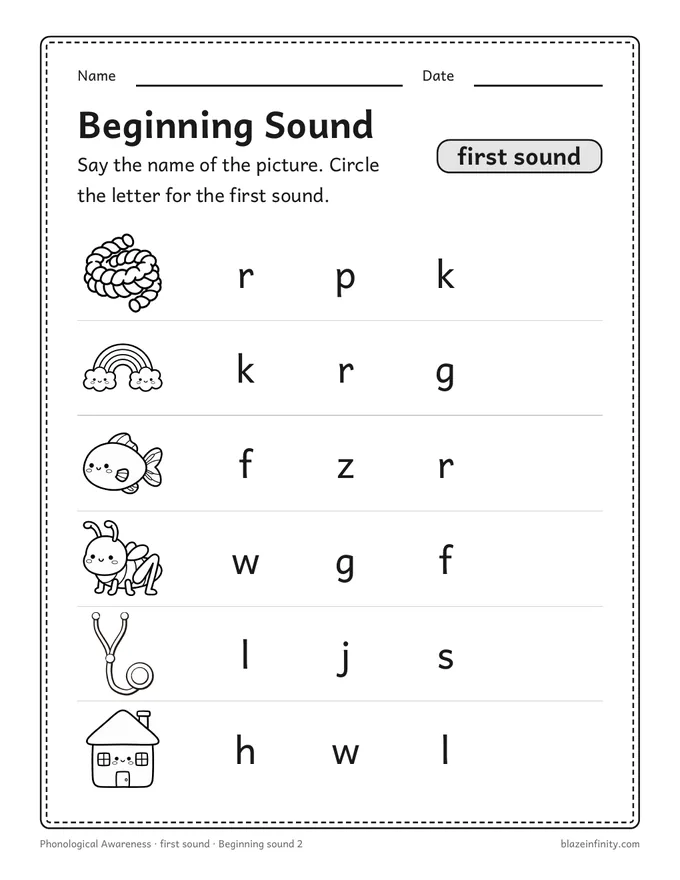
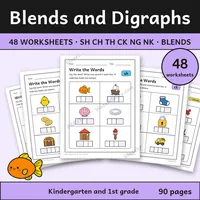
Saying the picture's name and listening for its first sound is the oral part, exactly as in First Sound Echo. Circling the letter is letter work, so use the page once the class knows those letter sounds. If a child circles the wrong letter, ask for the first sound before they look at the choices: that tells you whether the trouble is the sound or the letter.
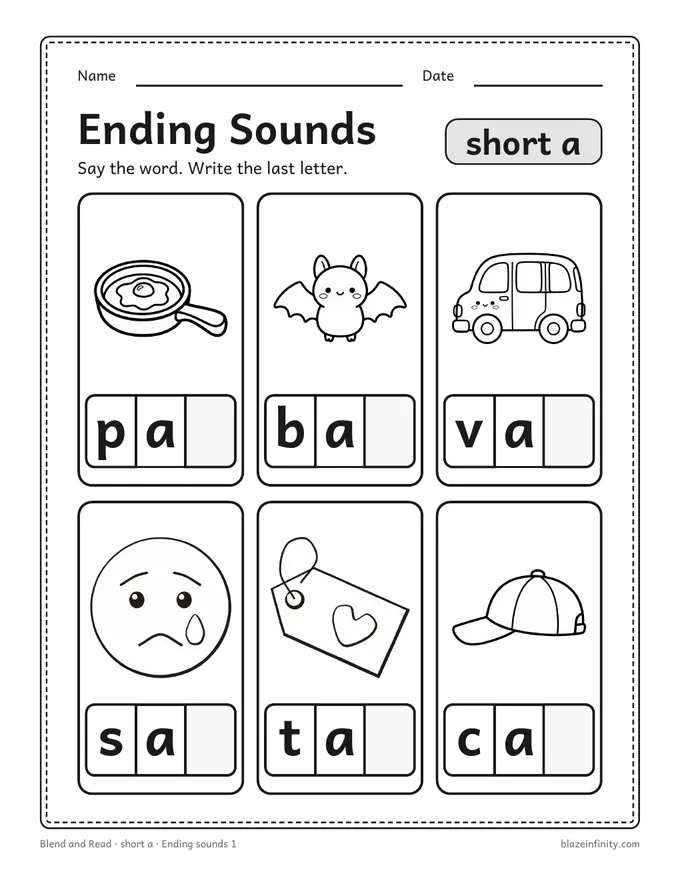
Here too, saying the word is the listening part and writing the last letter is spelling. Use it after Last Sound Detective is steady and children can write the letters. For centers, our beginning sounds clip cards give more practice with beginning sounds.
Phonemic awareness activities for preschool
Preschool and Pre-K children can play the first and third games. Use First Sound Echo with held sounds and names, and Robot Talk with two parts only, such as /m/ and "ilk". Leave chips and sound swapping for later, keep it to a few minutes, and mix it with rhymes and clapping syllables in line or at snack.
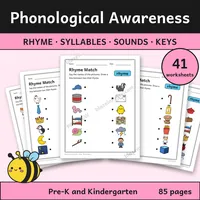
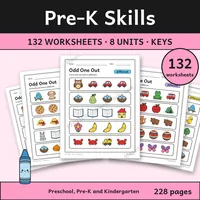
For printed practice of the same skills, Phonological Awareness has picture pages for Pre-K and kindergarten on rhymes, the odd one out, syllables, beginning, middle and ending sounds, and how many sounds a word has, with answer keys: 85 pages in all. More free pages are on our free worksheets page. When children can blend and segment three-sound words by ear and know their letter sounds, they are ready to read and spell CVC words.
What the research says
- Teaching children to manipulate phonemes was highly effective; the most effective instruction taught children to manipulate phonemes with letters, focused on one or two types of phoneme manipulation rather than multiple types, and included teaching in small groups. [1]
- Recommendation 2, develop awareness of the segments of sound in speech and how they link to letters, has strong evidence. Students can mark the sounds in two- or three-phoneme words with Elkonin sound boxes and colored discs or letter tiles; with discs, start with words whose consonants are continuous sounds. Students who struggle persistently often benefit from one-on-one or small-group help. [2]
- Kindergarten: isolate and pronounce the initial, medial vowel and final sounds in three-phoneme (CVC) words (RF.K.2d), and add or substitute individual sounds in simple, one-syllable words to make new words (RF.K.2e). [3]
Sources
- National Reading Panel (2000). Teaching Children to Read: Findings and Determinations of the National Reading Panel by Topic Areas. National Institute of Child Health and Human Development.
- Foorman, B., et al. (2016). Foundational Skills to Support Reading for Understanding in Kindergarten Through 3rd Grade (NCEE 2016-4008). What Works Clearinghouse, Institute of Education Sciences, U.S. Department of Education. Recommendation 2, Example 2.3 and Obstacle 2.2.
- Common Core State Standards for English Language Arts, Reading: Foundational Skills, Kindergarten, RF.K.2.
Common questions
- What are some phonemic awareness activities for kindergarten?
- Short oral games: saying the first or last sound of a word, blending sounds a robot says into a word, tapping or pushing a chip for each sound, and taking away or swapping a sound to make a new word. Each takes 2 to 5 minutes, and most need nothing printed.
- In what order should phonemic awareness skills be taught?
- Most children hear the first sound in a word before the last, then learn to blend sounds into a word, then segment a word into its sounds. Adding, taking away and swapping sounds come last, usually in the second half of kindergarten.
- How long should phonemic awareness practice take each day?
- About 10 minutes a day is plenty for a kindergarten class. Short daily practice on one or two skills keeps attention and gives children many tries.
- Should phonemic awareness be taught with letters?
- Yes, once children know a few letter sounds. The National Reading Panel found the most effective phonemic awareness teaching had children work with sounds using letters. Teach a new skill by ear first, then add letter tiles in sound boxes.
- What are good phonemic awareness games for preschool?
- Name games for first sounds, such as standing up if your name starts with /m/, and robot talk with two parts, like /m/ and "ilk". Keep them to a few minutes and mix them with rhyming and clapping syllables.
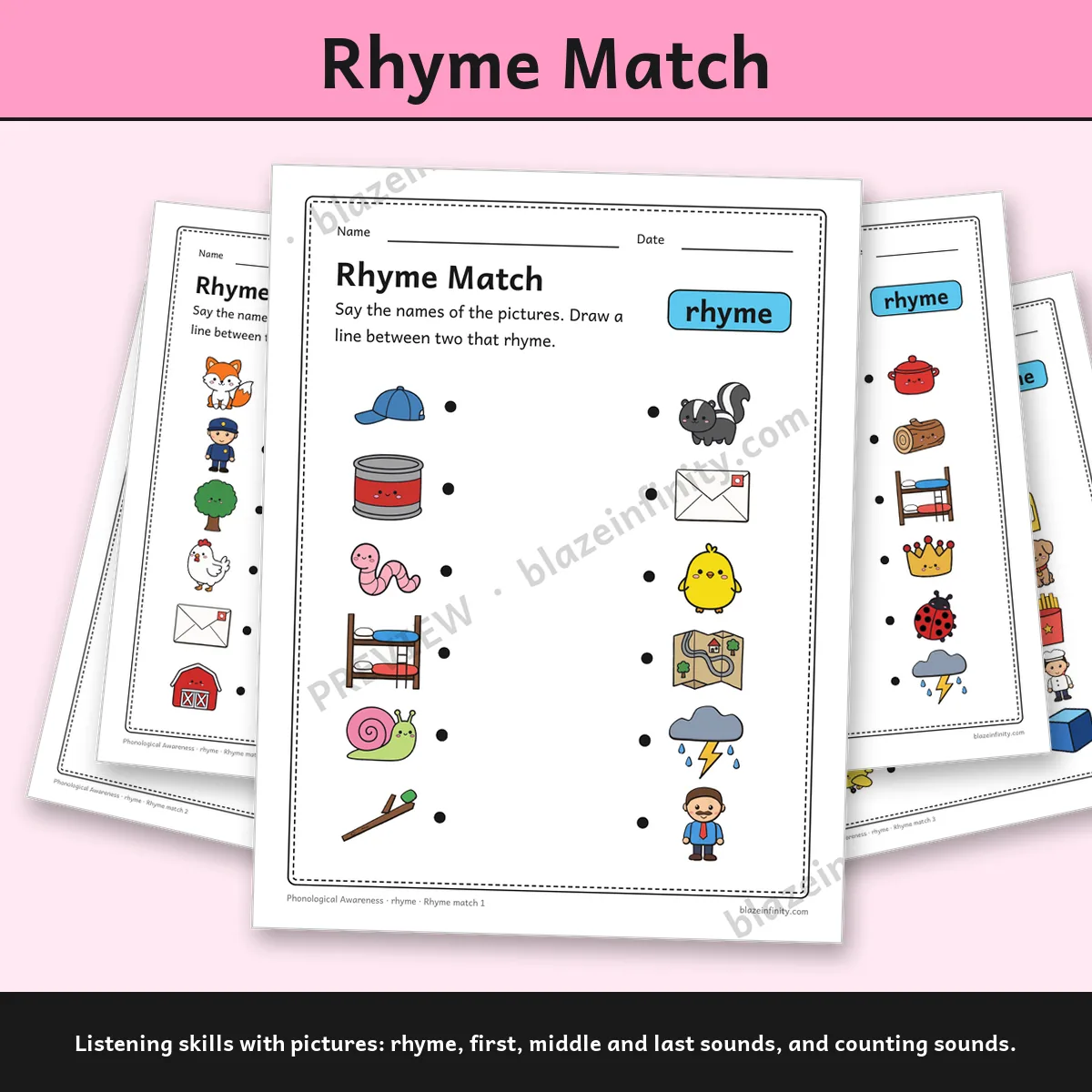
The full set for this skill
Phonological Awareness
Picture pages for the sounds children hear before they read: rhymes, the odd one out, syllables, beginning, middle and ending sounds, and how many sounds a word has.
- Rhyme Match and Which Does Not Rhyme pages
- Count the Syllables pages (clap the parts)
- Beginning, middle and ending sound pages
- Count the Sounds pages
- An answer key after every page