









Presidents' Day Activities for Kindergarten: Coins and Votes
A short, true Presidents' Day unit for kindergarten: study a penny and quarter, measure Lincoln's height, hold a class vote and write. Pre-K and 1st grade tips.
In short
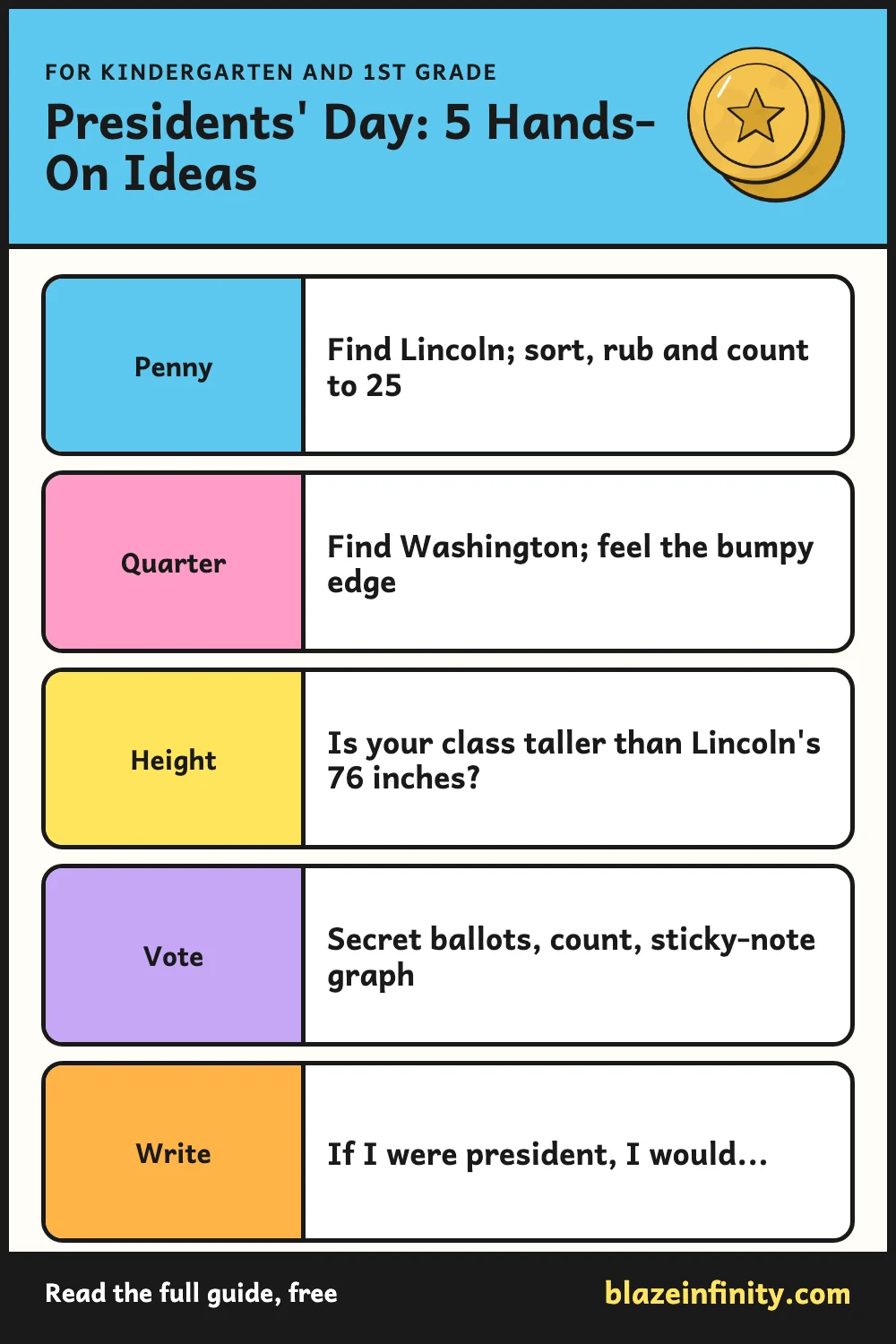
- Lincoln is on the penny and Washington on the quarter: sort, rub, feel and count real coins.
- A class vote teaches what voting is: one secret ballot each, every vote counted, and the result kept.
- Keep the history short and true: the cherry tree story is a legend, and Washington's false teeth were not made of wood.
Presidents' Day 2027 is Monday, February 15. It always falls on the third Monday of February, and its official name in federal law is Washington's Birthday. Many schools close that day, so plan these activities for the week before.
This guide is a four-part kindergarten unit built around things children can hold: a penny, a quarter, a paper strip as tall as Abraham Lincoln, and a ballot. Each part fits in one or two short sessions and practices a real skill: sorting, measuring, reading a graph and writing a sentence. Preschool and first grade versions are near the end.
What to tell children about Presidents' Day
Five-year-olds do not need dates and battles. They need a few true ideas they can say back to you. This takes under two minutes on the rug:
"A president is the leader of our whole country. Grown-ups in our country vote to choose the president. On Presidents' Day we remember two presidents who were both born in February. George Washington was the first president. Abraham Lincoln was the 16th president. He led the country during a hard time when it was split apart, and he worked to end slavery."
Two famous stories are better left out, or named as stories. The cherry tree tale was made up by Mason Locke Weems, who wrote a book about Washington soon after he died, and George Washington's Mount Vernon says it probably did not happen. And Washington had false teeth, but they were not made of wood. If a child brings either one up, say: "That is a story people like to tell, but it did not really happen. Here is something true: Washington is on the quarter."
Keep the talk on the job, not on anyone who holds it today. If a child names a current leader, say: "Lots of people have been president. Today we are learning about two of the very first ones."
Coin study: Lincoln on the penny, Washington on the quarter
Coins are an easy way into this holiday, because two of the presidents children hear about are sitting in every coin jar. In 1909 Lincoln became the first real person on a U.S. coin made for everyday spending, and he has been on the penny ever since. Washington was put on the quarter in 1932, for the 200th anniversary of his birth.
Give each table one penny, one quarter and a magnifying glass, and let children check every row of this chart with their own eyes before you tell them anything.
| Look for | Penny | Quarter |
|---|---|---|
| Who is on the front | Abraham Lincoln | George Washington |
| Color | Copper brown | Silver gray |
| Edge | Smooth | Bumpy ridges |
| Size | Smaller | Bigger |
| Worth | 1 cent | 25 cents |
Children may have heard that pennies are going away. In 2025 the U.S. government stopped making new pennies, but the penny is still legal tender, so the pennies already made are still money, and a class coin jar will still have plenty.
1. Sort the coin cup
Teaches: sorting into groups and counting each groupYou need: a cup of mixed pennies and quarters per table; a mat with two circles15 minutes
Children sort by the face on the front. Say: "Find Lincoln. Find Washington." When the cup is empty, each child counts one pile, touching each coin as they count. Then ask: "Which pile has more? How do you know?" Some children line the piles up side by side to check, which is exactly right.
2. Coin rubbings
Teaches: noticing detail; matching a face to a nameYou need: thin copy paper; peeled crayons; tape15 minutes
Tape a penny and a quarter face up on the table and lay paper over them. Children rub with the long side of the crayon until the faces appear, then copy the names Lincoln and Washington from a card under each rubbing. Ask: "Whose face came out bigger? Why?"
3. The mystery bag
Teaches: describing an object by what you can feelYou need: a paper bag; one penny; one quarter5 minutes
A child reaches in without looking and pulls out the coin you name. Before they show it, ask: "How do you know it is the quarter?" You hope to hear: "It is bigger, and the edge is bumpy." The edge is the clue most children miss at first, so let them run a thumbnail around each coin before the game starts.
4. One quarter, 25 pennies
Teaches: counting to 25; coins can be worth different amountsYou need: 25 pennies; one quarter; three ten frames10 minutes
Count 25 pennies onto ten frames together: two full frames and five more. Put the quarter beside them and say: "This one quarter buys the same as all of these pennies." Most children are surprised. In kindergarten that surprise is the goal; counting mixed coins can wait. Count the coins back into the cup at the end of every coin activity, so none end up in a pocket or a mouth.

Use Name the Coin the day after the sort, once Lincoln and Washington are familiar faces. It shows pictures of real pennies, nickels, dimes and quarters, some fronts and some backs, and the child colors the right name beside each one. It comes from our first and second grade money set, so in kindergarten read the three names aloud for each coin. The nickel and dime will be new, and that is fine: the nickel shows Thomas Jefferson and the dime shows Franklin D. Roosevelt, so every one of these coins has a president on the front.
How tall was Lincoln?
In 1859 Lincoln described himself as "six feet, four inches, nearly," and the Abraham Lincoln Presidential Library says he remains the tallest person to serve as president. Six feet four inches is 76 inches.
Before school, cut a strip of butcher paper 76 inches long: two yardsticks and 4 more inches. Write "Abraham Lincoln" at the top and tape it to the wall with the bottom on the floor. Then:
- Stand beside it. Each child stands with their back to the strip. Ask: "Are you taller or shorter than Lincoln? How much of the strip is above your head?" Children are comparing two lengths directly, which is a kindergarten measurement skill.
- Hold it to the door. Take the strip down and hold it against the classroom door. Ask: "Would Lincoln fit through our door?" Let them guess first, then check.
- Measure it with shoes. Lay the strip on the floor. Two children walk heel to toe along it and count their steps. When they get different numbers, ask why. Someone will say: "His feet are bigger." That is the start of understanding why grown-ups use rulers.
This activity uses Lincoln because he wrote his own height down, so children are measuring a number he gave himself.
A class vote that teaches what voting is
Voting is the one part of Presidents' Day a five-year-old can do for real. The rule that makes it work: vote on something the class will actually do, and do whatever wins. Never vote on real people, and never vote on anything you will not carry out.
- 1
Pick a real choice
For example: "Which game do we play at recess on Friday?" Offer three choices, each with a picture. Tell the class you will play whichever one wins. - 2
One ballot each
Hand out a slip with the three pictures. Each child circles one. Say: "Everyone gets one vote, and every vote counts the same." - 3
Vote in secret
Stand a folder up on the table as a voting booth. Say: "Your vote is yours. You do not have to tell anyone, and nobody can tell you how to vote." Ballots go folded into a box. - 4
Count together
Pull out one ballot at a time. A child puts a sticky note in that column for each one. At the end, count the notes and check that the total matches the number of children here today. - 5
Read the graph and keep the promise
Ask which choice has the most votes, which has the fewest and how many more. Then play the winning game on Friday, as promised.
The hardest moment comes after the count, when a child whose choice lost says it is not fair. This is the real lesson, so slow down. Say: "It was fair because everybody got one vote and we counted every single one. Fair does not mean you get your choice. It means everyone got the same say."
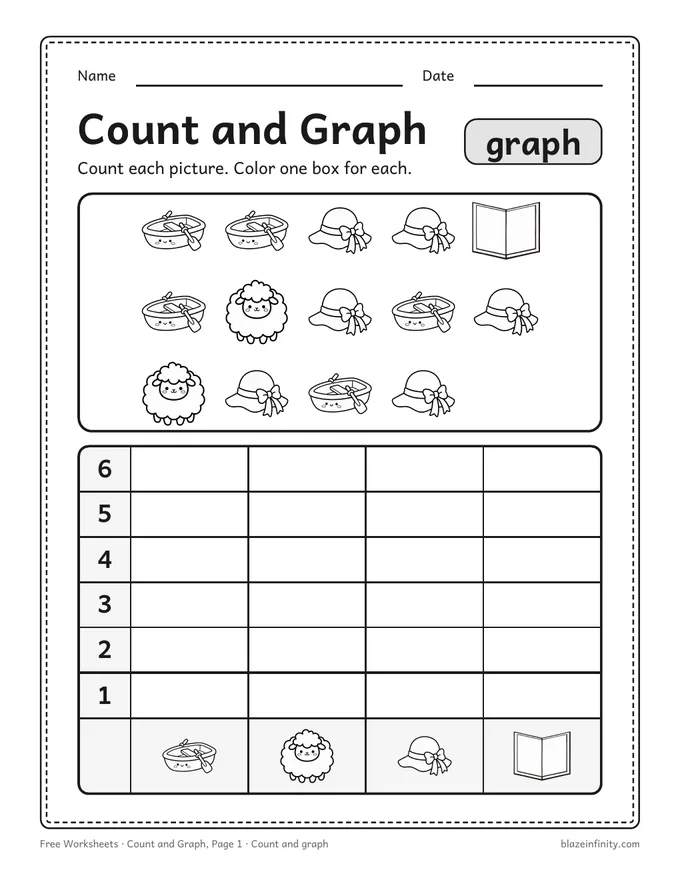
Use Count and Graph the day after the vote. Children count boats, sheep, hats and books in a picture and color one box in the graph for each, the same one-for-one idea as a sticky note for each ballot. Ask the same questions you asked about the vote: which has the most, which has the fewest. For more on reading graphs with young children, the kindergarten picture math worksheets include graphs and comparing numbers.
"If I were president" writing
This is the last task of the unit, because by now children know two things about the job: the president is chosen by votes, and the president works for the whole country. Give them a sentence frame on the board:
- "If I were president, I would ____."
- "I would help ____."
Kindergartners draw first, then write. Model your own page in front of them, out loud: "If I were president, I would build more parks. Let me draw the park first. Now I write it. If... I... were..." Children who are not ready to write a whole sentence can write the missing word and dictate the rest to you.
Expect a lot of "I would buy a pony" and "I would eat ice cream every day." Do not mark those wrong. Ask one question: "Who would that help?" Many children change it on their own to ice cream for everyone, a first step toward thinking about other people. For help with letter formation on these pages, see our guide to kindergarten handwriting.
Presidents' Day activities for preschool
The four parts stay the same at every age. What changes is how many choices there are, who does the writing and, in preschool, what kind of coins children touch.
| Activity | Preschool | Kindergarten | First grade |
|---|---|---|---|
| Coins | Large plastic or paper coins; sort by color and size | Real pennies and quarters; sort, rub, count 25 pennies | Add nickels and dimes; count mixed coins and compare amounts |
| Lincoln's height | Stand beside the strip: taller or shorter? | Compare to the door; measure with steps | Measure the strip with same-size units laid end to end, no gaps or overlaps |
| Class vote | Two choices; each child drops a block in a cup | Three choices; sticky-note graph | Children build the graph and write how many more |
| Writing | Draw and tell; the teacher writes the words | One frame sentence and a drawing | Two or three sentences, with a reason: because... |
For preschoolers, keep each part to about ten minutes and the history to one sentence: "A president is the leader of our whole country." Choose play coins that are bigger than a real quarter, and count them back into the bag at the end.
Presidents' Day activities for 1st grade
First graders are ready for a fuller graph. The first grade data standard asks children to organize and read data in up to three groups, find the total and say how many more or fewer one group has than another. After the vote, have them write the answers as number sentences. Our guide to comparing numbers in first grade has ways to teach "how many more."

Which Is More? is a first grade page: children find how much money is in each box and color the box with more. Give it to first graders after the coin study, once they can count on from the bigger coin. Kindergartners can skip it; naming the coins is their goal this week.
When something goes wrong
If you see
A child says a bigger coin is always worth more
They are judging value by size, which is the natural first guess.
Try this
If you see
Children vote the way their best friend votes
They are voting for the friend, not the choice.
Try this
If you see
Rubbings come out as a gray smudge
The coin slid, or the crayon tip was used.
Try this
If you see
A child insists the cherry tree story is true
Try this
If your first graders are working on money this year, our Money Worksheets are made for first and second grade: more than 180 worksheets in seven units, from naming the penny, nickel, dime and quarter to counting mixed coins, making and comparing amounts, deciding if you can buy it and solving money stories. The pictures show real coins at their true sizes. For kindergarten, start with the free coin and graph pages on our free worksheets page. If the 100th day lands near Presidents' Day, the counting games in our 100th day of school activities work with pennies too.
What the research says
- The February federal holiday's legal name is Washington's Birthday (5 U.S.C. 6103), and in 2027 it falls on Monday, February 15. [1]
- In 1909 Abraham Lincoln became the first real person on a U.S. circulating coin (the penny). [2]
- The federal government has stopped manufacturing new pennies; the penny will remain legal tender (FAQ dated December 23, 2025). [3]
- In 1932 George Washington appeared on the obverse of the quarter for the 200th anniversary of his birth. [4]
- Lincoln described himself in his 1859 autobiography for Jesse Fell as "in height, six feet, four inches, nearly". [5]
- Lincoln remains the tallest person to serve as president, at 6 feet 4 inches. [6]
- Washington had false teeth, but they were not made of wood; the cherry tree story was invented by Parson Mason Weems, and Washington probably did not chop down a cherry tree. [7]
- Grade 1: organize, represent and interpret data with up to three categories; ask and answer questions about the total and how many more or less are in one category than another (1.MD.C.4). Length is the number of same-size units that span it with no gaps or overlaps (1.MD.A.2). [8]
Sources
- U.S. Office of Personnel Management, Federal Holidays.
- United States Mint, H.I.P. Pocket Change: Penny.
- U.S. Department of the Treasury, Penny Production Cessation FAQs.
- United States Mint, H.I.P. Pocket Change: Quarter.
- National Park Service, Abraham Lincoln Birthplace National Historical Park, Abraham Lincoln Autobiography.
- Abraham Lincoln Presidential Library and Museum, Lincoln Facts.
- George Washington's Mount Vernon, Facts and Falsehoods About George Washington.
- Common Core State Standards for Mathematics, Grade 1, Measurement and Data.
Common questions
- When is Presidents' Day in 2027?
- Monday, February 15, 2027. It is always the third Monday in February, and its official federal name is Washington's Birthday.
- What should kindergartners learn about Presidents' Day?
- Three true ideas are enough: a president is the leader of the country, people vote to choose the president, and we remember George Washington and Abraham Lincoln, who were both born in February. Coins, a height strip and a class vote make those ideas concrete.
- What are good Presidents' Day activities for preschool?
- Sort large play coins by color and size, stand beside a 76-inch paper strip to compare with Lincoln, and vote between two choices by dropping a block in a cup. Keep real coins away from preschoolers, since small coins are a choking risk.
- Is the George Washington cherry tree story true?
- Probably not. George Washington's Mount Vernon says the story was invented by Mason Locke Weems, an early biographer, so treat it as a legend.
- How do I teach voting in kindergarten without politics?
- Vote on a real class choice, such as a recess game, and never on real people. Give each child one secret ballot, count every vote together, graph the result and do what wins.
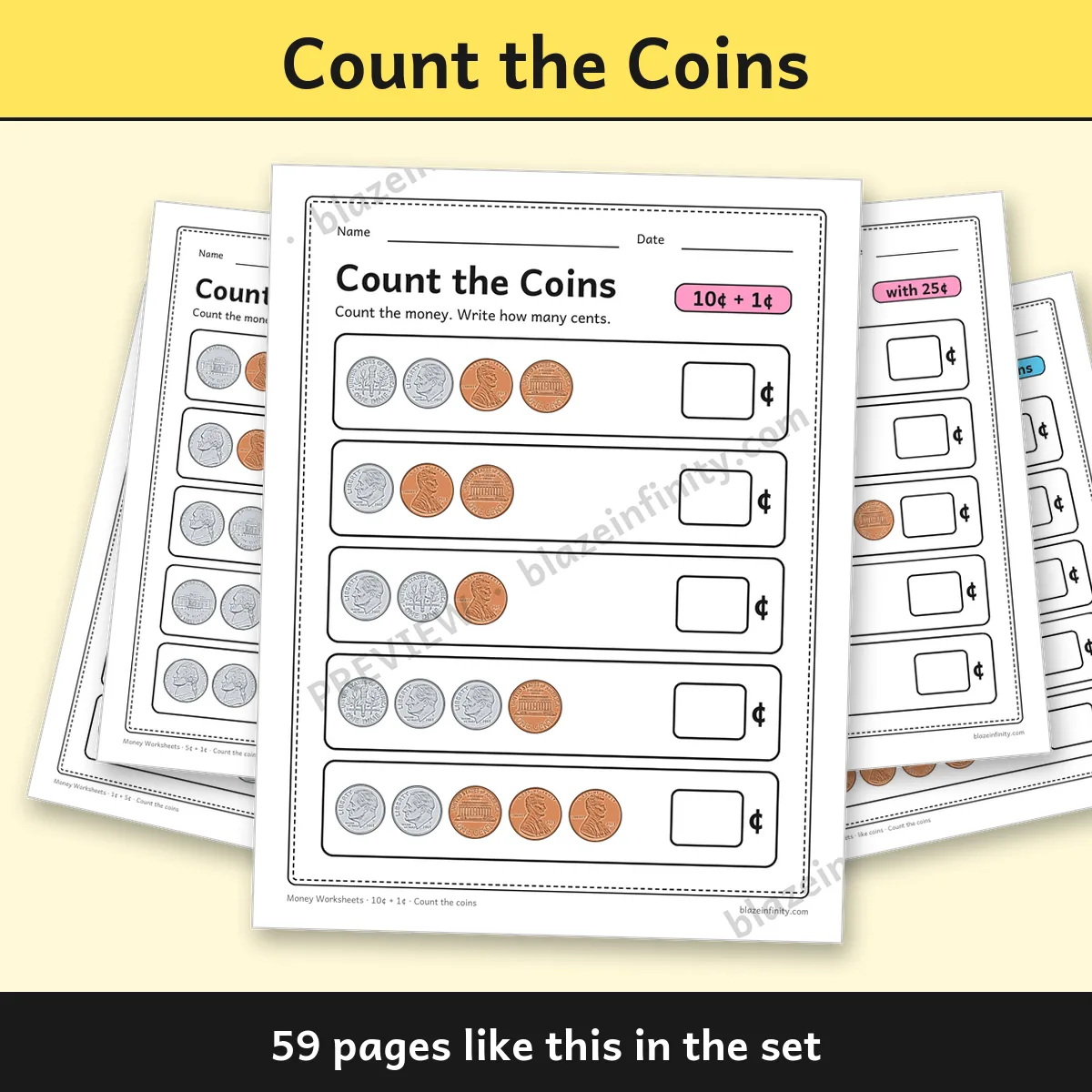
The full set for this skill
Money Worksheets
183 worksheets in seven units, from naming the penny, nickel, dime and quarter to counting mixed coins, making and comparing amounts, deciding if you can buy it and solving money stories. Pictures of real coins are shown at their true sizes, and an answer key follows every page.
- 183 worksheets in 7 units, each unit ending with a check-up
- An answer key after every page
- Pictures of real US coins at their true sizes, front and back (the quarter front only)
- Count like coins by 1s, 5s, 10s and 25s, then mixed coins
- Show the amount: exactly one right set of coins on every row