









Comparing Numbers in First Grade: Greater Than, Less Than
How to teach comparing numbers in first grade in four stages: groups, the number line, tens then ones, then the signs. Plus the tricks and mistakes.
In short
- Teach comparing in four stages: groups of objects, the number line to 20, tens then ones, and only then the signs.
- With two-digit numbers, compare the tens first. Look at the ones only when the tens are the same.
- Have children say every comparison as a sentence, left to right, and then say it from the other end.
- Memory tricks like the alligator help children draw the sign. They do not teach children to read it, so always pair a trick with the words.
Comparing numbers in first grade means deciding which of two numbers is greater, which is less, or whether they are equal, and writing it with >, < or =. With two-digit numbers, children compare the tens first and look at the ones only when the tens are the same. The signs come last. A child who can say “34 is less than 43 because 3 tens is less than 4 tens” picks up the signs quickly. A child who has only learned which way the alligator faces may not be able to read the sign back to you.
Below are four stages to teach it in, an honest look at the memory tricks, and the three mistakes you will see most.
What the standard asks for
The first grade Common Core standard 1.NBT.B.3 asks children to “compare two two-digit numbers based on meanings of the tens and ones digits, recording the results of comparisons with the symbols >, =, and <.” The meaning comes first. The signs are only for recording it.
In kindergarten, children compare groups of up to ten objects and written numbers from 1 to 10. So stage 1 is review for most first graders. Give it a day anyway.
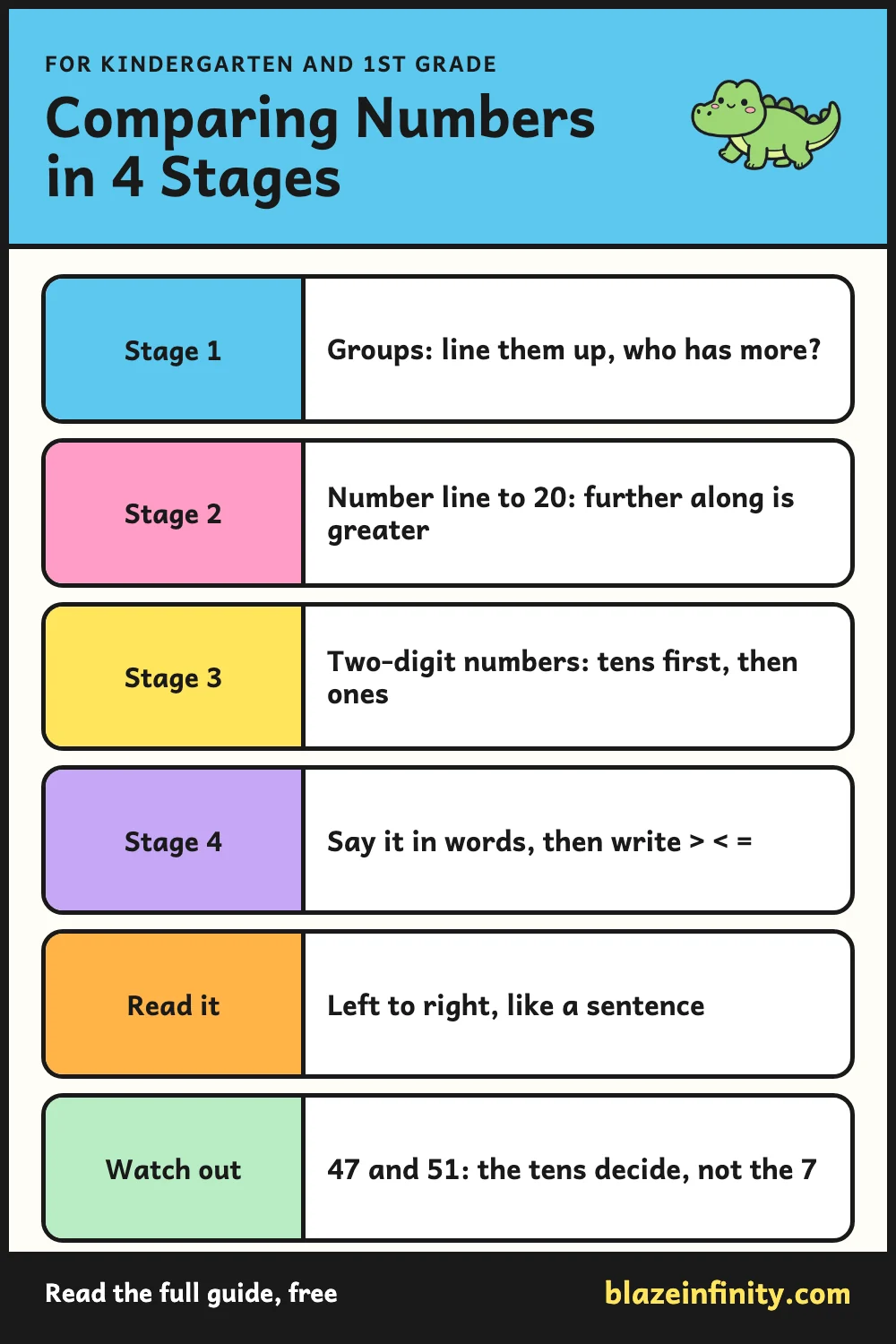
The four stages at a glance
Stage 1
Compare groups of objects
Line up two groups and match them one to one. The words: more, fewer, the same.Stage 2
Numbers to 20 on a number line
The number further along the line is greater. Sort out 9 and 10 and the teens here.Stage 3
Two-digit numbers: tens, then ones
Build both numbers as tens and ones. Compare the tens. Only if they match, compare the ones.Stage 4
The signs >, < and =
Say the comparison as a sentence, then write it with a sign. Read it aloud, left to right.
As a suggestion, plan two or three short lessons per stage, and keep a child on a stage until they can explain it in their own words.
Stage 1: Compare groups of objects
Put 6 bears in a row for Sam and 8 for Ana, both lined up at the left edge. Ask “Who has more?” before anyone counts. Then give each of Sam’s bears a partner in Ana’s row. The bears with no partner are the extras.
Show equal groups too, and a spread-out 5 next to a bunched-up 7. Matching settles it. How a pile looks does not.
Stage 2: Compare numbers to 20 on a number line
Move to a number line from 0 to 20 on the floor or the board. Children put a finger on each number. The one further along, to the right, is greater.
Spend time on 9 and 10. On the line, 10 is the very next step after 9. On a ten frame, 9 leaves one box empty and 10 fills it. The teens are the first two-digit comparisons: 13 and 17 both have one ten, so the ones decide.
Stage 3: Two-digit numbers, tens first, then ones
Now children build both numbers as tens and ones, with ten-sticks and cubes, bundles of straws or cups of ten. Take 34 and 43: the same digits, very different amounts.
On paper, the blocks become quick pictures: a line for each ten, a dot for each one. Have children underline both tens digits before they decide anything.
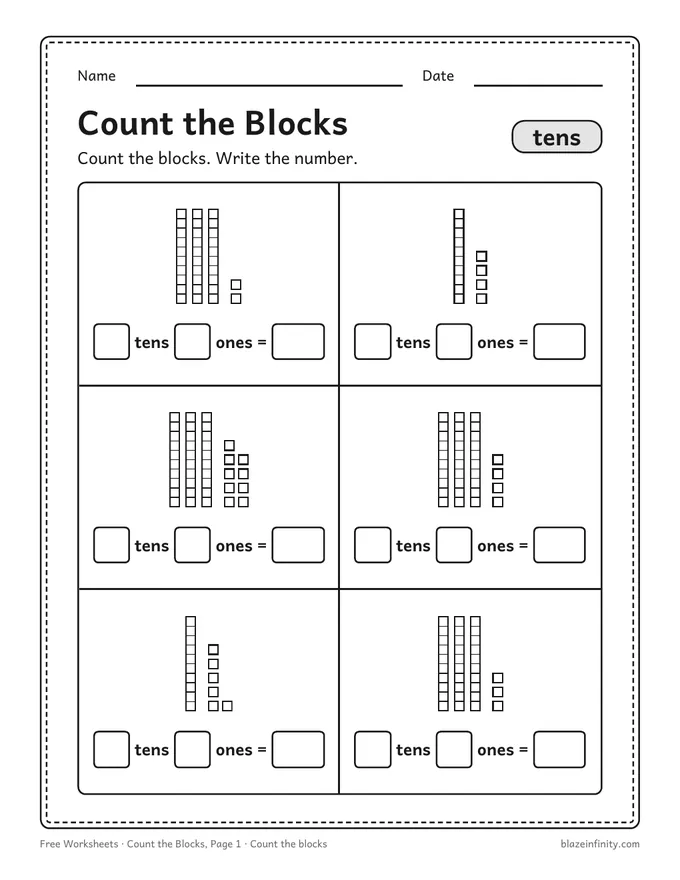
First, check that a child can read a block picture as a number. On this page they count six sets of base-ten blocks and write the tens, the ones and the number.
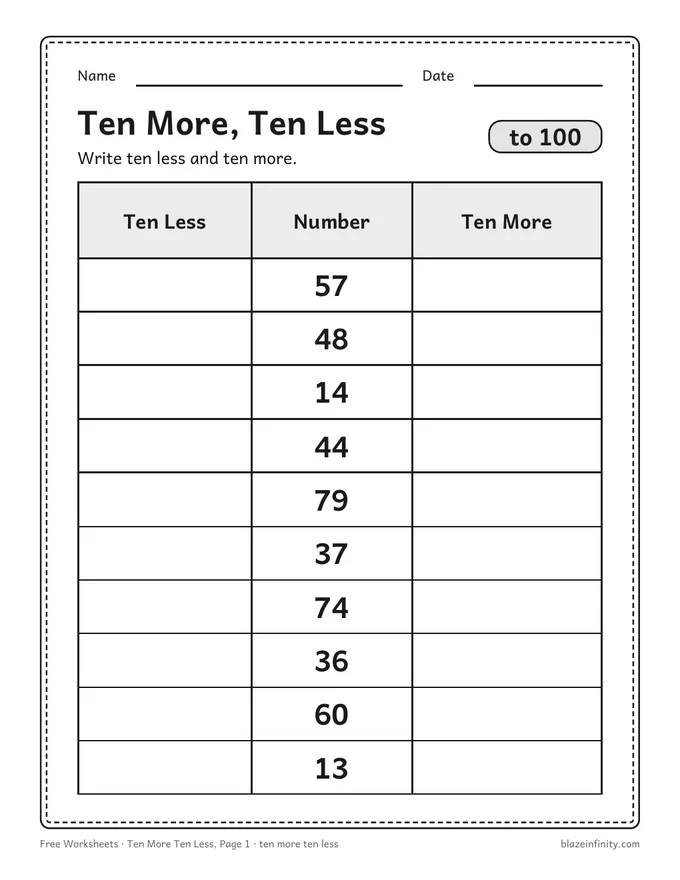
With ten more and ten less, only the tens digit changes. Each filled row of this table is a ready-made comparison. Ask the child to read the row for 48 aloud: “38 is less than 48, and 58 is greater than 48.”
Stage 4: Say it, then write >, < or =
For a few days, children say every comparison as a sentence: “43 is greater than 34.” “25 is equal to 25.” Then write the sentence on the board and swap the middle words for the sign. The sign is just a short way to write words they already say. Teach one rule with it: read left to right, like any sentence.
Then try a page of twelve pairs. Several swap the same two digits, like 73 and 37, so a child who looks only at the ones gets them wrong. One pair, 95 and 95, needs the equal sign.

Afterward, have the child read three rows aloud. A sign drawn right but read wrong is still a gap. There are three more pages of pairs.
Ways to remember the signs, compared honestly
Every common trick has a cost. Pick one, always use it with the words, and drop it once children can read the signs without it.
| Trick | How it goes | Good | Not so good |
|---|---|---|---|
| Alligator mouth | The open mouth faces the bigger number: the alligator wants the bigger meal. | Easy to remember, and fun to draw. | It shows which way to draw the sign, not what to call it. A child can draw the mouth the right way and still not know to read it as “greater than” or “less than”. |
| Points to the smaller number | The pointed end touches the smaller number. The open side faces the greater one. | No story to unlearn. It works on either side and in later grades. | Abstract. It needs a child who already knows which number is smaller. |
| Number line | A < looks like the left end of the line, where small numbers are. A > looks like the right end. | Ties the sign to where numbers sit, which stage 2 taught. | Only helps if the number line is familiar. Muddled if a child reads right to left. |
| Two dots, one dot | Two dots by the greater number, one by the smaller, then join them. Two dots by each make =. | The child builds the sign, so it cannot come out backward. | Slow, and it is drawing, not reading. Drop it once the signs are steady. |
Check yourself: which is greater, 4 tens and 12 ones, or 51? (tap to check)
4 tens and 12 ones. Twelve ones is one ten and 2 ones, so it is 5 tens and 2 ones: 52, which is greater than 51. A child who compares only the 4 and the 5 will say 51.
Three mistakes and how to fix them
If you see
The child writes 47 > 51.
They compared the ones first: 7 is more than 1.
Try this
If you see
The child reads 34 < 43 as “34 is greater than 43.”
They read the sign from the bigger number. The trick taught them to draw it, not say it.
Try this
If you see
The child says 9 is greater than 10.
They are judging the digits. 9 is the biggest digit, and 1 and 0 look small.
Try this
Two quick games
- Flip and compare. Take the tens and picture cards out of a deck. Each player flips two cards to make a two-digit number. The greater number wins, but only after the winner says the sentence: “52 is greater than 37.”
- Hundred chart hunt. Point to two numbers on a hundred chart. In the same row, the one further right is greater. In different rows, the one in the lower row is greater, because every number in a row comes after every number in the rows above it.
Where to go next
If a child stalls at stage 3, the gap is usually tens and ones, and the place value guide has the lessons for that. “How many more?” story problems come after “which is more?”, and our guide to types of word problems teaches them with matched rows like stage 1.
For a year of practice, 1st Grade Math Worksheets has a unit on numbers to 120 and a tens and ones unit, with answer keys.
What the research says
- First grade standard 1.NBT.B.3: compare two two-digit numbers based on meanings of the tens and ones digits, recording the results of comparisons with the symbols >, =, and <. [1]
- Kindergarten compares groups of up to ten objects (greater than, less than or equal to, by matching or counting) and compares two numbers between 1 and 10 presented as written numerals. [2]
- Some middle and high school teachers report that students taught only the alligator can draw the sign but cannot read inequality statements. [3]
Sources
- Common Core State Standards for Mathematics, Grade 1, Number and Operations in Base Ten. National Governors Association Center for Best Practices and Council of Chief State School Officers, 2010.
- Common Core State Standards for Mathematics, Kindergarten, Counting and Cardinality, K.CC.C.6 and K.CC.C.7.
- Math Coach's Corner, “Alligators Are for Swamps, Not Comparing Numbers” (2012), post and reader comments.
Common questions
- How do you teach greater than and less than in first grade?
- Start with real objects lined up in two rows, then numbers on a number line, then two-digit numbers built as tens and ones. Have children say each comparison in words, such as “43 is greater than 34”, before they write it with a sign.
- How do you compare two-digit numbers?
- Compare the tens first: the number with more tens is greater, whatever the ones are. If the tens are the same, compare the ones. If the tens and the ones are both the same, the numbers are equal.
- What is the trick for greater than and less than?
- The most common trick is the alligator, whose open mouth faces the bigger number. Another way to say it: the open side faces the greater number and the pointed end touches the smaller one. Whichever trick you use, have the child read the sign aloud as words, left to right.
- Is the alligator method bad?
- It is fine as a short-term reminder of which way to draw the sign, but it does not teach children what the sign is called. Pair it with the words from the first day and drop it once children can read the signs without it.
- What is Common Core standard 1.NBT.B.3?
- It is the first grade standard for comparing numbers. It asks children to compare two two-digit numbers based on what the tens and ones digits mean, and to record the result with the symbols >, = and <.
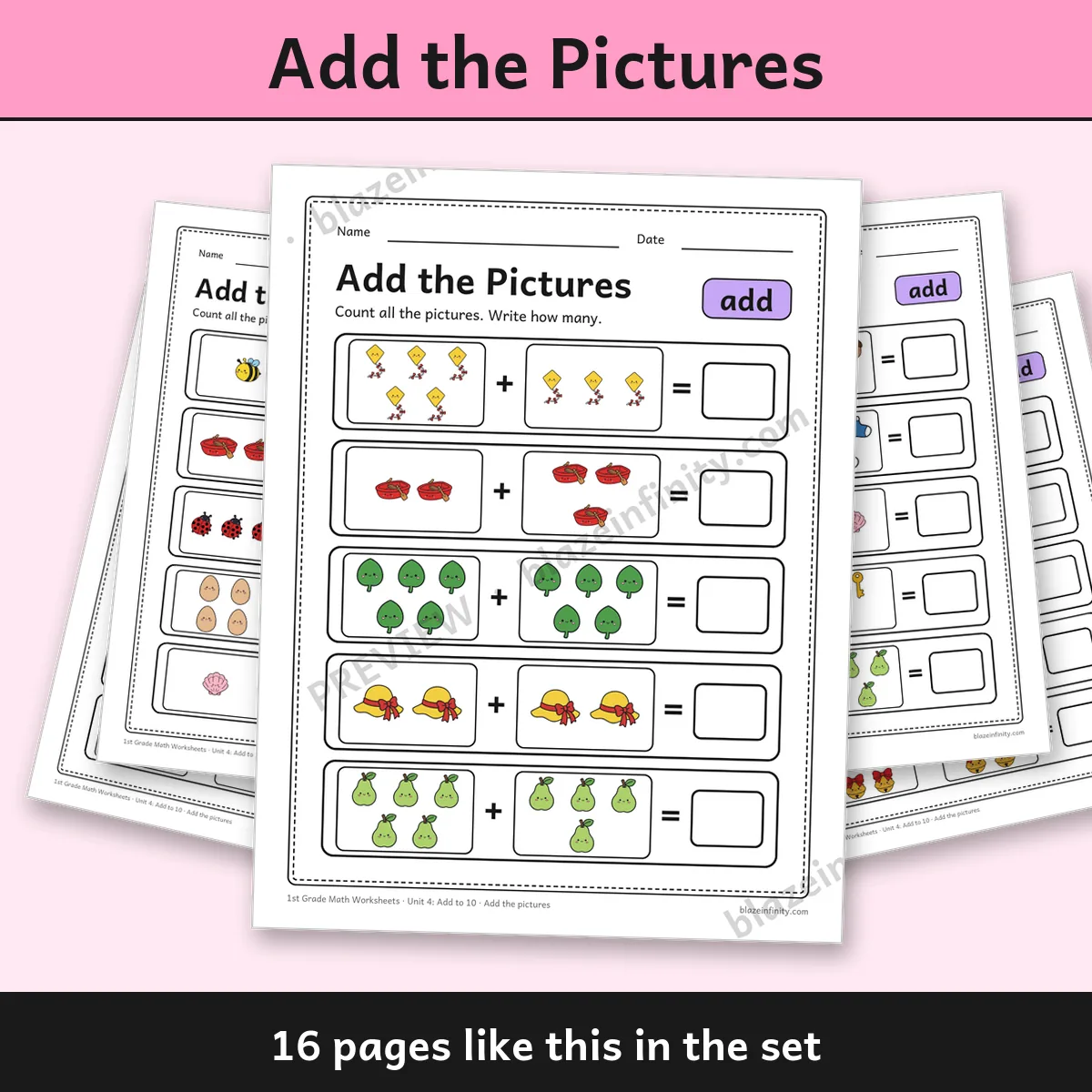
The full set for this skill
1st Grade Math Worksheets
833 worksheets in twelve units. Every unit goes in steps: pictures first, then a model (ten frame, number line, number bond, blocks), then the numbers on their own. An answer key follows every page that can be marked.
- 833 worksheets in 12 units
- An answer key after every page that can be marked
- Adding and taking away within 10, then within 20
- Number lines, number bonds, ten frames and tens-and-ones blocks
- Telling time to the hour and the half hour