





What is a ten frame? How to use one, with 6 games
What a ten frame is, why teachers use it for counting, adding and taking away, how to fill one, and six quick ten frame games for kindergarten and first grade.
In short
- A ten frame is two rows of five boxes, ten in all.
- Fill the top row left to right, then the bottom row.
- It shows how many there are, how many more make five and how many more make ten.
A ten frame is a rectangle split into two rows of five boxes, ten boxes in all. Children put one counter, dot or drawing in each box. It looks simple, and that is the point: in one glance a child can see how many there are, how many more make five, and how many more make ten. Those three facts are the base of almost everything in kindergarten and first grade math.
Why ten frames work
Young children count one object at a time. A ten frame lets them stop counting and start seeing. Seven counters in a frame is “a full row of five and two more”, and also “three empty boxes, so three more make ten”. Being able to name a small amount without counting is called subitizing, and the ten frame trains it by organizing objects into fives and tens, the same way our number system works.
How to fill a ten frame
Fill the top row from left to right first, then the bottom row from left to right, just like reading. Keeping to this order matters. When every child fills the frame the same way, 7 always looks like 7, and the empty boxes always tell you how many more make ten. Once that is secure, show numbers in other arrangements too, so children learn that 7 is still 7 however the counters sit.
What children learn with a ten frame
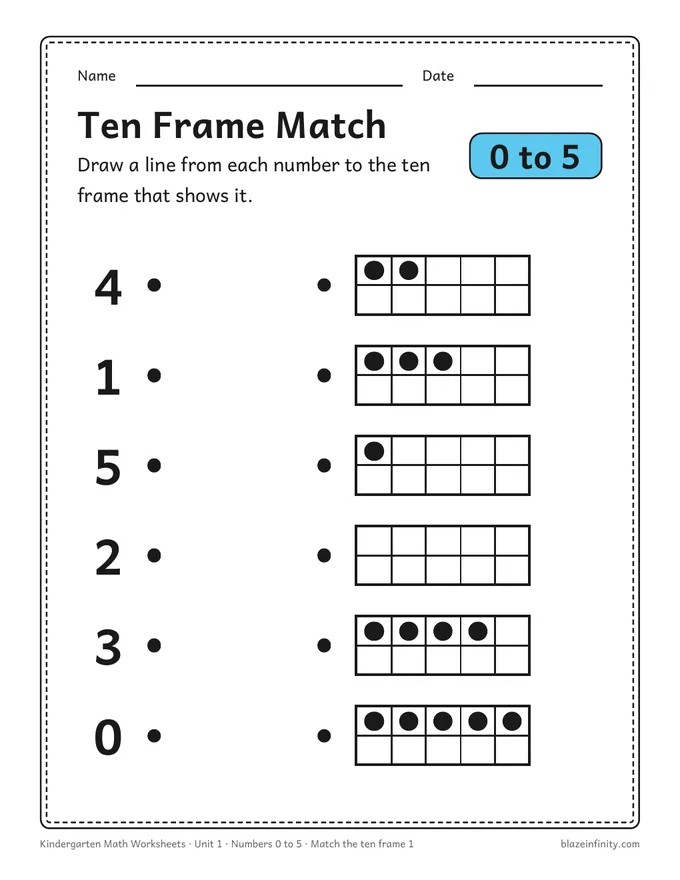
- Counting and numbers to 10. Show a number on the frame and write it, or read a frame and say the number.
- Five as a landmark. 6, 7, 8 and 9 are “five and some more”, which makes them easy to picture.
- Pairs that make ten. Three counters means seven empty boxes, so 3 and 7 make ten.
- Adding and taking away. Two colors of counters show both parts of an addition. Covering counters shows taking away.
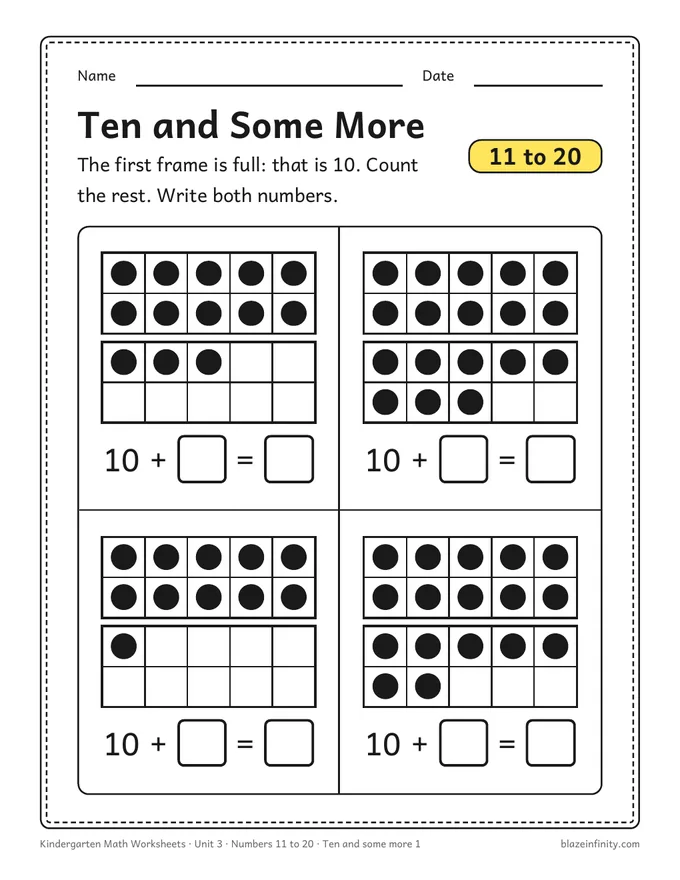
- Teen numbers. Two frames, one full, show that 14 is ten and four more. This is the first step towards place value.
Six ten frame games
- Flash and say. Show a frame for two seconds, then hide it. Children say the number. Start with full rows, then mix.
- How many more to ten? Show a frame. Children answer with the number of empty boxes.
- Roll and fill. Two players, one frame each. Roll a die and add that many counters. The first player to fill the frame exactly wins.
- Make it match. One child builds a number, the partner builds the same number in a different arrangement.
- Ten frame war. Each player turns over a ten frame card. The bigger number wins both cards. Ties mean another turn.
- Double frame teens. Show one full frame and one partly full frame. Children say the teen number and write it.
When to stop using it
Children should not need a ten frame forever. When a child can answer “how many more make ten?” instantly for any number, and can picture the frame without seeing it, take it away. If the answers slow down, bring it back for a few days. For how the ten frame supports first grade adding, see addition strategies for first grade.
Common questions
- What is a ten frame in math?
- A rectangle of two rows of five boxes. Children place one counter in each box to show numbers to 10, and use two frames for numbers to 20.
- Why do teachers use ten frames?
- They help children see amounts without counting one by one, learn the pairs that make ten, and understand teen numbers as ten and some more.
- What grade uses ten frames?
- Mostly Pre-K to first grade. Kindergartners use them for counting and numbers to 10; first graders use them for adding, taking away and teen numbers.
Ready-made pages for this skill
Kindergarten Math Worksheets: ready-made printable pages for this skill.
See the set