





How to teach place value in first grade: tens and ones
What place value means in first grade, how to teach tens and ones with bundles and ten frames, the common mix-ups, and end-of-year goals.
In short
- In first grade, place value means tens and ones in numbers to 100.
- Bundle objects into tens so children see ten as one unit.
- Build the number, draw it, then write it.
In first grade, place value means one big idea: in a two-digit number, the first digit counts tens and the second counts ones. 34 is 3 tens and 4 ones. That sounds obvious to adults. For a six-year-old it is a real leap, because it asks them to see ten things as one thing, a ten. This guide shows how to teach that leap and what to expect along the way.
What first graders are expected to know
The Common Core standards for first grade ask children to count to 120, to understand that a two-digit number is made of tens and ones (standard 1.NBT.B.2), to compare two-digit numbers using greater than, less than and equal to, and to add a two-digit number and a one-digit number or a multiple of ten within 100. All of that rests on tens and ones.
Start with ten as one thing
Give children a pile of straws, craft sticks or linking cubes, between 20 and 40. Ask them to count it. Most will count by ones and lose their place. Now show them how to make bundles of ten with a rubber band, and count the bundles first: “ten, twenty, thirty”, then the loose ones. The point lands quickly: grouping in tens makes big numbers easy. Say “one ten”, not just “ten”, so children hear that a bundle is a single unit.
Then the teen numbers
The teens are the hardest place value numbers in English, because their names hide the ten. “Fourteen” says the four first and the ten second, and “eleven” and “twelve” do not mention ten at all. Spend time here. Show every teen number as one full ten frame and some more, and say it both ways: “fourteen is one ten and four ones”.
Build, draw, write
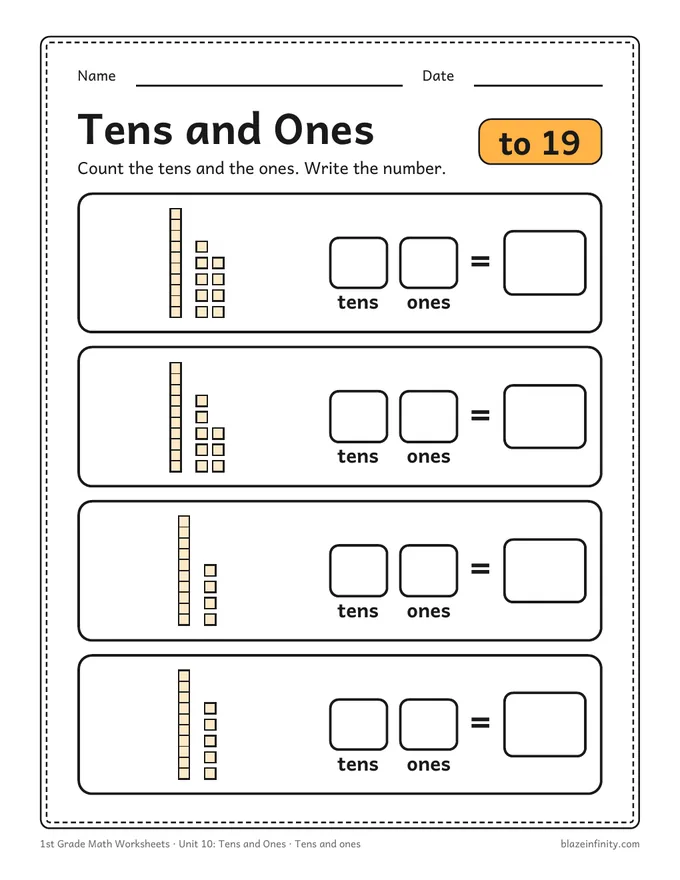
- Build the number with bundles or cubes on a tens and ones mat.
- Draw it the quick way: a line for each ten and a dot for each one.
- Write it three ways: 47, 4 tens and 7 ones, and 40 + 7.
Keep all three steps for each new idea. Children who jump straight to writing often learn to say “4 tens” without knowing that it means forty things.
The mix-ups to look out for
- Reversed teens. Writing 41 for fourteen, because they hear the four first. Point to the tens place and ask, “How many tens?”
- Counting the digit, not its value. Saying the 3 in 36 means three. Ask “three what?” until the answer is “three tens, thirty”.
- Zero as nothing. Writing 4 for forty. Build forty with four bundles and no loose ones, and show that the zero holds the ones place.
Games that practice tens and ones
Roll two dice and make the biggest two-digit number you can, then build it. Play “I am thinking of a number with 5 tens and 2 ones”. On a hundreds chart, jump down one row to add ten and notice that only the tens digit changes. Each takes five minutes and keeps the idea in front of children all year.

Place value grows straight out of ten frame work in kindergarten. If a child is struggling, go back to ten frames and teen numbers before pushing on to numbers to 100.
Common questions
- What is place value for grade 1?
- Knowing that in a two-digit number the first digit counts tens and the second counts ones, so 34 is 3 tens and 4 ones.
- Why are teen numbers hard?
- Their names hide the ten: fourteen says the four first, and eleven and twelve do not mention ten at all. Children need to see each teen as one ten and some ones.
- What should first graders know about place value by the end of the year?
- Count to 120, read and write numbers to 120, show two-digit numbers as tens and ones, and compare two-digit numbers with greater than, less than and equal to.
Ready-made pages for this skill
1st Grade Math Worksheets: ready-made printable pages for this skill.
See the set