




Addition strategies for first grade: what to teach, in order
The addition strategies first graders need, from counting on to making ten, in the order to teach them, with examples and a weekly plan.
In short
- Teach counting on, make ten, doubles, near doubles and bridge through ten, in that order.
- Show each strategy with a ten frame, number line or number bond before using bare numbers.
- Move on when a child uses a strategy without reminders, not when they are fast.
By the end of first grade, children are expected to add within 20 and to know their facts within 10 without counting. They do not get there by memorizing a chart. They get there by learning a handful of addition strategies, each one a shortcut that turns a hard fact into an easy one. This guide covers the strategies first graders use, the order that works, and how to tell when a child is ready for the next one.
Why strategies come before speed
A child who knows that 8 + 6 is the same as 10 + 4 can work out the answer in a second, and can do it again tomorrow. A child who only memorized 14 has nothing to fall back on when the memory slips. The US Common Core standard for first grade (1.OA.C.6) names the same strategies teachers use: counting on, making ten, using doubles, and using what you know about subtraction. Speed comes on its own once the strategies are secure.
The strategies, in the order to teach them
- Count all. Two groups of objects, count every one from one. This is where kindergarten ends and first grade begins. Move on as soon as the child counts reliably.
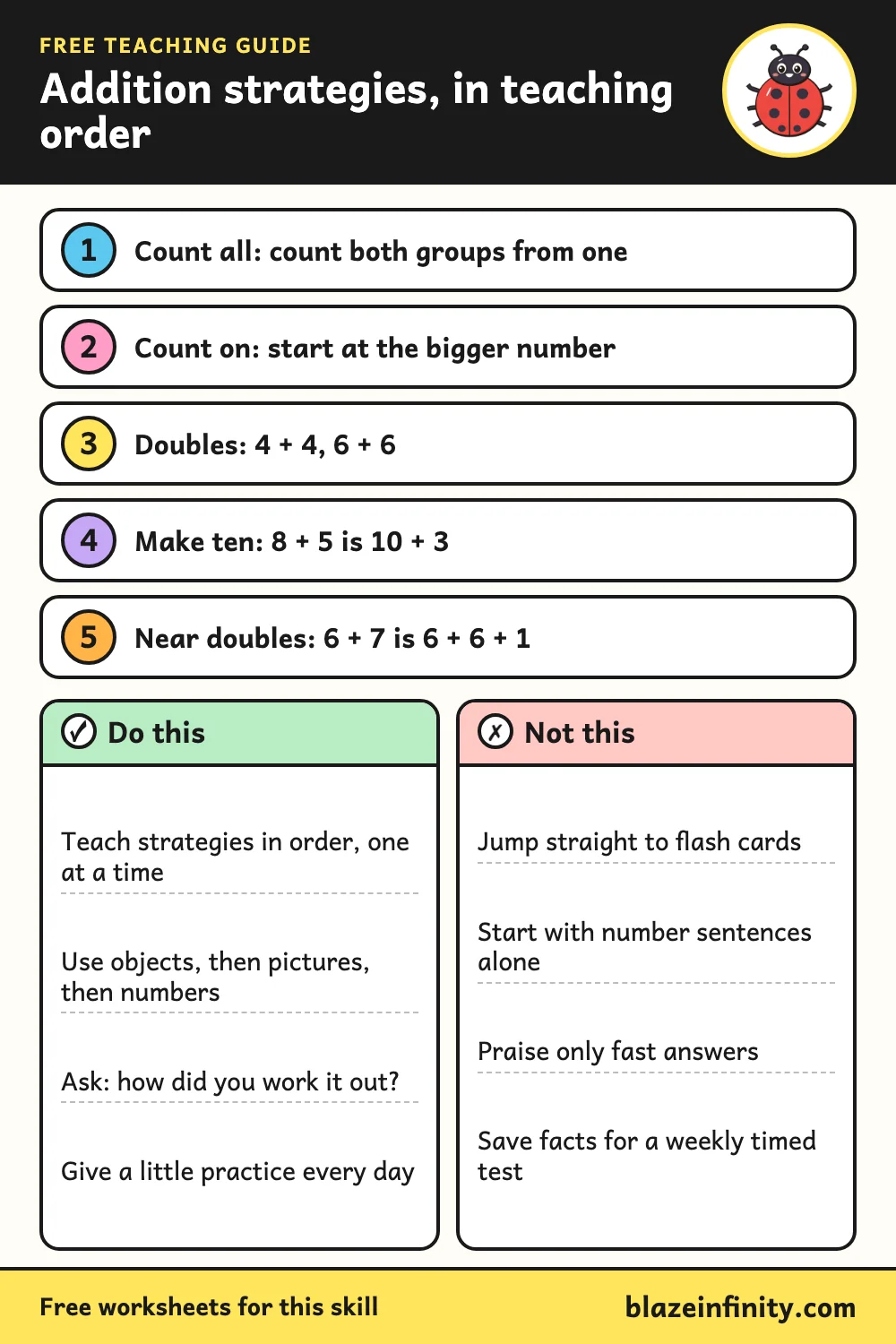
- Count on. Hold the bigger number in your head and count up from there. For 3 + 8, start at 8 and say “9, 10, 11”. Teach children to start with the bigger number: it means fewer counts and fewer mistakes.
- Plus zero and plus one. Adding zero changes nothing; adding one is the next number. These two rules settle 36 of the 100 basic facts, from 0 + 0 to 9 + 9, straight away.
- Turn-around facts. 2 + 7 and 7 + 2 have the same answer. Children who see this halve the number of facts they need to learn.
- Make ten. Know the pairs that make 10 (1 and 9, 2 and 8, 3 and 7, 4 and 6, 5 and 5) until they are automatic. Everything after this depends on them.
- Doubles. 4 + 4, 6 + 6, 7 + 7. Doubles are easy to remember because they come in pictures: two hands, a spider's legs, an egg carton.
- Near doubles. 6 + 7 is a double plus one: 6 + 6 is 12, so 6 + 7 is 13.
- Bridge through ten. For 8 + 5, take 2 from the 5 to fill the 8 up to 10, then add the 3 that is left: 10 + 3 is 13. This is the strategy that unlocks every fact from 11 to 20.
The tools that make each strategy visible
Strategies make sense when children can see them. Three tools do most of the work in first grade.
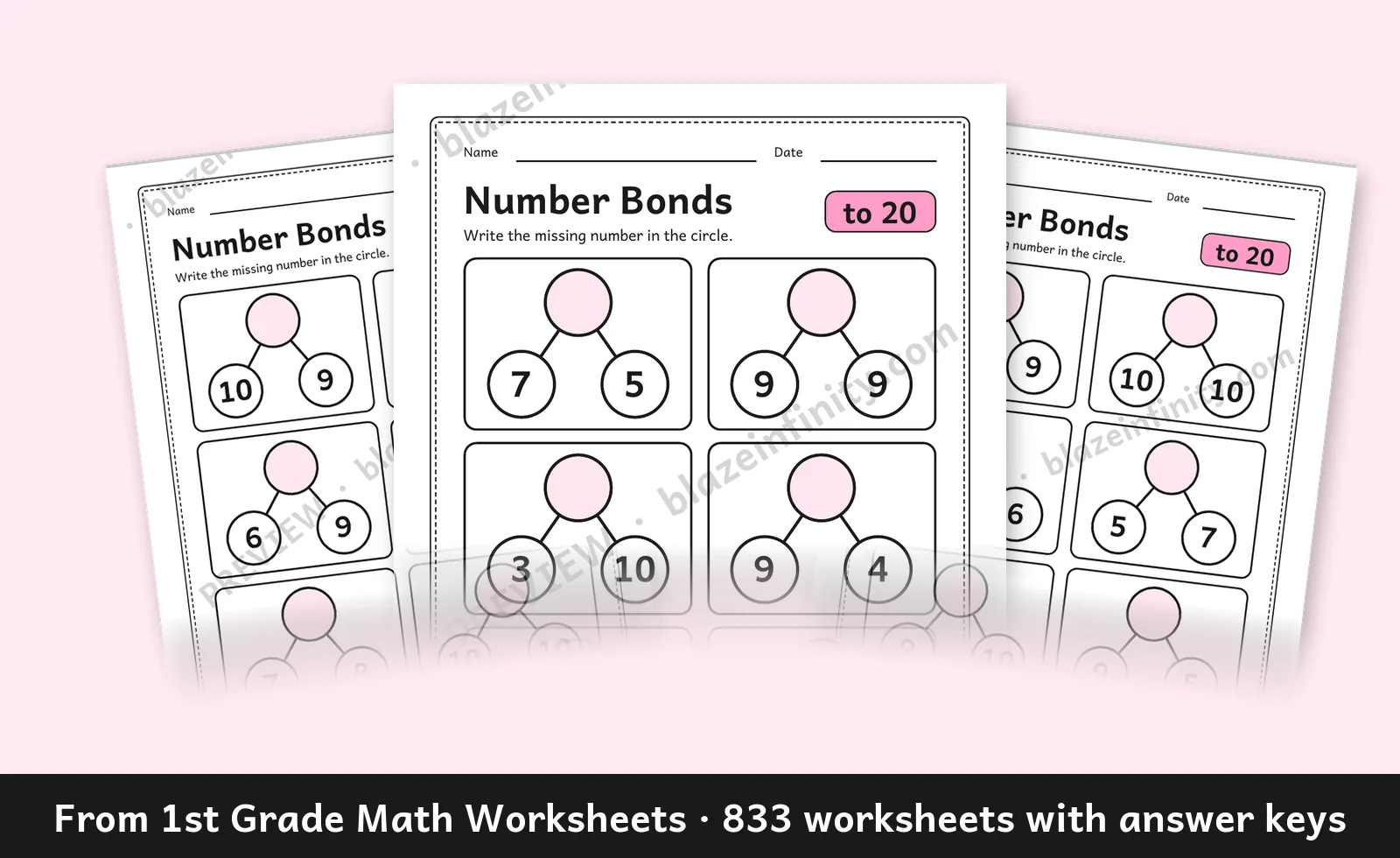
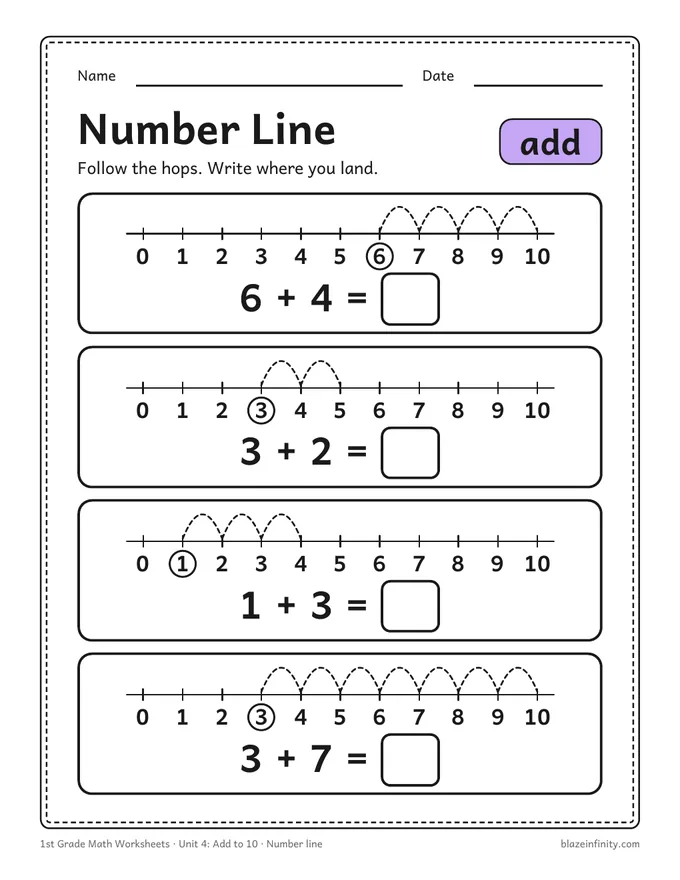
A ten frame (two rows of five boxes) shows at a glance how many more make ten, which is exactly what make-ten and bridge-through-ten need. Our guide to using a ten frame has games for this. A number line turns counting on into hops: start at 9, hop 4 times, land on 13. A number bond (a whole in one circle, its two parts in two more) shows that 13 is 10 and 3, which is the idea behind bridging.
Use the tool first, then a drawing of it, then just the numbers. Teachers call this concrete, then pictures, then abstract. Rushing to bare number sentences is the most common reason a strategy does not stick.
A simple week for one strategy
- Day 1, show it. Model the strategy with objects or a ten frame. Think aloud: “8 needs 2 more to make 10.”
- Day 2, do it together. Children solve five or six facts with the tool while saying the steps.
- Day 3, draw it. Same facts, but children draw the dots or hops instead of using objects.
- Day 4, play it. A quick game with dice or cards, using only facts that fit the strategy.
- Day 5, mix it. A short page that mixes this week's facts with earlier ones, so children choose the strategy themselves.
Why our addition pages look like this
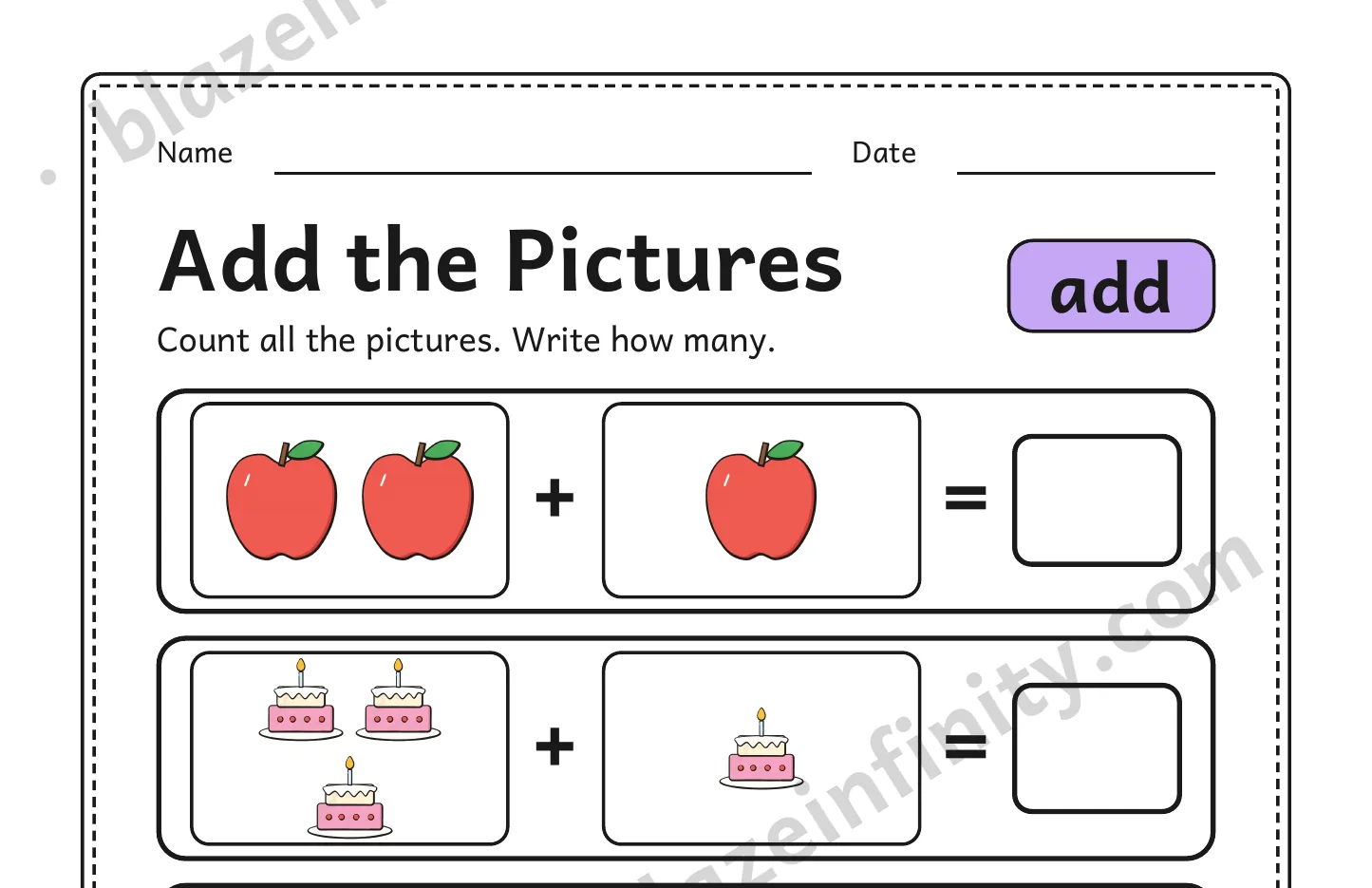
- 1One activity, one short instruction. A six-year-old can read the instruction and start alone, so you are free to work with a small group.
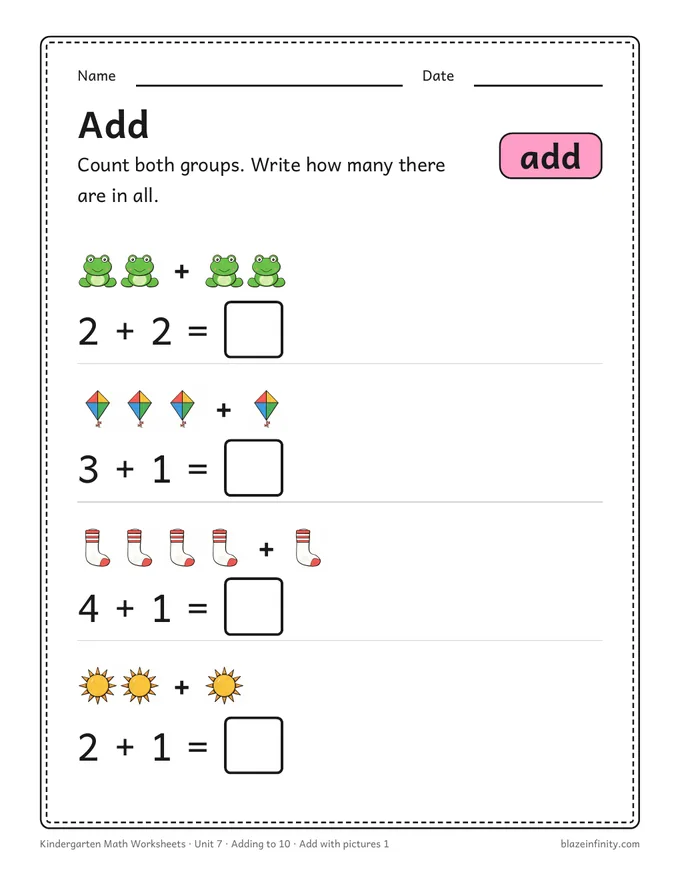
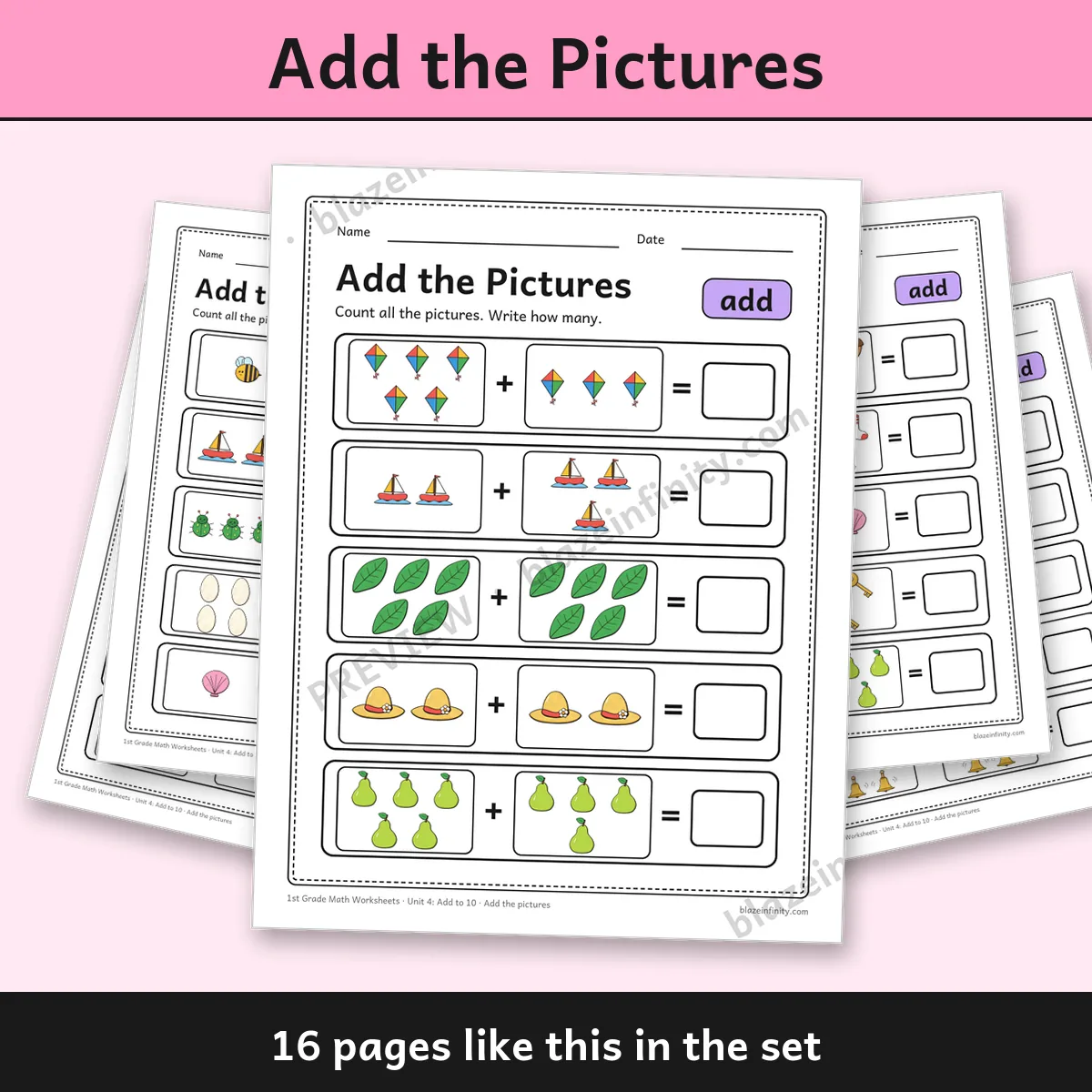
- 2Pictures, then a model, then numbers. Each unit starts with pictures to count, then a ten frame, number line or number bond, then the numbers on their own: the order this guide describes.
- 3Big answer boxes. Young children write large. A box that fits their numbers keeps the page neat and quick to check.
- 4The unit and skill on every page. The footer names the unit and the skill, so you can find the right page again in seconds.
- 5An answer key after every page. Checking a stack of pages takes a minute, and a parent can check at home.
- 6Color and black-and-white. Every page comes in both editions, so the copier version is as clear as the color one.
Story problems keep addition meaningful
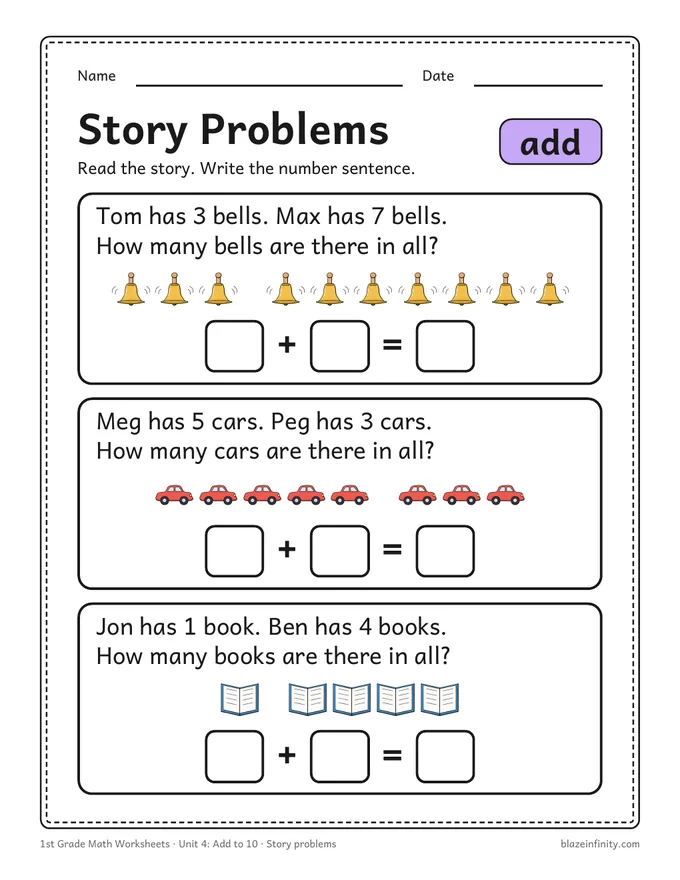
Children should meet addition in stories, not only in number sentences: “Sam has 6 shells. He finds 5 more. How many shells does he have now?” First graders also need the harder kinds, where the missing number is not the answer at the end, such as “Sam has some shells. He finds 5 more. Now he has 11. How many did he start with?” Drawing a picture or a number bond is the best first step for every story.
How to tell a child is ready to move on
Watch rather than time. A child is ready for the next strategy when they use the current one without being reminded, can explain it in their own words, and answer most facts of that kind within about three seconds. If a child is still counting every fact on fingers in spring, go back to make ten and doubles. Those two strategies carry the rest.
When a strategy is not sticking
- The child counts everything from one. Hide the first group under a cup, say its number, and count on from there: “Seven under the cup. Eight, nine, ten.”
- Doubles are known, near doubles are not. Build 6 + 6 and 6 + 7 side by side with cubes. The only difference is one cube, so the answer is one more.
- Make ten is slow. Two minutes a day of “how many more make ten?” with a ten frame flashed and hidden. Speed here makes every teen fact easier.
- Bridging goes wrong (8 + 5 = 12). The child took 2 from the 5 but forgot it. Draw two ten frames: fill the first to ten, then put what is left in the second.
The same strategies work backwards for taking away. Our guide to subtraction strategies shows how.
Do this, not that
Do: Teach strategies in order, one at a time.
Not: Jump straight to flash cards.
Do: Use objects, then pictures, then numbers.
Not: Start with number sentences alone.
Do: Ask: how did you work it out?.
Not: Praise only fast answers.
Do: Give a little practice every day.
Not: Save facts for a weekly timed test.
What the research says
- Children master number facts best by learning thinking strategies, such as making ten and using doubles, rather than by memorizing each fact alone. [1]
- For children who get extra help in math, about ten minutes of each session is recommended for building quick recall of basic facts, with efficient counting strategies taught first in kindergarten to grade 2. [2]
- Moving from objects to pictures to numbers, in that order, can help children carry an idea over to new problems. [3]
Sources
- Baroody, A. J. (2006). Why children have difficulties mastering the basic number combinations and how to help them. Teaching Children Mathematics, 13(1), 22-31.
- Gersten, R., Beckmann, S., Clarke, B., Foegen, A., Marsh, L., Star, J. R., & Witzel, B. (2009). Assisting Students Struggling with Mathematics: Response to Intervention (RtI) for Elementary and Middle Schools (NCEE 2009-4060). National Center for Education Evaluation and Regional Assistance, Institute of Education Sciences, U.S. Department of Education.
- Fyfe, E. R., McNeil, N. M., Son, J. Y., & Goldstone, R. L. (2014). Concreteness fading in mathematics and science instruction: A systematic review. Educational Psychology Review, 26(1), 9-25.
Common questions
- What are the addition strategies for first grade?
- Counting on, plus zero and plus one, turn-around facts, making ten, doubles, near doubles and bridging through ten. Together they cover every fact within 20.
- What is the make a ten strategy?
- Breaking one number apart to fill the other up to ten. For 8 + 5, move 2 from the 5 to make 10, then add the 3 left over to get 13.
- Should first graders memorize addition facts?
- They should know facts within 10 by the end of the year, but through strategies and practice rather than rote memorizing. A child who understands make ten can rebuild a fact they forget.
- Why start counting on from the bigger number?
- It means fewer counts. For 2 + 9, starting at 9 takes two counts; starting at 2 takes nine, with more chances to slip.
The full set for this skill
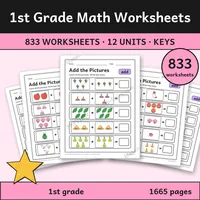
1st Grade Math Worksheets
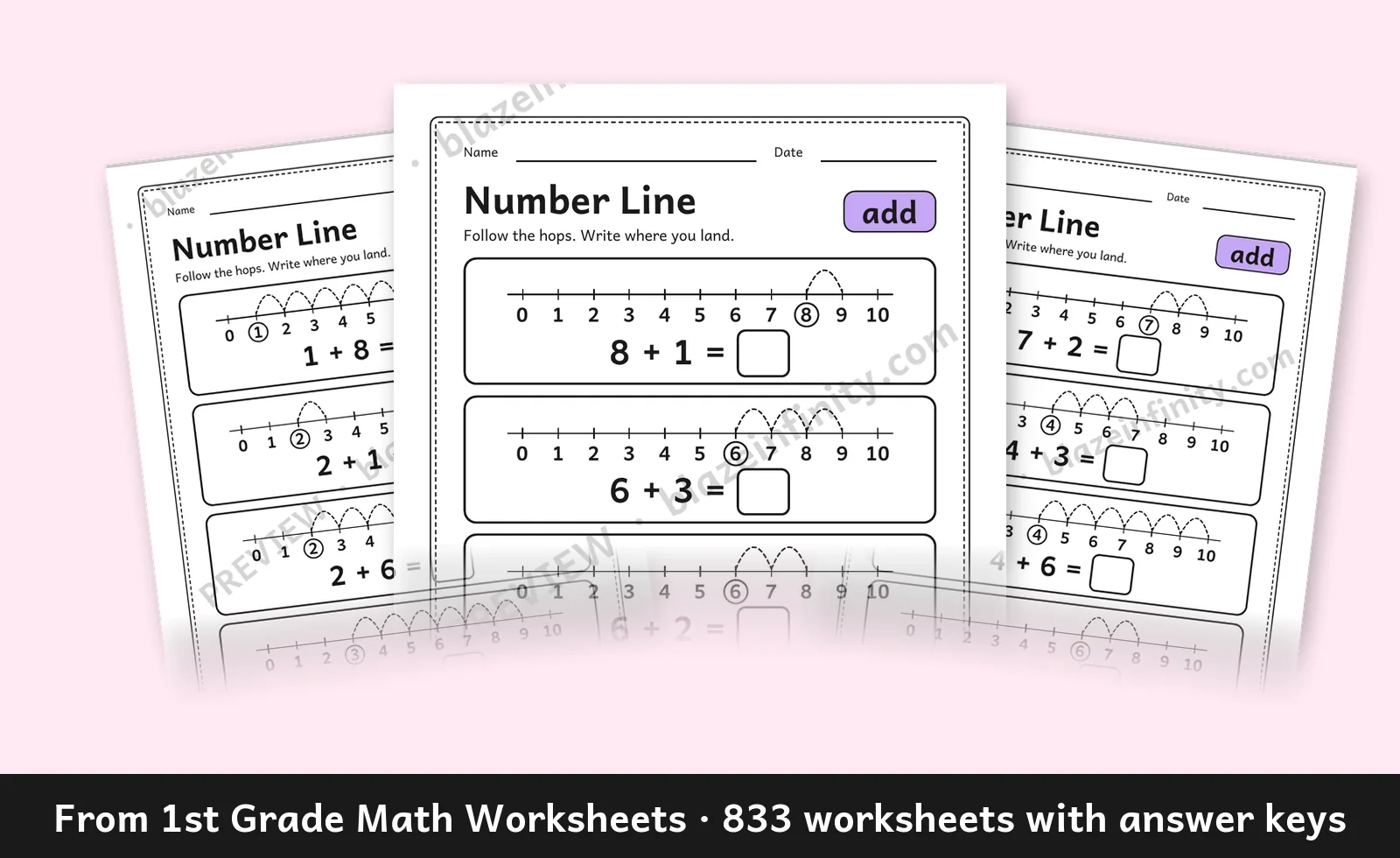
Every strategy in this guide has its own pages, in the order the guide teaches them: pictures first, then ten frames, number lines and number bonds, then facts to 20 and story problems. Twelve units, so the whole year is planned.
- 833 worksheets in 12 units
- An answer key after every page that can be marked
- Adding and taking away within 10, then within 20
- Number lines, number bonds, ten frames and tens-and-ones blocks
- Telling time to the hour and the half hour