




Subtraction strategies for first grade, with examples
Take away, count back, count up, make ten and think addition: the subtraction strategies first graders use, with examples and common mistakes.
In short
- Teach subtraction as take away, compare and missing part, not only take away.
- Count back for small amounts, count up when the numbers are close, go down through ten for teen facts.
- Use related addition facts: if 6 + 7 = 13, then 13 − 7 = 6.
Subtraction is harder than addition for most young children, and not because the numbers are bigger. It is harder because there is more than one way to think about it: taking away, comparing, and finding a missing part. Good subtraction strategies give a child a way in for each one. Here they are in order, with a first lesson, a week of practice and the mistakes to watch for.
Three ways to see subtraction
Take away: there were 9 birds and 3 flew off. Compare: Mia has 9 stickers and Leo has 3; how many more does Mia have? Missing part: 9 apples, 3 are red, the rest are green. All three are 9 − 3, but children picture them differently. Use all three kinds of stories from the start, so that the minus sign does not only mean “take away”.
The hardest stories hide the start: “Ben gave 4 marbles away. Now he has 5. How many did he have at first?” The answer comes from adding, 5 + 4 = 9, so drawing the story works where hunting for key words fails.
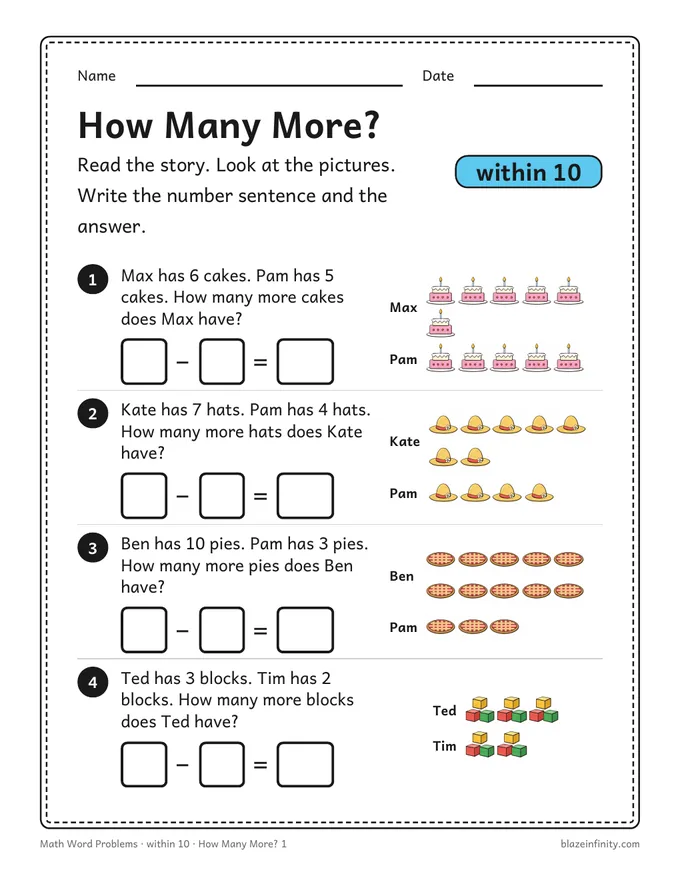
For comparing stories, draw the two amounts as rows side by side. The part of the longer row with no partner is the answer.
What comes before the strategies
Kindergartners take away within 10 with objects and drawings. The Common Core standard for first grade (1.OA.C.6) asks children to add and subtract within 20 using strategies, and to be fluent with facts within 10. Before teaching any shortcut, check that a child can count back from 20, say the number just before any number to 20, split a small number into two parts (7 is 5 and 2, or 4 and 3), and name the partner that makes 10 for any number from 1 to 9.
Teach subtraction alongside addition, not a month later: counting back in the same week as counting on, going down through ten soon after make ten. Teen facts usually come later in the year.
The strategies, in the order to teach them
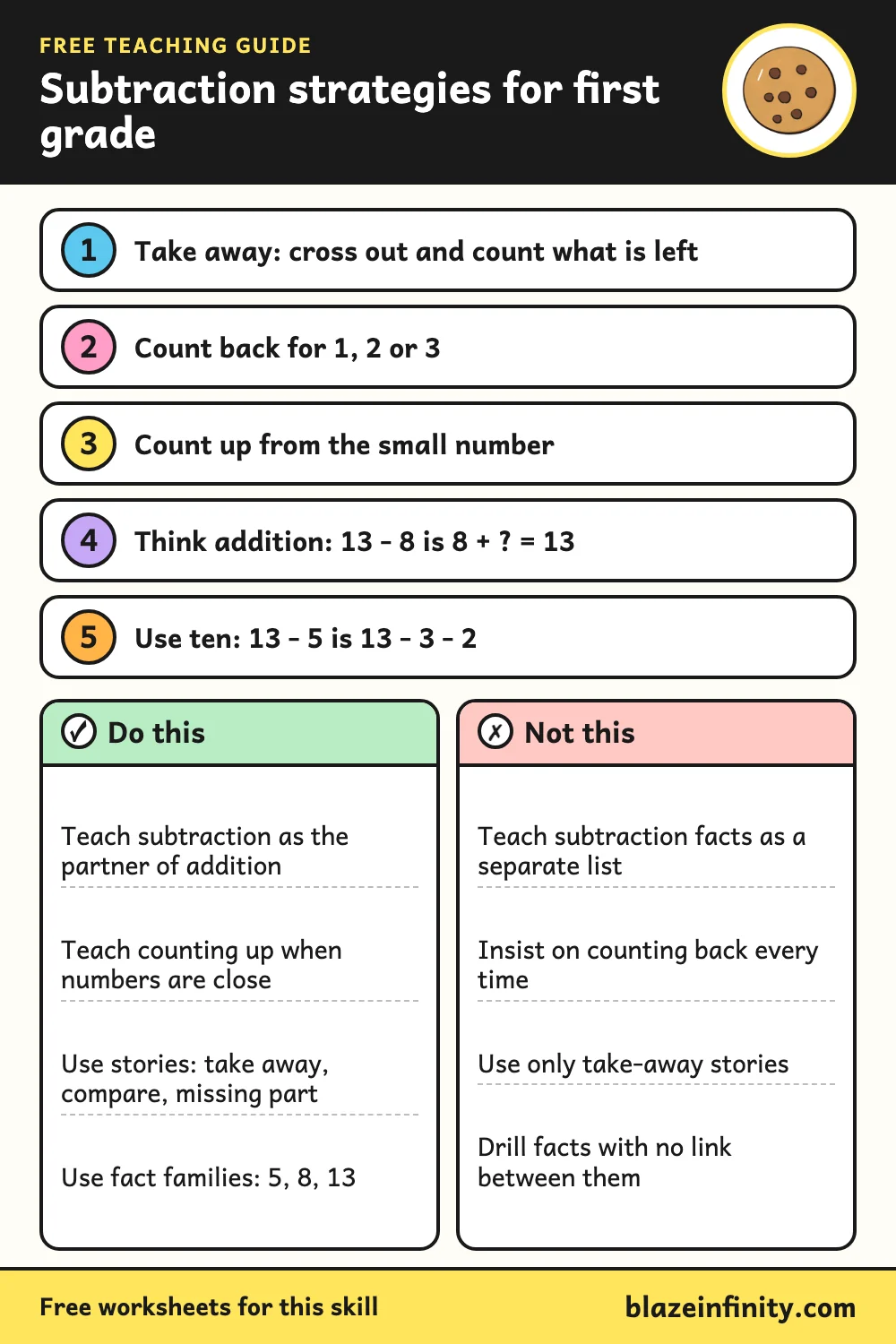
- Take away with objects. Build 9, remove 3, count what is left. Cross out pictures on paper once objects are easy.
- Count back. For small amounts only: 9 − 2, start at 9 and say “8, 7”. Counting back more than three steps leads to errors, so stop using it there.
- Count up (think addition). For 12 − 9, start at 9 and count up to 12: three steps, so the answer is 3. This works best when the two numbers are close.
- Use a related addition fact. If 6 + 7 = 13, then 13 − 7 = 6. Fact families make this visible: three numbers that belong together in four sentences.
- Make ten (go down through ten). For 13 − 5, take 3 to get to 10, then 2 more to get to 8. Common Core calls this decomposing a number leading to a ten.
- Subtract from ten. For 15 − 8, take 8 from the ten (2 left) and add back the 5 ones: 2 + 5 = 7. Children who know their pairs to ten find this one quick.

Teach each one with objects first, then a drawing, then numbers alone. For going down through ten, build 13 as one full ten frame and 3 more. Take away the 3 loose counters, then 2 from the full frame: 8 are left. Then children draw and cross out, and only then write 13 − 3 − 2 = 8.
Which strategy for which fact
Teach children to look at the numbers before they start. Is the number being taken away small (1, 2 or 3)? Count back. Are the two numbers close together, such as 11 − 9? Count up. Is the first number in the teens and the second number bigger than its ones, such as 14 − 6? Go down through ten: 14 − 4 is 10, and 10 − 2 is 8. Ask “Which way did you use?” more often than “What is the answer?”.
Why our subtraction pages look like this
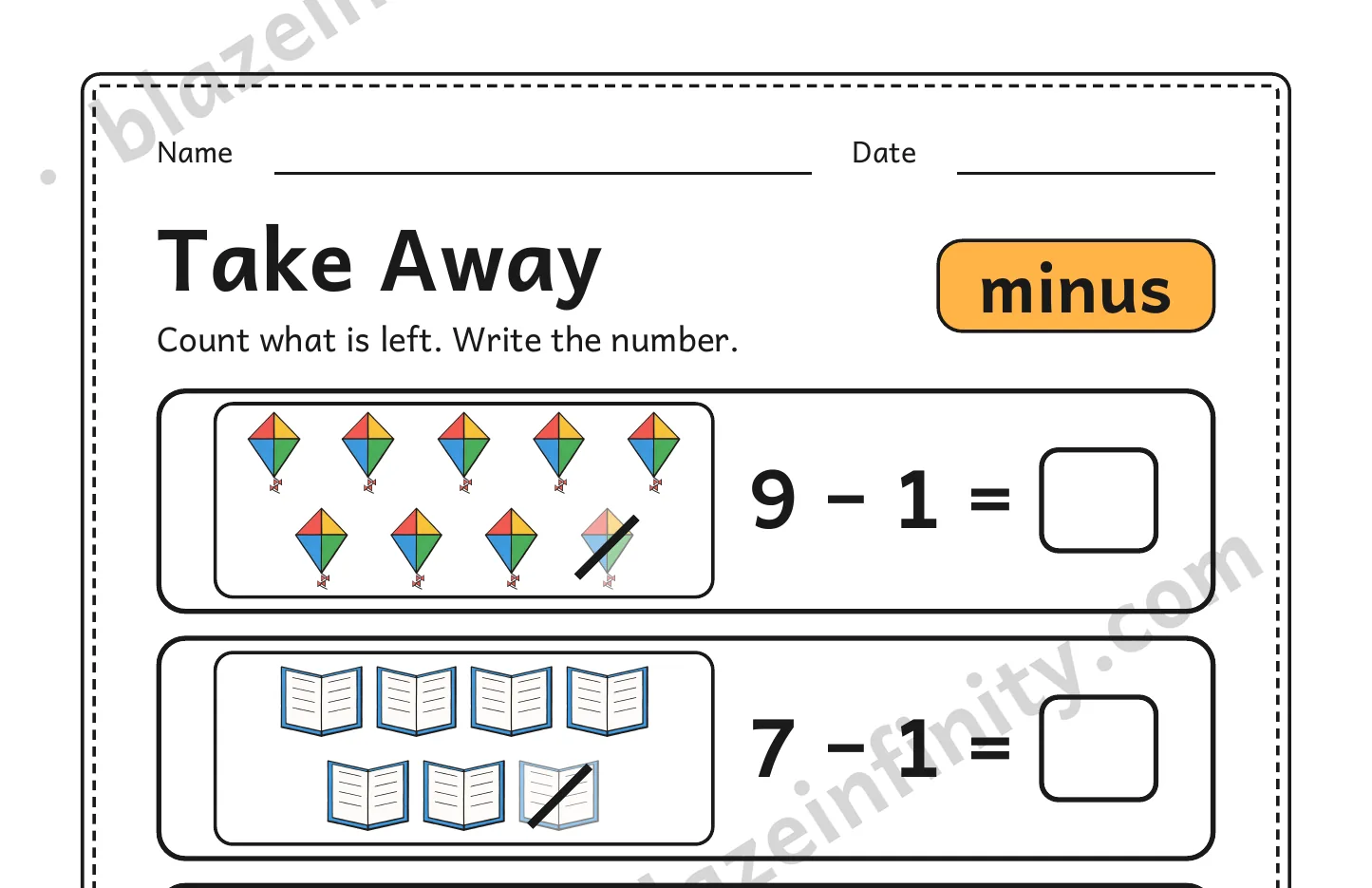
- 1One activity, one short instruction. A six-year-old can read the instruction and start alone, so you are free to work with a small group.
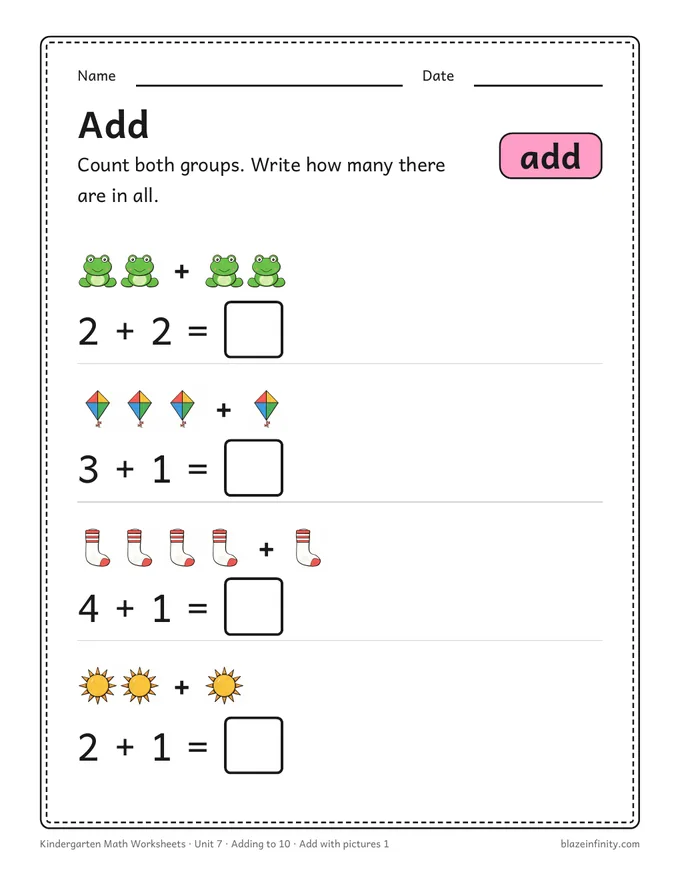
- 2Pictures, then a model, then numbers. Each unit starts with pictures to count, then a ten frame, number line or number bond, then the numbers on their own: the order this guide describes.
- 3Big answer boxes. Young children write large. A box that fits their numbers keeps the page neat and quick to check.
- 4The unit and skill on every page. The footer names the unit and the skill, so you can find the right page again in seconds.
- 5An answer key after every page. Checking a stack of pages takes a minute, and a parent can check at home.
- 6Color and black-and-white. Every page comes in both editions, so the copier version is as clear as the color one.
A first lesson: the hidden part
This lesson teaches think addition: turning a subtraction fact into a known addition fact. You need ten cubes and a paper cup.
- Show the whole. Put 8 cubes on the table. “Count them with me.”
- Hide a part. Children close their eyes while you hide some cubes under the cup, leaving 5 showing. “There were 8. I can see 5. How many are hiding?”
- Think out loud. “5 and how many more make 8? Let's count up from 5: 6, 7, 8. Three counts.” Lift the cup and check.
- Write both sentences. 5 + 3 = 8 and 8 − 5 = 3, side by side. “The hiding part is the answer to the take-away.”
- Pairs play. Partners take turns hiding cubes from 6 to 10 and saying both sentences.
- Close. Write 9 − 6. “What can you ask yourself?” You want: “6 and how many more make 9?”
A five-day plan and games with no printing
- Day 1, build and hide. The lesson above.
- Day 2, draw it. Children draw dots and cross some out, or draw a number bond with a missing part.
- Day 3, hop it. A number line on the floor: small hops back, or count up when the numbers are close.
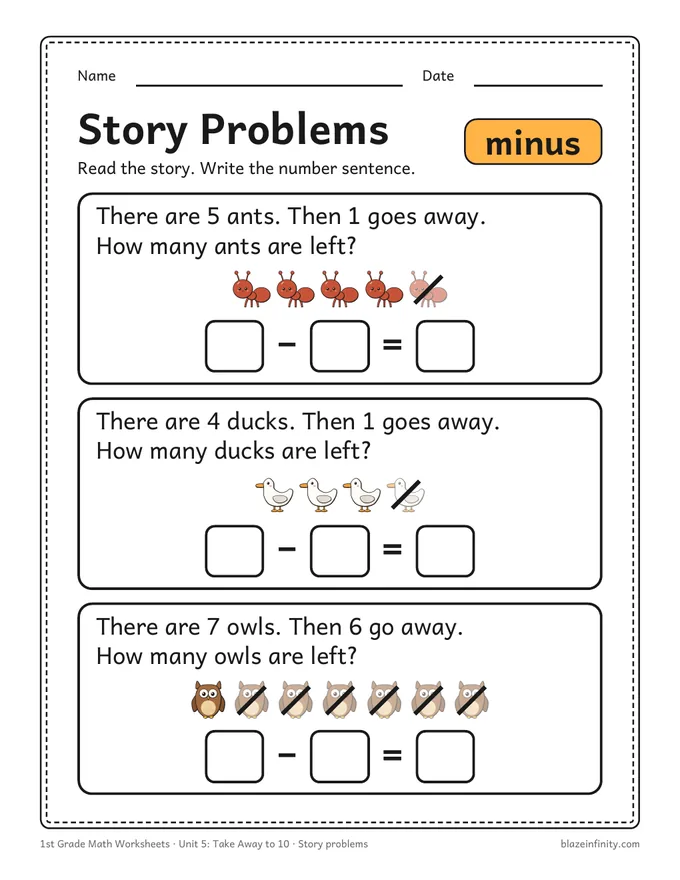
- Day 4, tell it. Act out a take away, a compare and a missing part story. Children draw each one first.
- Day 5, mix and choose. A short mixed page; children say which way they used for each fact.
Five-minute games: Fingers down: everyone shows ten fingers, you say “fold down 4”, and children say how many are up. Bottle bowling: knock down some of ten plastic bottles and say the sentence. Dice difference: roll two dice and say how many more the bigger number is.
Common mistakes and how to fix them
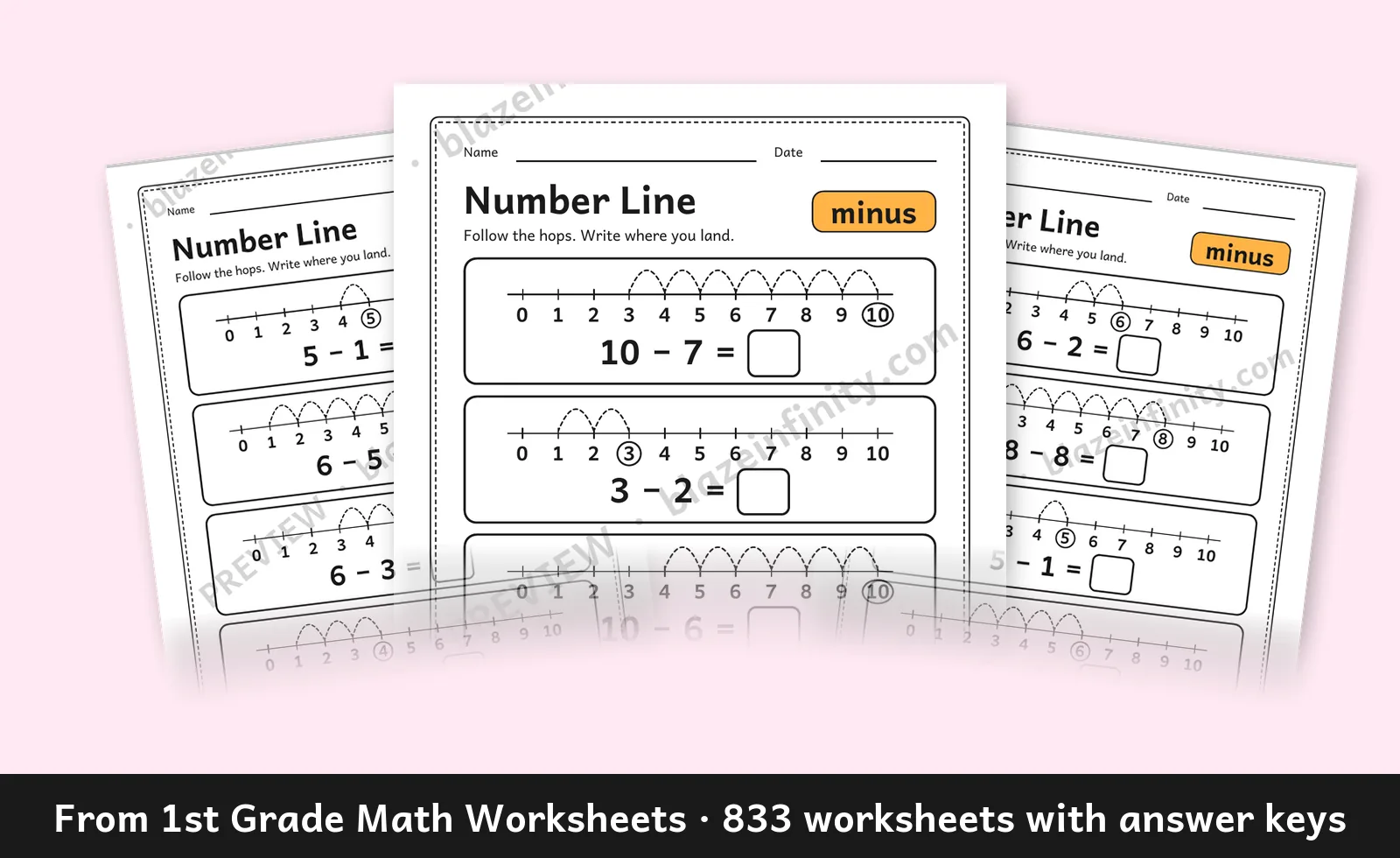
- Counting the starting number. For 9 − 3, the child says “9, 8, 7” and answers 7, counting numbers instead of steps. Draw each hop on a number line as an arc and count the arcs, not the numbers you land on.
- Turning it around. The child writes 3 − 9 = 6, expecting subtraction to turn around like addition. Act it out: you cannot take 9 cookies from a plate of 3.
- Always taking away. In a comparing story, the child adds the two numbers, because every story so far was take away. Line the amounts up in rows: how many more are in the longer row?
- Counting back a long way. For 15 − 9, the child counts back nine steps and loses track. Show that counting up from 9 to 15 takes only six counts.
- Losing part of the split. For 13 − 5, the child takes 3 to reach 10, then takes all 5 again. Write the split under the 5 as a number bond, 3 and 2, and cross off each part as it is used.
Ready to move on, and what comes next
A child is ready to move on when they choose a sensible strategy without reminders, can explain it, and can draw all three kinds of story. Facts within 10 should come in a few seconds without fingers. If a child still counts back for every fact late in the year, go back to pairs to ten and the hidden part game.
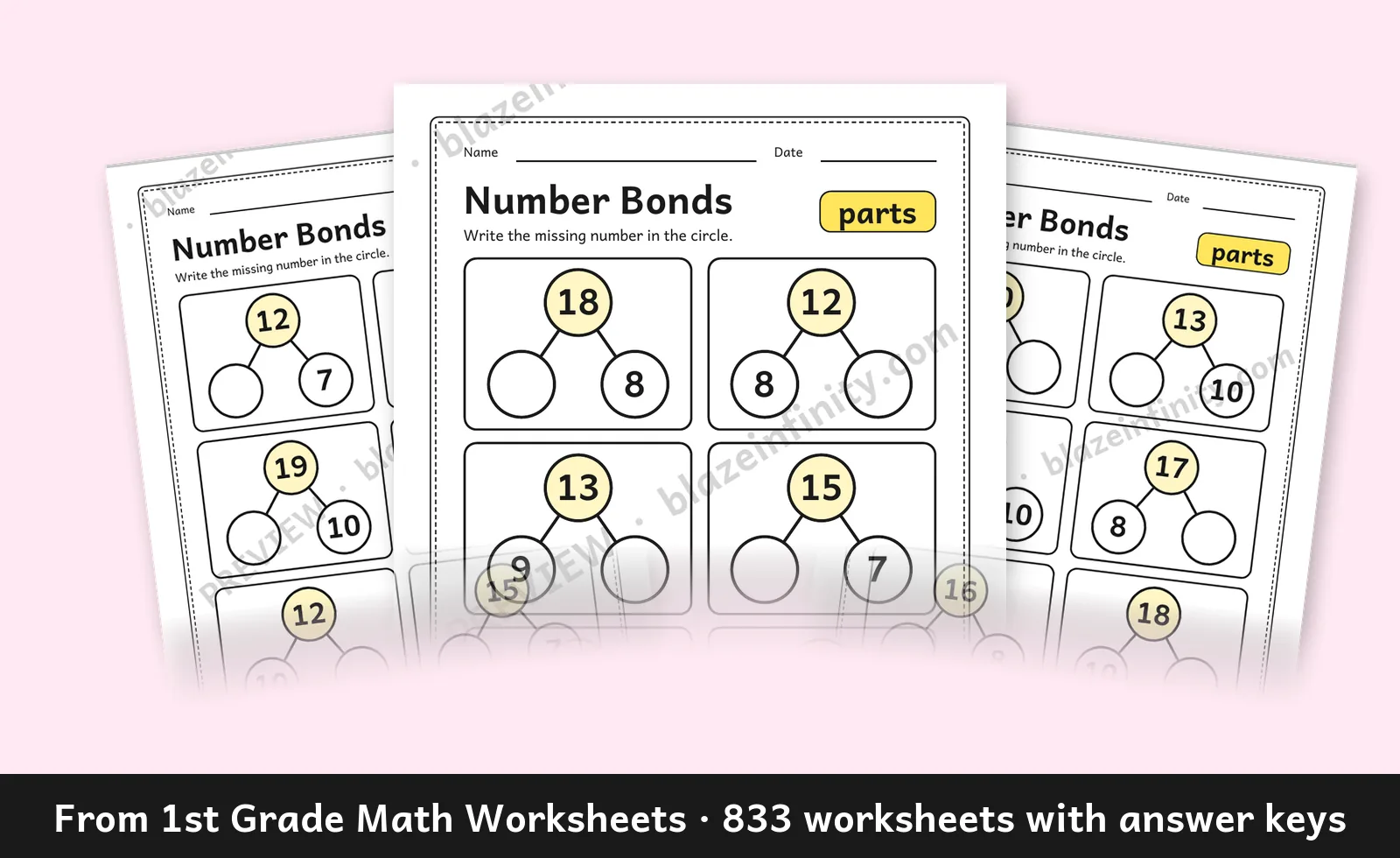
Every time a child learns an addition fact, ask for its subtraction partners. A number bond is the easiest picture for this: the whole at the top, the two parts below, and every sentence the three numbers can make. For the addition side, see our guide to addition strategies for first grade.
Later in first grade, children subtract tens from tens, such as 70 − 30, by thinking “7 tens take away 3 tens is 4 tens”. In second grade the same strategies return with numbers to 100. A child secure with place value and going down through ten is ready for both.
Do this, not that
Do: Teach subtraction as the partner of addition.
Not: Teach subtraction facts as a separate list.
Do: Teach counting up when numbers are close.
Not: Insist on counting back every time.
Do: Use stories: take away, compare, missing part.
Not: Use only take-away stories.
Do: Use fact families: 5, 8, 13.
Not: Drill facts with no link between them.
What the research says
- Subtraction facts are easier to master when children see them as missing-addend problems (8 + ? = 13), because each addition fact they know gives them a subtraction fact. [1]
- Young children solve subtraction stories in different ways depending on the story: taking away, comparing or finding a missing part. Meeting all three builds understanding. [2]
Sources
- Baroody, A. J. (2006). Why children have difficulties mastering the basic number combinations and how to help them. Teaching Children Mathematics, 13(1), 22-31.
- Carpenter, T. P., Fennema, E., Franke, M. L., Levi, L., & Empson, S. B. (2015). Children's Mathematics: Cognitively Guided Instruction (2nd ed.). Heinemann.
Common questions
- What are the subtraction strategies for first grade?
- Taking away with objects, counting back, counting up, using a related addition fact, and going down through ten. The first grade standard (1.OA.C.6) names the same ideas: counting on, breaking a number apart to reach ten, and using the link between addition and subtraction.
- What is the count up strategy?
- Starting at the smaller number and counting up to the bigger one. For 12 − 9, count 10, 11, 12: three counts, so the answer is 3.
- Why do children get 9 − 3 = 7?
- They count the starting number as a step. On a number line, count the hops between numbers, not the numbers themselves.
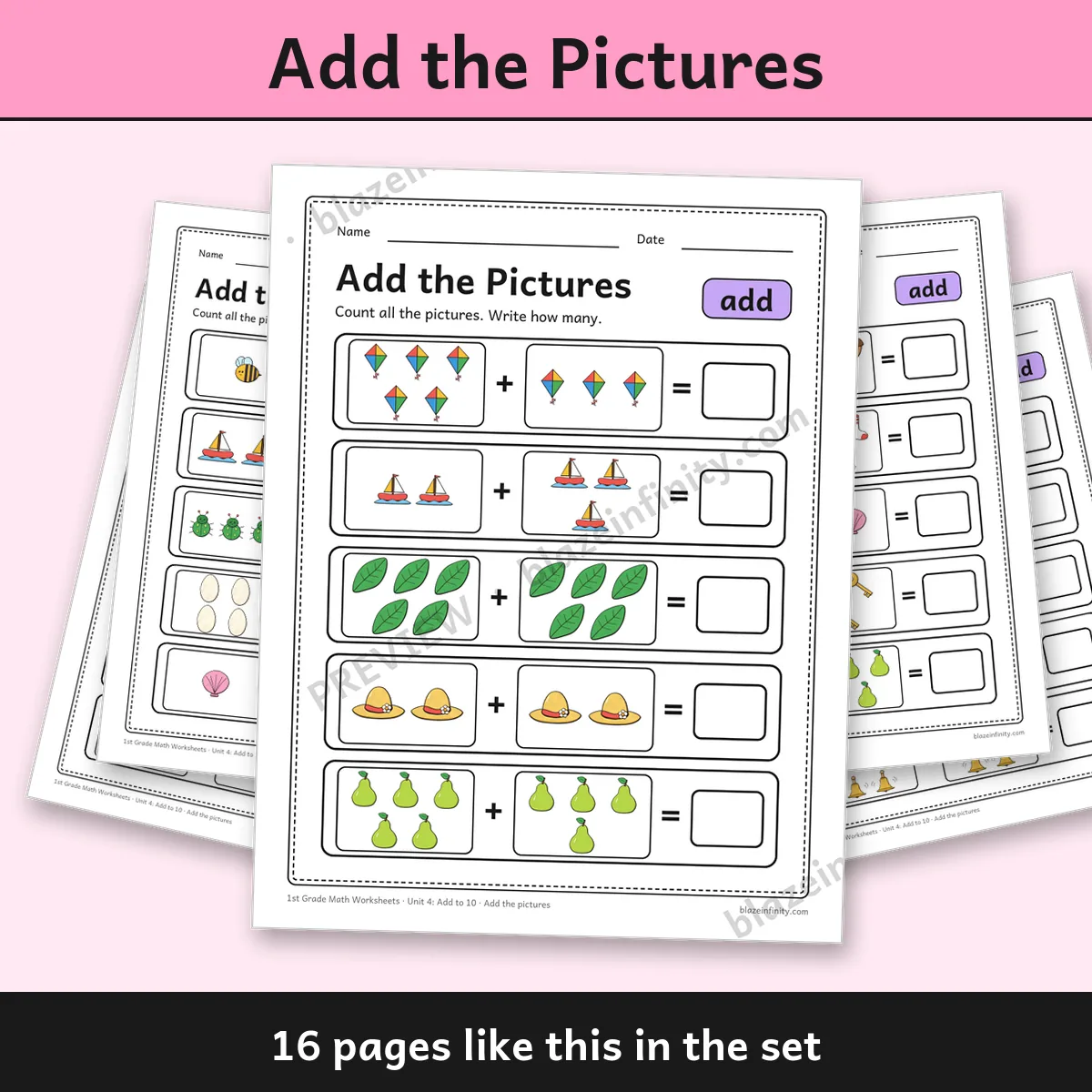
The full set for this skill
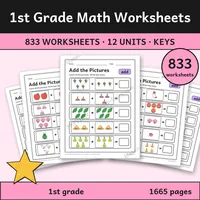
1st Grade Math Worksheets
Taking away within 10, then within 20, in the same steps this guide uses: pictures with the taken-away ones crossed out, number lines to hop back, number bonds for the missing part, then facts and story problems.
- 833 worksheets in 12 units
- An answer key after every page that can be marked
- Adding and taking away within 10, then within 20
- Number lines, number bonds, ten frames and tens-and-ones blocks
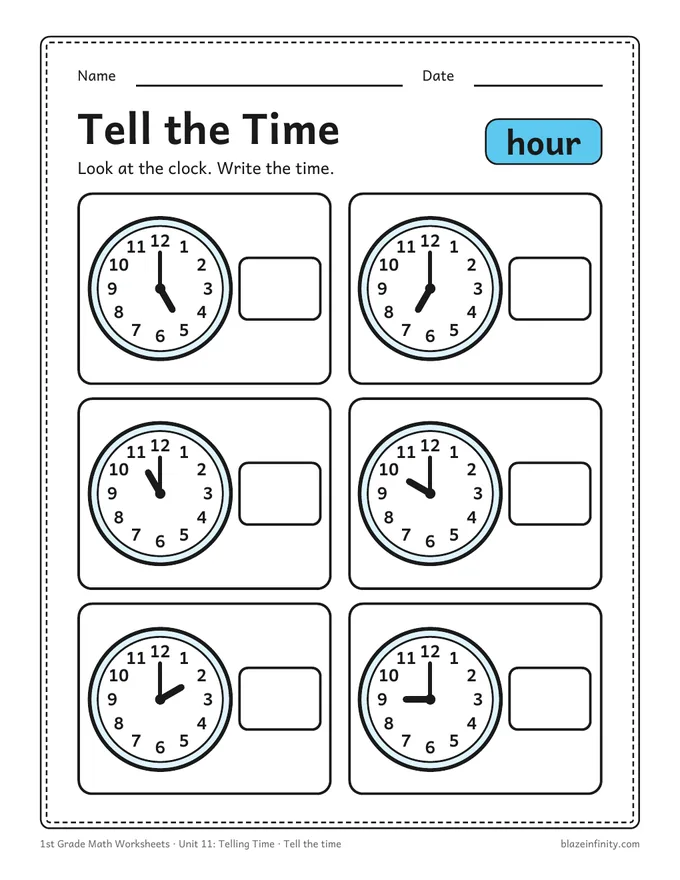
- Telling time to the hour and the half hour