




Types of Word Problems in 1st Grade, With an Example of Each
Every addition and subtraction word problem type for 1st grade in one table: a story, a drawing and an equation for each, plus fixes for the hard ones.
In short
- Four situations: Add To, Take From, Put Together/Take Apart and Compare. Any number can be the unknown.
- Key words fail: “more” can mean add in one story and subtract in the next. Ask who has more.
- Start Unknown and the tricky Compare wordings are hardest. Use number bonds and matched rows.
Your first graders can add 4 and 3. Put the same numbers inside a story and half the class freezes, or grabs both numbers and adds because that worked yesterday. The trouble is rarely the arithmetic. It is that the stories are not all the same kind, and nobody showed the children the kinds.
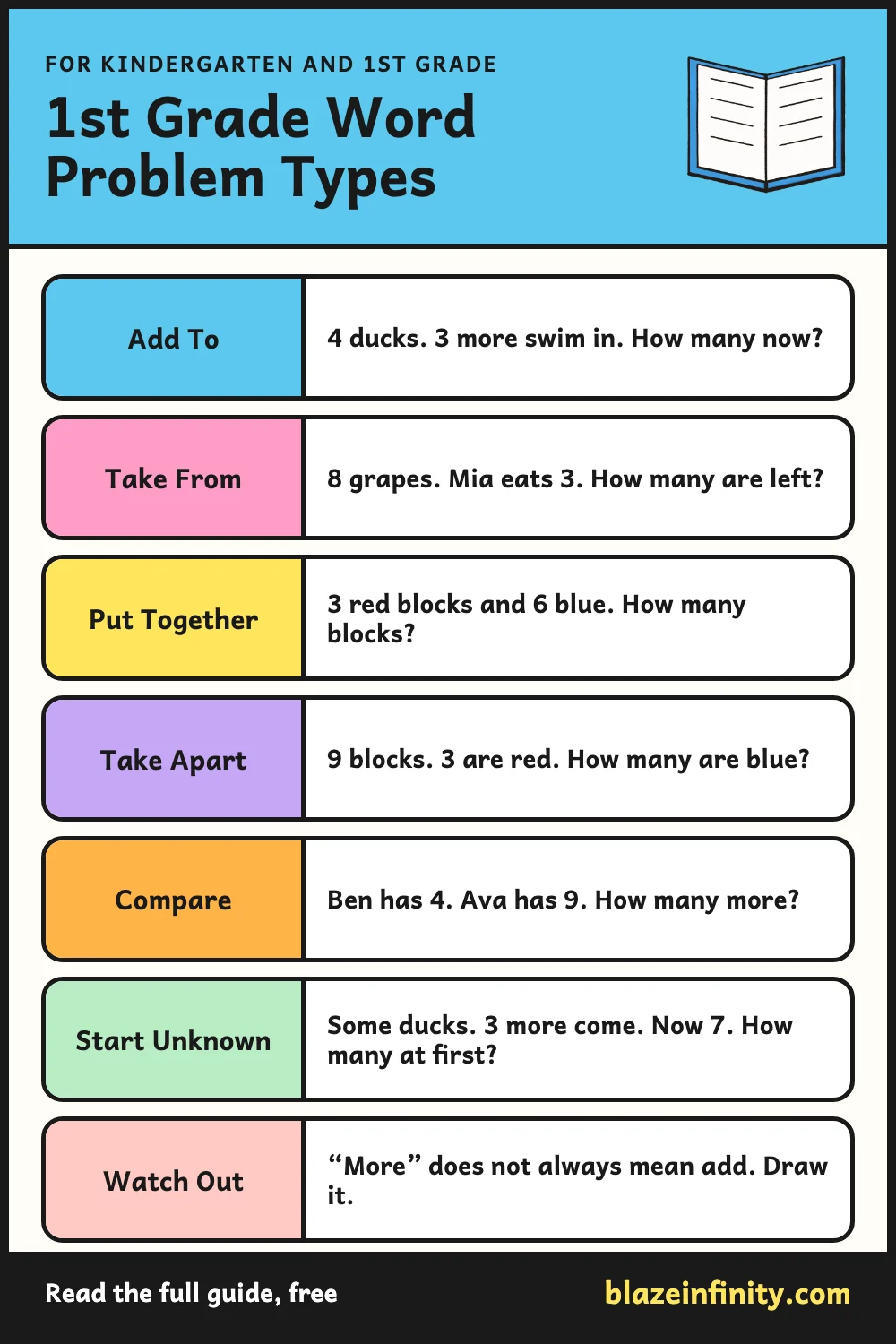
There are four situations, and each one can hide a different number. Below is every type in one table, with a story, a drawing and an equation for each. After the table: which types are hard, why key words let children down, and the routine and questions that work in their place.
The types of word problems, in one table
The names here are the ones used in the Common Core table of addition and subtraction situations: Add To, Take From, Put Together/Take Apart and Compare. Each situation has three versions, depending on which number is missing. That makes twelve boxes. The stories are ours, with small numbers so you can see the structure.
| Type | What is unknown | A story | What to draw | Equation |
|---|---|---|---|---|
| Add To | Result | 4 ducks are in the pond. 3 more swim in. How many ducks are in the pond now? | 4 circles, then 3 more. Count them all. | 4 + 3 = ? |
| Add To | Change | 4 ducks are in the pond. Some more swim in. Now there are 7. How many swam in? | 4 circles. Keep drawing until there are 7. Ring the new ones. | 4 + ? = 7 |
| Add To | Start | Some ducks are in the pond. 3 more swim in. Now there are 7. How many were there at first? | A number bond: 7 in the whole, 3 in one part, the other part empty. | ? + 3 = 7 |
| Take From | Result | 8 grapes are on a plate. Mia eats 3. How many grapes are left? | 8 circles. Cross out 3. | 8 − 3 = ? |
| Take From | Change | 8 grapes are on a plate. Mia eats some. 5 are left. How many did she eat? | 8 circles. Ring the 5 that are left. Count the rest. | 8 − ? = 5 |
| Take From | Start | Some grapes are on a plate. Mia eats 3. 5 are left. How many were there at first? | A number bond: 3 and 5 in the parts, the whole empty. | ? − 3 = 5 |
| Put Together/Take Apart | Total | 3 red blocks and 6 blue blocks are in the box. How many blocks are in the box? | 3 circles and 6 circles, one ring around both groups. | 3 + 6 = ? |
| Put Together/Take Apart | Addend | 9 blocks are in the box. 3 are red and the rest are blue. How many are blue? | A number bond: 9 in the whole, 3 in one part. | 3 + ? = 9 |
| Put Together/Take Apart | Both Addends | Sam has 5 stickers. How many can go on his red folder and how many on his blue folder? | 5 dots and a line that splits them. Move the line to find another way. | 5 = 1 + 4, 5 = 2 + 3 |
| Compare | Difference | Ben has 4 shells. Ava has 9 shells. How many more shells does Ava have than Ben? | A row of 4 above a row of 9, lined up at the left. Count the extras. | 4 + ? = 9 or 9 − 4 = ? |
| Compare | Bigger | Ava has 5 more shells than Ben. Ben has 4 shells. How many shells does Ava have? | Ben’s row of 4. Ava’s row is the same 4 and then 5 more. | 4 + 5 = ? |
| Compare | Smaller | Ben has 5 fewer shells than Ava. Ava has 9 shells. How many shells does Ben have? | Ava’s row of 9. Ben’s row stops 5 short. | 9 − 5 = ? |
Notice what the table shows about one pair of numbers. Ducks in a pond with 4, 3 and 7 make three different problems, and only one of them is “4 + 3”. A child who has only ever met the first row has learned one twelfth of the job.
Which type is this? “6 kids are on the rug. Some are sitting and 2 are standing. How many are sitting?” (tap to check)
Put Together/Take Apart, Addend Unknown. Nobody arrives and nobody leaves, so it is not Add To or Take From. You know the whole (6) and one part (2). The equation is 2 + ? = 6, and the answer is 4.
Which types belong to kindergarten and which to first grade
The progression document written alongside the standards sorts the types by grade. Kindergarten works with four: Add To with Result Unknown, Take From with Result Unknown, and Put Together/Take Apart with Total Unknown and with Both Addends Unknown. These are the stories where you can act out what happens and count what you see.
First grade works with all of them. The first grade standard asks for word problems within 20 “with unknowns in all positions”. Most types are meant to be mastered this year. Four are not: the same document lists four that first graders should work with but need not master until second grade. They are the two Start Unknown types and the two Compare versions where the wording points to the wrong operation. More on those below.
So if your class is solid on “how many now?” and “how many are left?” and shaky on everything else, that is the normal place to be at the start of first grade. The work of the year is the other rows.
Why key words fail
Many of us were taught a chart: “more” and “altogether” mean add, “left” and “fewer” mean subtract. It works on the first row of the table, which is why it feels true. Then it breaks.
Now you try one before you open the answer.
Tess has 7 crayons. She has 2 fewer crayons than Omar. How many crayons does Omar have? Add or subtract? (tap to check)
Add. Tess has fewer, so Omar has more than 7. Omar has 7 + 2 = 9 crayons. The word “fewer” pulls children toward 7 − 2 = 5, and then Omar ends up with fewer crayons than the girl who has fewer than him. This is Compare, Bigger Unknown, in its hard wording.
What to ask instead of “is it add or subtract?”
“Is it add or subtract?” asks for the last step first, and it invites a guess. These questions make the child look at the story. Ask them in this order and stop as soon as the child can draw it.
Six questions to keep on a sticky note
- What is happening in this story? Tell me without the numbers.
- Is something joining, is something leaving, or is nothing moving?
- What do we know? What do we not know yet?
- Is the missing number the whole or one of the parts?
- If two people are being compared: who has more?
- Will the answer be bigger or smaller than this number? Why?
The last question is the one that catches key word answers. A child who says “Nora has 9” can be asked, “Who has more, Leo or Nora?” and will usually fix it without you saying another word.
The numberless word problem routine, in four steps
A numberless word problem is a story shown first with the numbers taken out. With no numbers, there is nothing to grab and add, so the only thing left to do is think about what is going on. Here is one story, built up over about five minutes.
- 1
Show the story with no numbers
“Some birds are sitting on a fence. Some of them fly away.” Ask: “What is happening? Are there more birds on the fence now, or not as many?” Have a child act it out with a hand for the fence. - 2
Add one number
“9 birds are sitting on a fence. Some of them fly away.” Ask: “What do we know now? Could 12 birds fly away? Could 9?” Children start to reason about what is possible. - 3
Add the second number
“9 birds are sitting on a fence. 4 of them fly away.” Ask: “What could we find out?” Let the children say the question themselves. - 4
Add the question, then draw and solve
“How many birds are still on the fence?” Children draw 9 circles, cross out 4, write 9 − 4 = 5 and answer in a sentence: “5 birds are still on the fence.”
The same routine works for every row of the table. For a Start Unknown story, step 1 already sounds different (“Some birds are on a fence. Some more land. Now there are a lot.”), and the children hear that before a single number appears. Once the drawing is done, the counting is ordinary work: the addition strategies and subtraction strategies your class already uses.
The hardest types, what goes wrong and the fix
These are the four that the progression document says first graders should meet but need not master yet. Teach them anyway, slowly, with small numbers. Each has its own typical wrong answer.
If you see
Add To, Start Unknown: “Some ducks, 3 more swim in, now there are 7.” The child answers 10.
They saw 3, 7 and the word “more”, and added. There is no first number to start drawing from.
Try this
If you see
Take From, Start Unknown: “Some grapes, Mia eats 3, 5 are left.” The child answers 2.
They heard “eats” and “left” and subtracted the two numbers they could see.
Try this
If you see
Compare with “fewer” where you must add: “Kim has 6 beads. She has 3 fewer than Jo.” The child says Jo has 3.
“Fewer” was read as “take away”.
Try this
If you see
Compare with “more” where you must subtract: “Jo has 9 beads. She has 3 more than Kim.” The child says Kim has 12.
“More” was read as “add”.
Try this
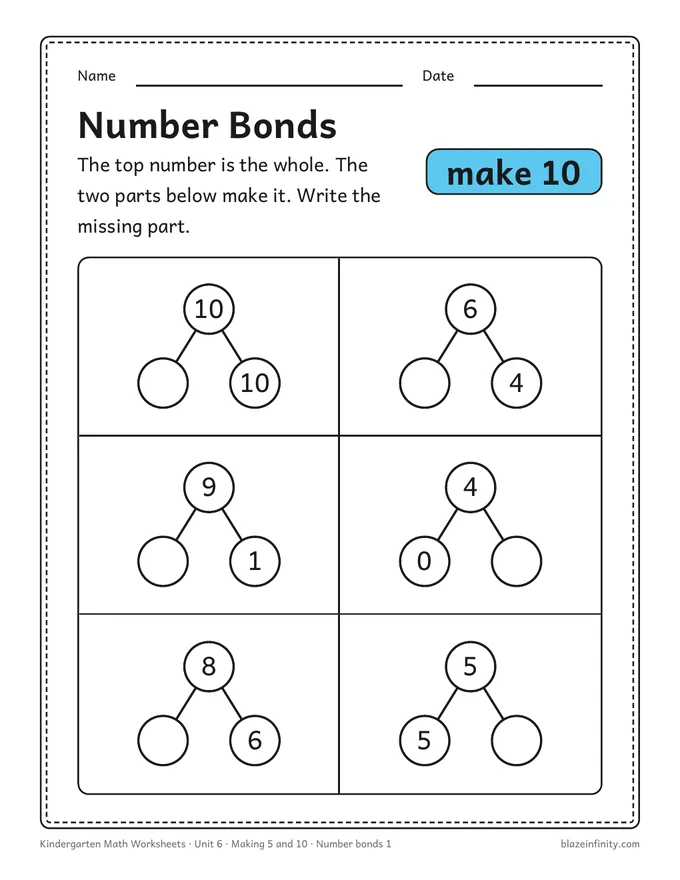
For the two Start Unknown types, the number bond does the heavy lifting, because it makes the child decide which number is the whole. If your class needs practice finding a missing part before you put it in a story, start here.
How to teach comparison word problems
Compare problems are different from the rest because nothing happens in them. Nobody arrives, nobody leaves, nothing is put in a box. Two amounts just sit side by side, and the unknown is the gap between them. Children who solve stories by acting them out have nothing to act out.
So make the gap something they can see. Three moves, in this order:
- Build two towers. 4 cubes for Ben, 9 for Ava. Stand them side by side. Ask, “Who has more?” first, every time, before “how many more?”
- Match, then count the extras. Break Ava's tower at the height of Ben's. The part that sticks out is the answer. Say: “These 4 have a partner. These 5 do not. Ava has 5 more.”
- Say it both ways. “Ava has 5 more than Ben. Ben has 5 fewer than Ava.” One picture, two sentences. This is what protects children when the wording flips later.
If “how many more?” still gets a blank look, ask the same thing as an action: “How many does Ben need to get so he has the same as Ava?” Most children can answer that, and you can then tie the new question to the old one.
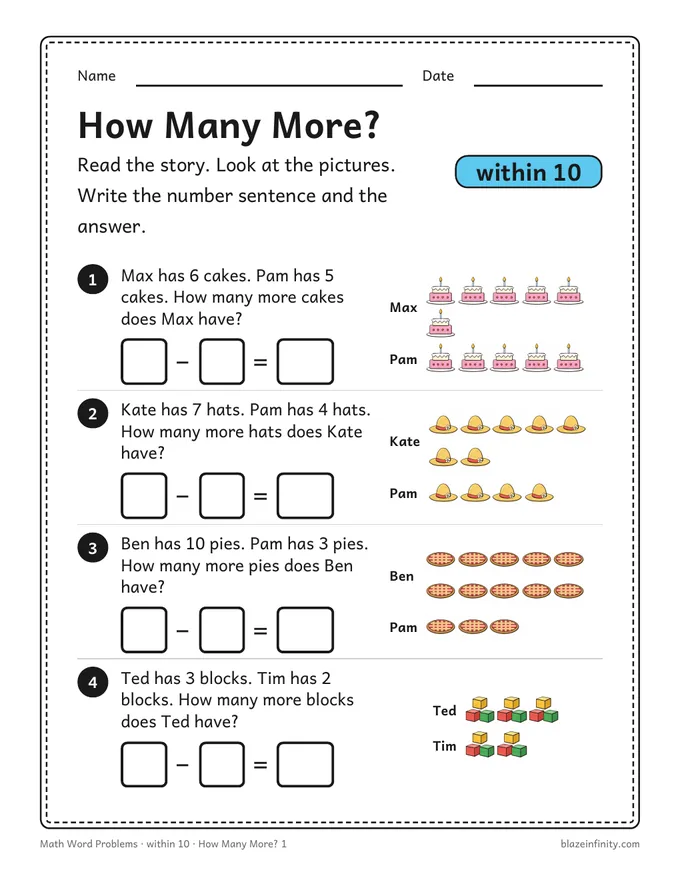
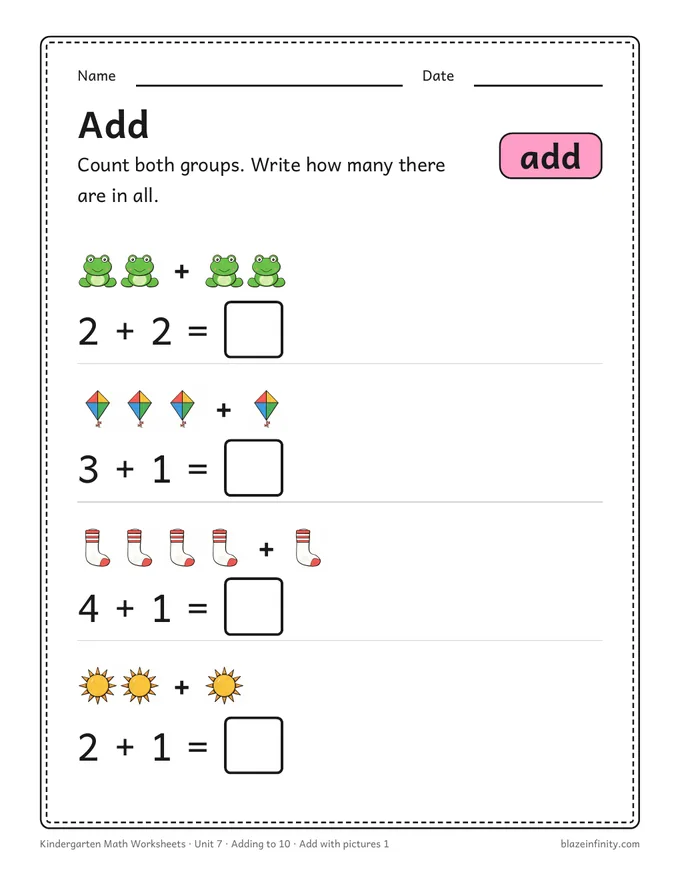
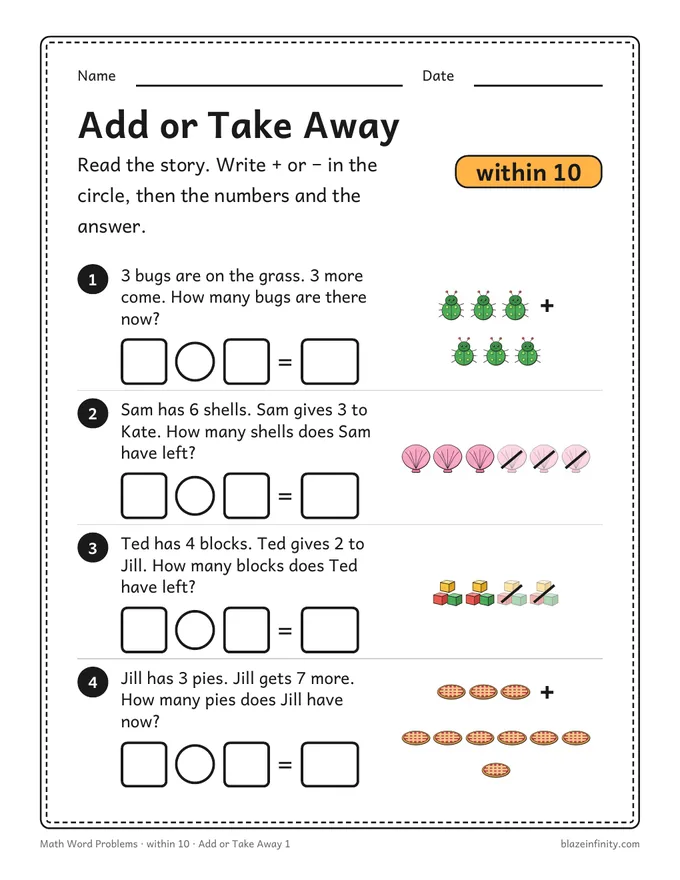
On paper, the towers become two rows of circles lined up at the left edge. The fish bowl “how many more” pages in 1st Grade Picture Math use pictures in the same way, and the set has story problem pages for when the class is ready to read the stories alone.
How to use the table this week
You do not need a new unit. Take the story problem you already planned for tomorrow and find its row. Then change which number is missing and ask it again the next day with the same characters. Three days, three rows, one set of numbers. Children start to see that the story decides the operation, not a word in it.
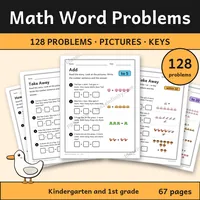
Keep the numbers small while the type is new. A Start Unknown problem with 3 and 7 teaches the structure. The same problem with 8 and 15 mostly tests counting. When you want a stack of ready pages to work through, Math Word Problems is our set for this.
What the research says
- Addition and subtraction word problems fall into four situations (Add To, Take From, Put Together/Take Apart, Compare), each with three unknown positions: Result, Change and Start Unknown; Total, Addend and Both Addends Unknown; Difference, Bigger and Smaller Unknown. [1]
- Kindergarten works with four subtypes: Add To with Result Unknown, Take From with Result Unknown, and Put Together/Take Apart with Total Unknown and Both Addends Unknown. Grade 1 works with all subtypes; four (Add To with Start Unknown, Take From with Start Unknown, Compare with Bigger Unknown using 'fewer' language, Compare with Smaller Unknown using 'more' language) are to be worked with in Grade 1 but need not be mastered until Grade 2. [2]
- The situations table is also counted as fifteen situation types, because each Compare box has two wordings. [3]
- The first grade standard asks for addition and subtraction word problems within 20 with unknowns in all positions. [4]
Sources
- Common Core State Standards for Mathematics, Mathematics Glossary, Table 1: Common addition and subtraction situations. National Governors Association Center for Best Practices and Council of Chief State School Officers, 2010.
- Common Core Standards Writing Team. Progressions for the Common Core State Standards in Mathematics (draft): K, Counting and Cardinality; K-5, Operations and Algebraic Thinking. 29 May 2011. Table 2 and the Kindergarten and Grade 1 sections.
- Achieve the Core (Student Achievement Partners). Situation Types for Operations in Word Problems, with the Add Subtract Situation Types table excerpted from the progression document.
- Common Core State Standards for Mathematics, Grade 1, Operations and Algebraic Thinking, first standard. National Governors Association Center for Best Practices and Council of Chief State School Officers, 2010.
Common questions
- What are the different types of word problems?
- For addition and subtraction there are four situations: Add To, Take From, Put Together/Take Apart and Compare. Each has three versions depending on which number is unknown, such as Result Unknown, Change Unknown or Start Unknown.
- How do you teach a child to solve word problems?
- Have the child retell the story without numbers, draw it, and decide which number is the whole and which are parts before choosing an operation. Then write an equation with a blank for the unknown and check that the answer makes sense in the story.
- What is a numberless word problem?
- It is a story problem shown first with the numbers removed. Children talk about what is happening, then the numbers are added one at a time and the question comes last, so they think about the story before they calculate.
- Should I teach word problem key words?
- No. A word such as “more” can call for addition in one story and subtraction in another, so key words lead to confident wrong answers. Teach children to work out what is happening in the story.
- How do you teach comparison word problems in 1st grade?
- Build the two amounts as towers or rows, ask who has more, match them one to one and count the extras. Then say the result both ways: one has 5 more, the other has 5 fewer.
The full set for this skill
Math Word Problems
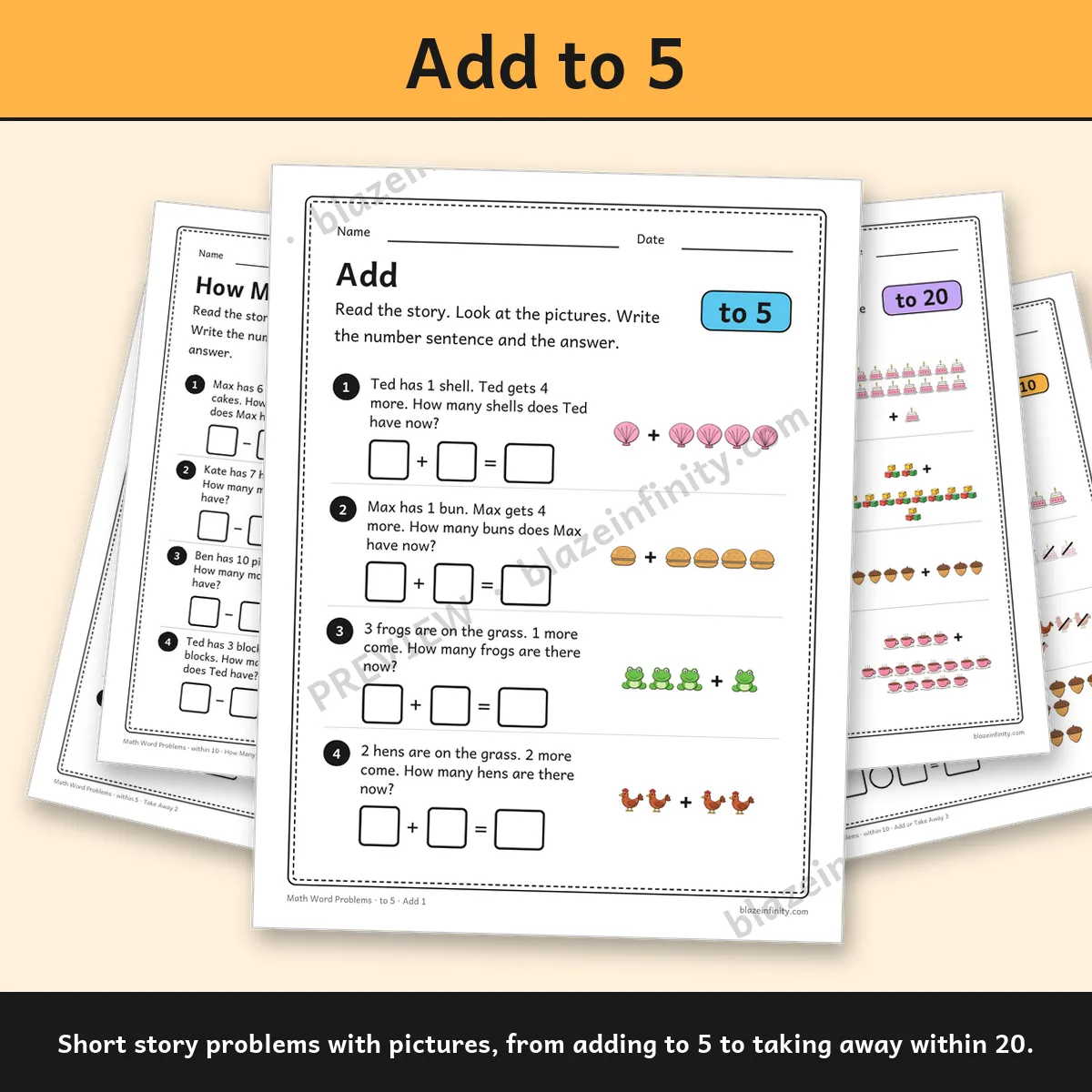
Four story problems on each page. The pictures show the story, so children can count to check. Adding, taking away, mixed, how many more, missing part and start unknown.
- 128 story problems in order of difficulty
- Missing part and start unknown problems
- Pictures that show every story
- A number sentence to fill in for each
- An answer key after every page