






What should kindergarten handwriting look like?
What kindergarten handwriting looks like at the start and end of the year, what is normal (reversals included), and how to teach letters with short daily practice.
In short
- By the end of kindergarten most children write their name and form most letters from memory.
- Reversals are common until about age seven.
- Five to ten minutes of daily practice works better than long sessions.
Parents and new teachers often ask what kindergarten handwriting should look like, usually while looking at a page of wobbly, mixed-size letters. The honest answer is that it varies a lot, and that progress matters more than neatness. Here is what is typical at the start and end of the year, what is normal, and how to help.
At the start of kindergarten
Many five-year-olds arrive able to write their first name, often in capitals. Most can copy lines, circles and crosses. Letters may be big, sit anywhere on the page, and face the wrong way. Some children still hold the pencil in a fist. All of this is normal at the start of the year.
By the end of kindergarten
US standards ask kindergartners to “print many upper- and lowercase letters” (L.K.1a); first graders are expected to print all of them. By the end of the year, most kindergartners:
- write their first and last name;
- form most letters from memory, starting at the top;
- write letters on lines, with tall letters taller than small ones;
- leave spaces between words when writing a short sentence;
- hold the pencil between thumb and fingers rather than in a fist.
Perfect size, even spacing and speed are not expected yet. Readable is the goal.

What is normal
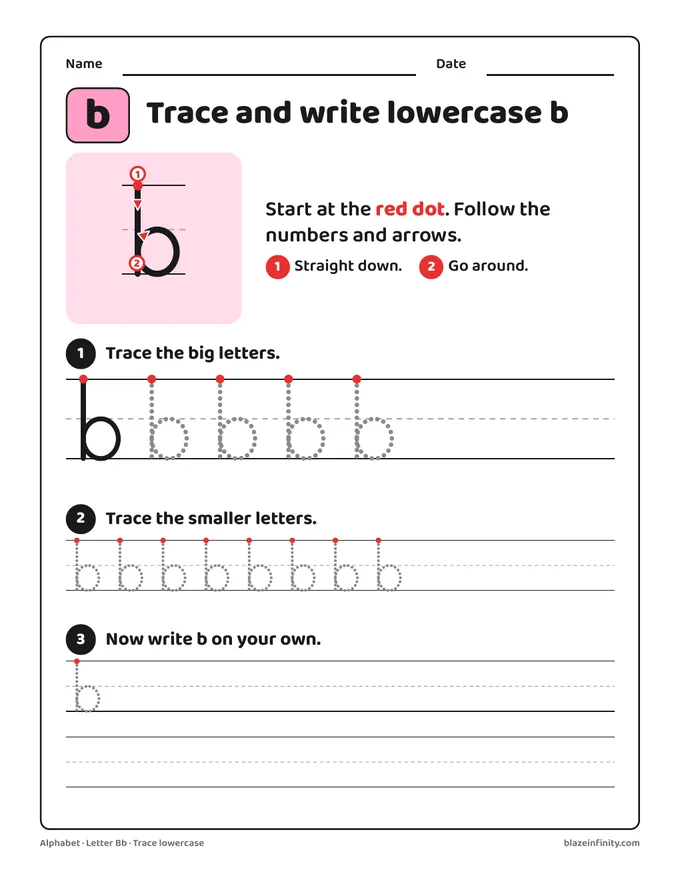
Reversals such as b for d, backwards s, or a backwards j are common until about age seven, and are not on their own a sign of a learning difficulty. Mixing capitals and lowercase inside a word is normal too; teach lowercase steadily, because that is what children read most. A tight grip or tired hand after a few minutes usually means the hand muscles need more play, not more writing.
How to teach it
- Start every letter at the right place. Most letters start at the top. Where a letter starts matters more than how pretty it looks; our guide to letter formation explains why.
- Group letters by first stroke. Letters that start with a line down (l, t, i), letters that start like c (c, a, d, g, o, q), and so on. Children learn families faster than the alphabet in order.
- Say the strokes. “Down, back up, around” as the child writes. Talking keeps the movement the same every time.
- Practice little and often. Five to ten minutes a day beats a long session once a week.
- Strengthen hands through play. Play dough, tongs, building bricks, cutting with scissors and drawing on a vertical surface all build the muscles writing needs.
When to get help
Talk to the child's teacher or an occupational therapist if, by the end of kindergarten, a child avoids drawing and writing altogether, cannot copy simple shapes, or still holds the pencil in a fist despite practice. Early help with fine motor skills is simple and very effective.
Common questions
- What should kindergarten handwriting look like by the end of the year?
- Readable letters, most formed from memory and started at the top, written on lines with spaces between words. Neatness and even size come later.
- Is it normal for kindergartners to write letters backwards?
- Yes. Reversals such as b and d are common until about age seven and are not on their own a sign of a learning difficulty.
- How do I teach my kindergartner handwriting?
- Teach where each letter starts, group letters with the same first stroke, say the strokes out loud, and practice a few minutes every day.
Ready-made pages for this skill
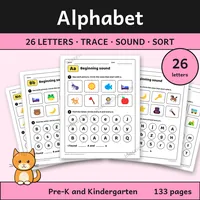
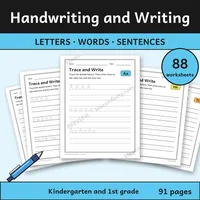
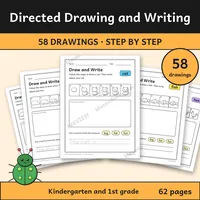
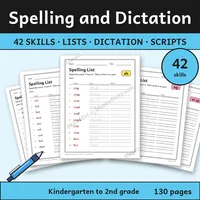
Handwriting and Writing: ready-made printable pages for this skill.
See the set