









Short Vowels vs Long Vowels: How to Teach the Difference
Short vowels vs long vowels, explained in words you can say to a class: a two-column sort, the spellings that make a vowel long, the exceptions and the fixes.
In short
- A short vowel is the sound in cat, bed, pig, hot and sun; a long vowel says its own name.
- Children decide short or long by listening first; the spelling comes after.
- Silent e, vowel teams and open syllables usually make a vowel long, with a few honest exceptions.
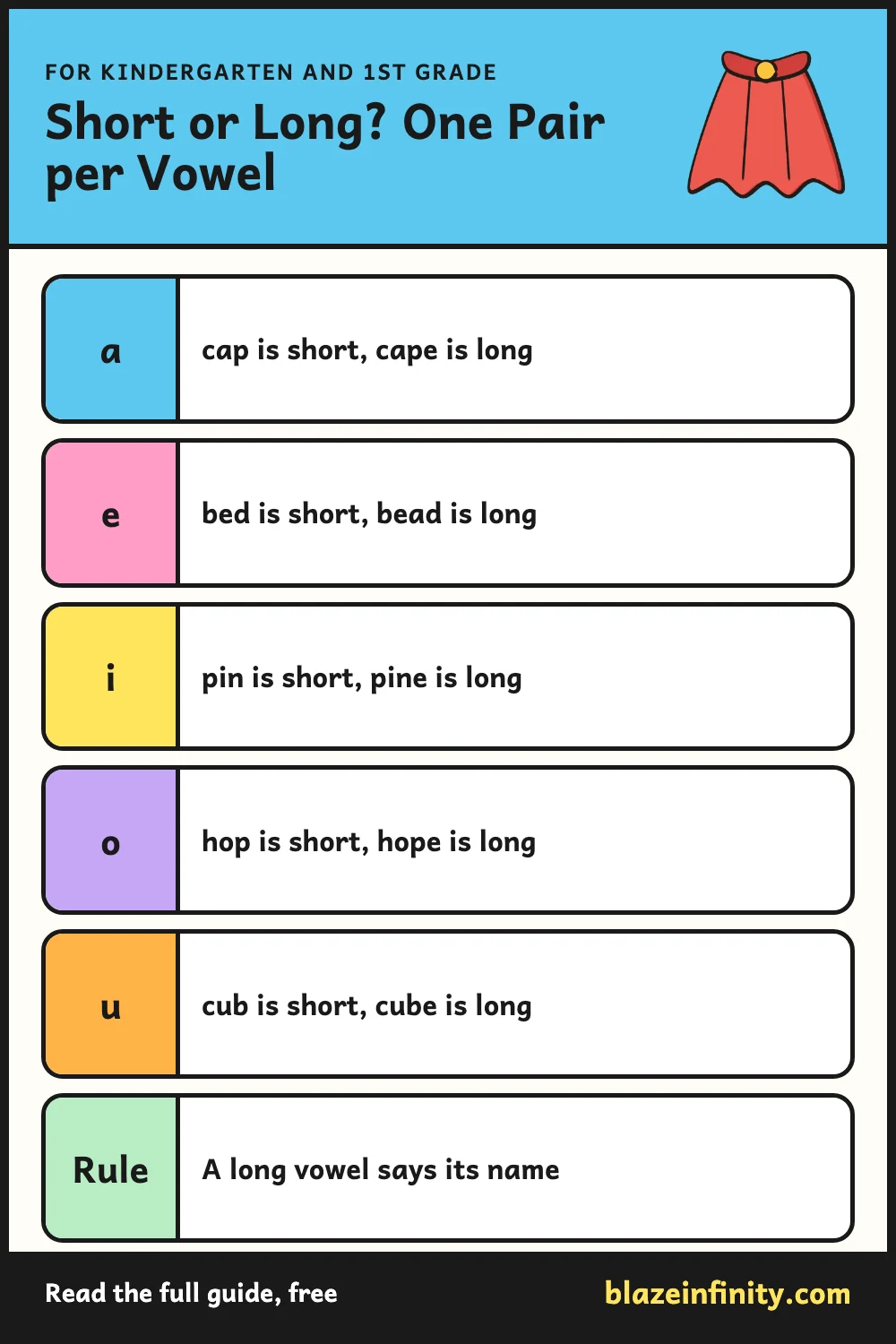
A short vowel is the sound you hear in the middle of cat, bed, pig, hot and sun. A long vowel says its own name, the way the a says "ay" in cake. That is the whole difference, and it is about the sound you hear, not the letter you see. Here is how to explain it, sort it, spell it and fix the usual mistakes.
Long vowels say their name: what to tell children
Children already know the vowel letter names. That is the hook: long vowels borrow those names.
Short vowels and long vowels: examples, one pair per vowel
Teach each vowel with one pair. Only the vowel sound changes, so the pair does the teaching.
| Vowel | Short sound | Long sound (says its name) | One pair to say aloud |
|---|---|---|---|
| a | /a/ as in cat | "ay" as in cake | cap and cape |
| e | /e/ as in bed | "ee" as in feet | bed and bead |
| i | /i/ as in pig | "eye" as in kite | pin and pine |
| o | /o/ as in hot | "oh" as in rope | hop and hope |
| u | /u/ as in sun | "you" as in cube | cub and cube |
It is the sound, not the letter
The letter a is in cat and in cake, doing a different job in each, while rain, play and cake share one long a sound with three spellings. Children who judge by the letter will often be wrong. Children who judge by ear can then ask a useful question: "I hear long a. Which spelling does this word use?"
That is why the first grade standard asks children to tell long from short in spoken words. Do the listening before any print: eyes closed, you say a word, they say short or long. That is phonemic awareness, a separate skill from reading letters, as our guide to phonemic awareness vs phonics explains.
How to teach short and long vowels: the two-column sort
Come back to this all year. It takes about ten minutes, with pictures in kindergarten and written words in first grade.
Set up. Draw two columns on the board or lay two hoops on the rug. Label one "short" with a picture of a cat and the other "long" with a cake. Keep these two key pictures for every sort.
Say and echo. Say the picture's name; the class echoes it, then says only the vowel sound: for kite, children say "eye."
Ask one question. "Did the vowel say its name?" Thumbs up means long, thumbs down means short.
Read the column. Every few cards, read a column top to bottom. Children often hear the odd one out and fix it themselves.
Then make it harder, one step at a time. Start with one vowel, short a and long a. Next, written words of that vowel. Last, mix two vowels, but only once a one-vowel sort is easy.
Leave out cards like car, ball and saw. Their vowels are neither short nor long, and they belong in later lessons such as r-controlled vowels. A sort only teaches if every card has a clear answer.

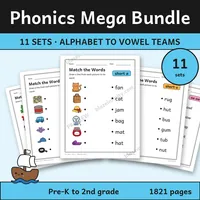
Use that page once children hear the middle sound. Every picture is a three-letter short vowel word and the vowels are mixed, so the child has to listen before writing. A child who misses several needs more short vowel time before long vowels, not a new rule.
The spellings that usually make a vowel long
Once children hear the difference, show them what to look for in print. One pattern covers most short vowels in early books, and three cover most long ones.
One vowel, closed in by a consonant: usually short. In hop the o is boxed in by the p. Every CVC word works this way.
Silent e at the end: usually long. Add an e to hop and you get hope. Our silent e guide has a first lesson and a five-day plan.
Two vowels working as a team: usually long. In boat and rain, two letters spell one long sound; the vowel teams guide shows where each team goes.
A vowel at the very end of a short word: usually long. In go, me and hi, nothing closes the vowel in, so it says its name. That is an open syllable, which is why no is long and not is short; see open and closed syllables for longer words.
Give children one question that works for all four: "How many vowels, and what comes after the vowel?" One vowel with a consonant after it, try short. A silent e at the end, a team, or nothing after the vowel, try long.
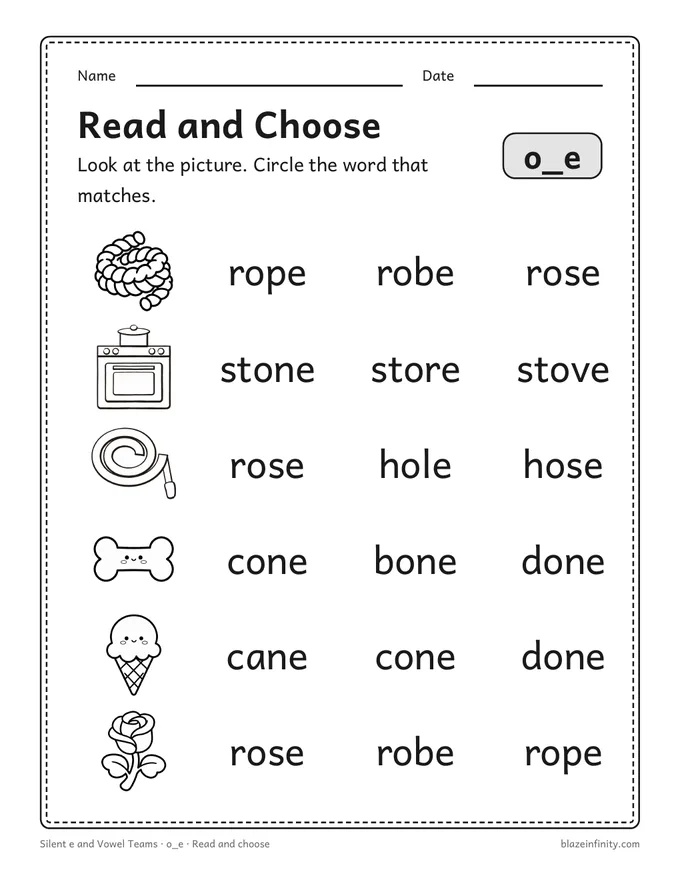
This page fits after the first week of silent e. The child looks at each picture and circles the word that names it, which means reading to the end of every word instead of guessing from the first letters.
The honest exceptions
Tell children the patterns say "usually," and mean it. A rule children think is always true breaks the first time they read have.
Words that end in e but stay short. Have and give need the e only because English words almost never end in v. Come, some and love keep a short sound too, though it is the short u of sun, not the short o of hot. Teach these as heart words.
Long vowels with no e and no team. The i in find and kind is long, and so is the o in cold and most. They are closed in by consonants and still say their names, so point them out as a small family before they turn up as surprises.
The lazy vowel, or schwa. In longer words, the vowel in the weak beat often relaxes into a quick "uh." Say about or lemon at normal speed: the unstressed vowel is neither short nor long. Kindergartners do not need the word schwa, but they need to hear from you that this is not a mistake. Small words like the, was and of often have the same quick "uh."
A teaching order for kindergarten and first grade
Go by what the child can do, not the calendar. This is a common path.
Kindergarten, fall and winter. Short vowel sounds by ear, one vowel at a time, then reading and writing short vowel words. Start the spoken short and long sort with pictures.
Kindergarten, spring. The kindergarten standard asks children to connect long and short sounds with the common vowel spellings. In practice, that means reading and hearing pairs such as cap and cape. Keep it light; fluent silent e reading can wait.
First grade, fall. A quick short vowel review, the spoken sort with all five vowels mixed, then silent e one vowel at a time.
First grade, winter and spring. Vowel teams, one long sound at a time, then open syllables in words like she and robot. Mix every new spelling with short vowel and silent e words, and mention the schwa as longer words appear.
Common mistakes and the fixes
Here is what each common error looks like, why it happens and what to do the same day.
If you see
The child reads cape as cap
They read left to right and said the vowel before they saw the e.
Try this
Teach "end first." The child looks at the last letter before reading: "Is there an e on the end? Then the vowel says its name." Practice with pairs so they hear what the e changed.
If you see
The child says a word is long because it has that letter
They hear the letter name in their head and decide cat is long a because it has an a.
Try this
Separate the name from the sound. "This letter's name is ay. In cat, does it say ay?" Go back to spoken sorts, no print, until they decide by ear.
If you see
The child calls a stretched vowel long
They held the sound longer while blending and took the word long literally.
Try this
Say the word fast and slow: "caaat, cat. Did a say its name either time? No, so it is short." Repeat that long is a name, not a speed.
If you see
The child mixes up short e and short i
The two sounds are close, and in some US accents, especially in the South, pen and pin sound the same.
Try this
Use a mirror and a hand under the chin. For short e the jaw drops a little more; for short i the mouth stays nearly closed in a small smile. Sort only e and i pictures for a few days, and start with words where no m or n follows the vowel, such as bed and big, because that is where some accents merge the two.
If you see
The child reads go as "gah" or me as "meh"
They have learned that one vowel means short, every time.
Try this
Show that nothing comes after the vowel. "The door is open, so the vowel can say its name." Pair the words with closed ones: no and not, he and hen.
Quick games for short and long vowels
Each takes five minutes or less and needs no printing.
Stand or sit. Say a word. Children stand up if the vowel says its name and stay seated if it is short. You see every answer at once.
Make it say its name. Say a short word, and the class turns it into a long one by changing only the vowel sound. You say cap, they say cape. Pick words that give a real word back. It is oral, so it works in kindergarten.
Teacher's mistake. Read a sentence aloud with one vowel sound wrong: "I ride my bick." Children say the right word and which spelling makes its vowel long.
Check yourself: three quick questions
Is the vowel in have long or short? (tap to check)
Short. The e is there because English words almost never end in v. It is a heart word.
Go has no silent e and no vowel team. Why is the o long? (tap to check)
It is an open syllable. Nothing comes after the o, so it says its name. Compare it with got, where the t closes the vowel in.
Is the first vowel in about short or long? (tap to check)
Neither. It is the schwa, a quick "uh" in the weak beat.
Where to go from here
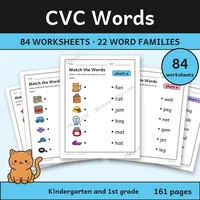
For short vowel practice, CVC Words has 84 worksheets with a picture for every word, including eight picture pages per vowel and a Find page and a Sort page for each of 22 word families. For long vowels, the Silent e and Vowel Teams set has 49 worksheets across a_e, i_e, o_e, u_e and the common vowel teams, with pictures and answer keys, an Add the Silent e page that turns cap into cape, and mixed spelling review. Or start with our free worksheets.
What the research says
- Kindergarten: associate the long and short sounds with the common spellings (graphemes) for the five major vowels (RF.K.3b). [1]
- First grade: distinguish long from short vowel sounds in spoken single-syllable words (RF.1.2a). [2]
- First grade: know final -e and common vowel team conventions for representing long vowel sounds (RF.1.3c). [3]
Sources
- Common Core State Standards for English Language Arts, Reading: Foundational Skills, Kindergarten.
- Common Core State Standards for English Language Arts, Reading: Foundational Skills, Grade 1.
- Common Core State Standards for English Language Arts, Reading: Foundational Skills, Grade 1.
Common questions
- What are the 5 long vowels?
- The long vowels are a, e, i, o and u when each one says its own name, as in cake, feet, kite, rope and cube. Long u can also say "oo," as in rule.
- What is the difference between a short vowel and a long vowel?
- A short vowel is the sound in the middle of cat, bed, pig, hot and sun. A long vowel says the letter's name. The difference is the sound you hear, not how long you hold it.
- How do you teach short and long vowels to kindergarten?
- Start with short vowel sounds by ear, then sort spoken picture words into two columns by asking, "Did the vowel say its name?" Use one vowel at a time and pairs such as cap and cape before any spelling rules.
- Why do have and give end in e but have short vowels?
- English words almost never end in v, so the e is there for spelling, not to make the vowel long. Teach them as heart words.
- When do children learn long vowels?
- The Common Core standards start connecting long and short sounds to vowel spellings in kindergarten and teach final e and vowel teams in first grade. Go by what the child can do rather than the calendar.
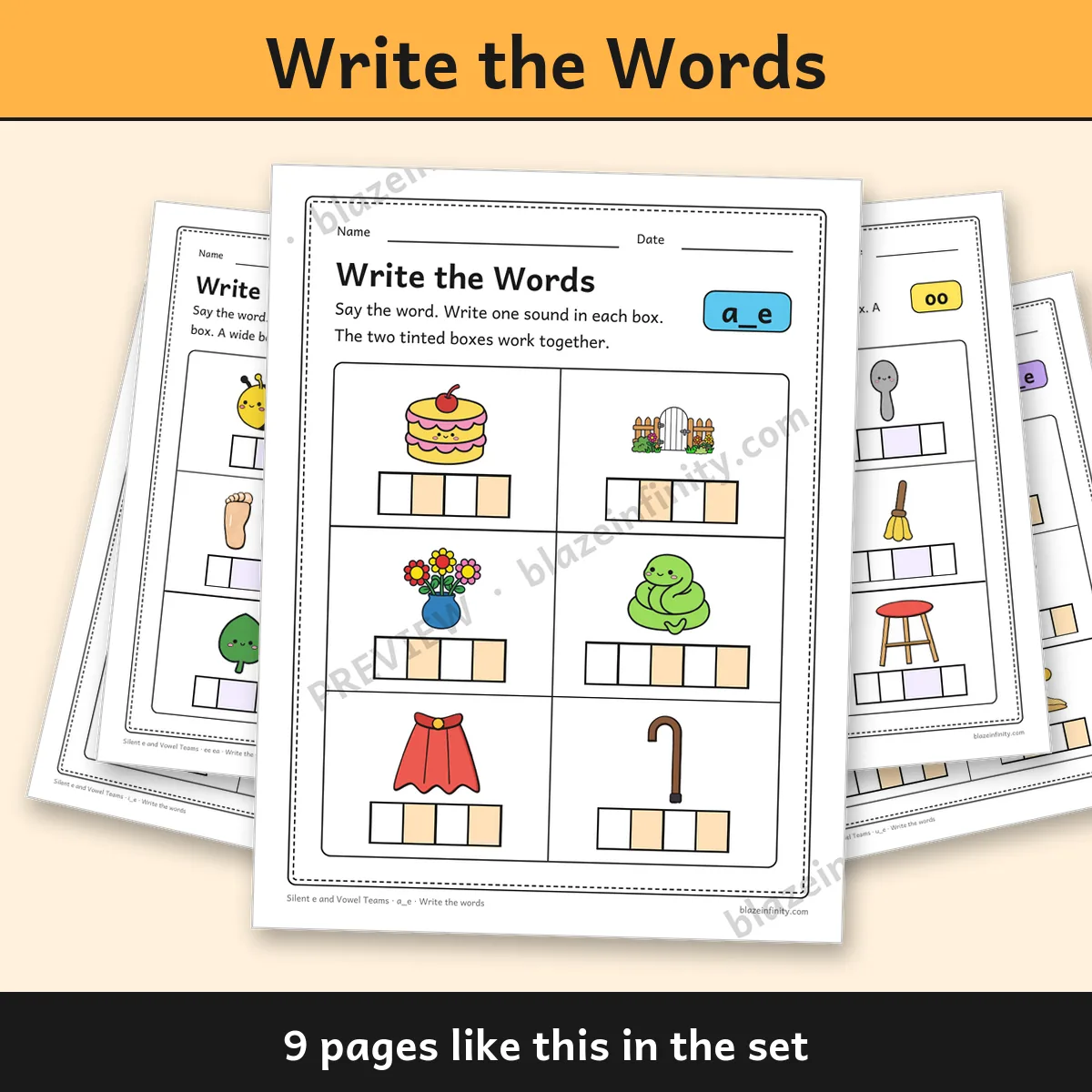
The full set for this skill
Silent e and Vowel Teams
Nine long vowel skills with six pictured words each, an Add the Silent e page that turns cap into cape, and mixed spelling review.
- 49 worksheets with answer keys
- Nine long vowel skills, six pictured words each
- An Add the Silent e page (cap to cape)
- Mixed "Which spelling?" review
- Tinted sound boxes show the vowel and e working together