









Valentine's Day Activities for Kindergarten That Still Teach
Valentine's Day activities for kindergarten and first grade: a calm card exchange, four learning stations for the party hour and a timed plan. No candy needed.
In short
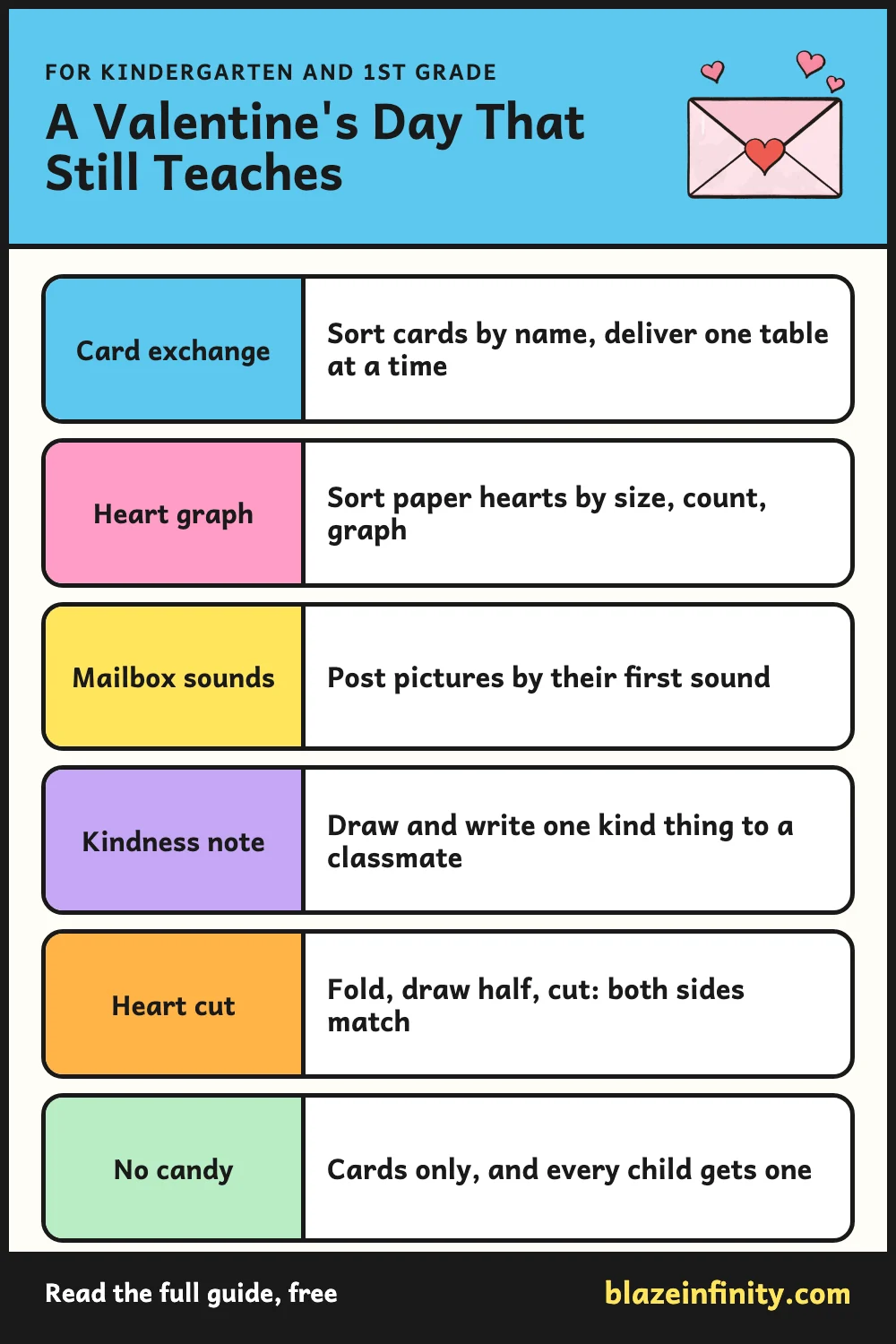
- Turn the card exchange into reading: children match each card's name to a name strip with photos, then deliver one table at a time.
- Fill the party hour with four 12-minute stations: heart graph, mailbox sounds, a kindness note and a folded heart cut.
- Ask for cards only, with nothing attached, and keep spare cards so every child goes home with a full bag.
Valentine's Day in kindergarten can go two ways. In one, twenty-two children rip open paper bags at 9 a.m., cards end up on the floor, someone gets three and someone gets none, and nothing is learned after lunch. In the other, the cards become a reading task, the party hour becomes four learning stations, and every child goes home with a full bag. This guide plans the second kind of day: how to run the card exchange, what to put at each station, and a timed plan you can copy into your plan book.
Nothing here needs candy or food. Every part also works as a kindness day for families who do not celebrate Valentine's Day, and there is a section on that below.
How to run a Valentine's Day card exchange in kindergarten
Most of the chaos comes from three things: cards with no names or the wrong names, everyone delivering at once, and a child who gets fewer cards than the rest. The steps below fix all three, starting two weeks before the day.
- 1
Send the class list home two weeks before
Valentine's Day 2027 is a Sunday, so if your class party is on Friday, February 12, the list goes home around January 29. One page with every child's first name, typed the way it appears on their name tag, and the rule in one line: "If your child brings cards, please bring one for every child in the class." Ask for cards only, with nothing attached. Leave it to families to send cards or not, say that children who bring none will make cards at school, and invite any family who does not celebrate to tell you privately.
- 2
Decide: names on the cards, or "from" only
If children write the classmate's name on each card, the delivery becomes a reading task and takes about 25 minutes. If children sign only their own name and leave the "to" line blank, delivery takes about 10 minutes but skips the reading. Pick one and say which in the letter home. This guide uses names on the cards.
- 3
Make the mailboxes the week before
A paper lunch bag or a large envelope per child, with their name written big and their photo glued beside it. Children decorate their own bag and write their own name on it during a handwriting slot. Tape each bag to the back of its owner's chair. The photo matters: it lets a child who cannot read "Jasmine" yet match the card to a face.
- 4
Collect the cards at the door
As children arrive on the day, their cards go into one bin with their name on a sticky note, not into the bags. Nobody delivers during arrival. This also gives you the morning to see who brought nothing.
- 5
Sort at the table before anyone walks
Give each table a strip with every child's name and photo. Children lay out their own cards and match each card's name to the strip, saying the first letter as they go: "M, Mateo." When two names start the same way, such as Mia and Max, they look at the next letter. This is the literacy task, and it is real reading: matching print to print, then to a face.
- 6
Deliver one table at a time
One table walks while the rest stay seated and color or read their kindness notes. With a class of 22, four tables of five or six take about five minutes each. Twenty-two children on their feet at once is where the floor fills with cards.
- 7
Fill the gaps before delivery, not after
A child who brought no cards makes them at school, so every bag still gets one from them. Keep a few blank spares for a new student or a lost card. At the sorting step you can see whose name is missing from a stack, so add the spares then, before anything is delivered. At the end of the day each child counts their cards: in a class of 22 where every child sends cards, 21 is a full bag.
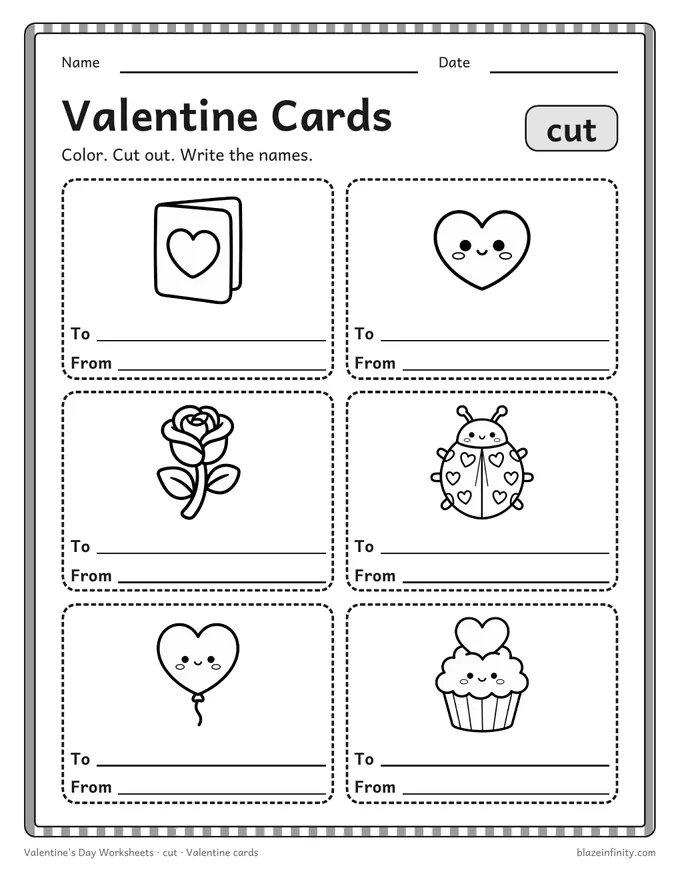
Use that page during the week before for children whose families will not be sending cards, and for your spare stack. Each sheet has six small cards to color, cut out and fill in with who each one is to and from, so four sheets cover a class of 22.
Four Valentine's Day party stations that teach
Split the class into four groups of five or six and rotate every 12 minutes, with a two-minute clean-up between stations. That fills about 55 minutes. If family helpers come in, put one adult at the kindness writing station and one at the heart cut; the other two stations run on their own once you have shown them on the rug.
1. Heart count and graph
Teaches: sorting, counting and comparingYou need: a zip bag of 12 to 18 paper hearts in three sizes per group; a three-column graph; crayons12 minutes
Cut paper hearts in three sizes and write a short kind word on each, such as "pal" or "be kind," so they look like conversation hearts with no candy involved. Children sort their bag into big, medium and small, count each pile, and color one box on the graph for each heart. Then they answer two questions out loud: "Which pile has the most? Which has the fewest?" Sorting objects into groups, counting each group and putting the groups in order by count is a kindergarten measurement and data standard (K.MD.B.3).
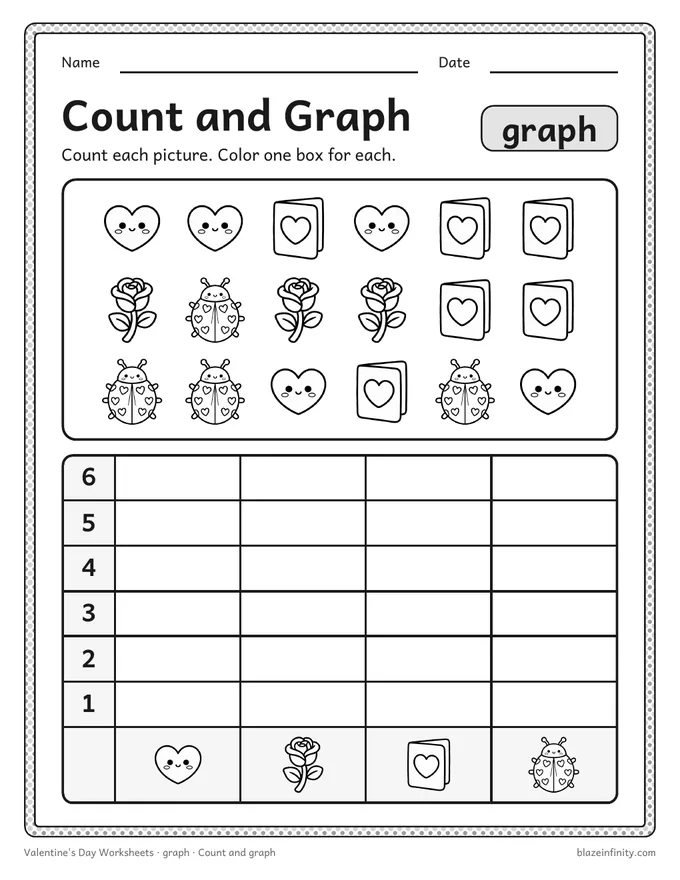
Use that page at the graph station once a group has finished its bag, or the next morning to check who can count and graph on paper without the hearts in front of them.
2. Mailbox sounds
Teaches: beginning soundsYou need: three small paper mailboxes, each with one letter; nine picture cards12 minutes
Label three mailboxes h, m and b. Children take turns picking a picture card, saying the word slowly and posting it in the mailbox for its first sound: heart, hat and house go in h, mail, moon and mitten go in m, and bear, bee and box go in b. When the cards are posted, a child empties one box and the group says each word to check. Avoid pictures like card or candy for this station, since their first sound is /k/ and the letter is c, which is a lesson of its own.
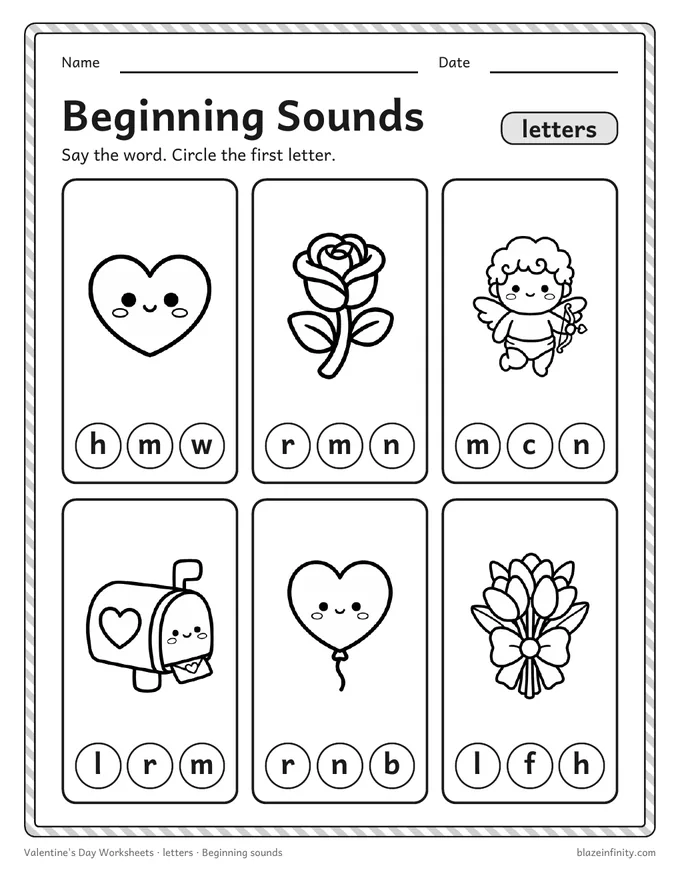
Use that page for children who finish the mailboxes early: they say the name of each picture and circle the letter it starts with, the same job on paper.
3. A kindness note
Teaches: drawing and writing to tell a reader somethingYou need: half sheets with a sentence starter; a cup of name sticks; crayons and pencils12 minutes
Each child pulls a name stick and writes to that classmate. The sentence starter is "You are kind when you ___." Children draw first, then write, using the sounds they hear: "u shr" for "you share" is good kindergarten writing. Children who are not writing words yet tell an adult, who writes their words under the drawing. Finished notes go into a tray and are delivered with the cards, so every child gets at least one note written just for them. Before the station starts, check that every name is in the cup once, and put back any stick a child pulls with their own name.
4. Heart cut
Teaches: folding, cutting and seeing two matching halvesYou need: quarter sheets of copy paper; crayons; scissors12 minutes
Children fold the paper in half and draw a crayon line down the fold. They draw half a heart that starts on the fold line at the top and ends on the fold line at the bottom, then cut along it with the paper still folded. When they open it, ask: "Look at the fold. Is this side the same as that side?" Keep a few sheets with a dotted half heart already drawn for children who need it. Use copy paper, not card stock: folded card stock is too thick for small scissors.
A Valentine's Day read-aloud with real comprehension questions
Pick a picture book about friendship or kindness for morning meeting. Ask the same four questions you would ask after any story, so the day still practices reading comprehension: "Who is in the story? What is the problem? How did it get fixed? Which character was kind, and what did they do?" The last question leads straight into the kindness note station. Our guide to reading comprehension in kindergarten has more questions for before, during and after a read-aloud.
A timed plan for the day
Shift the times to fit your schedule. The order matters more than the clock: cards are sorted in the morning when children are fresh, the stations fill the afternoon, and the bags open at the end.
8:30
Arrival
Cards go into the bin at the door, not into bags. Mailboxes are already taped to chairs. Note who brought no cards and pull spares for them.
8:50
Morning meeting and read-aloud
Read the friendship book and ask the four questions. Say the every-child rule. Explain when the bags will open: "Our mailboxes open at 2:30. Until then, the mail stays inside."
9:20
Literacy block: sort the cards
Children match the names on their cards to the name strip at their table. Sorted stacks go back in the bin, held with a rubber band and the name note. Children with no cards of their own help sort, or make spares from the cut-out cards.
10:00
Math block
Teach your normal math lesson, then show the heart graph on the rug with one bag of hearts so the station runs on its own later.
1:00
Party hour: four stations
Four rotations of 12 minutes with a two-minute clean-up between. Ring a bell or play a short song for each change, and point to the next station before anyone stands up.
2:00
Deliver the mail
One table at a time, about five minutes each. The kindness notes from the tray go out with each table's cards. Children who are waiting color at their seats.
2:30
Open, count and pack
Children open their bags, count their cards and read their kindness note, with an adult reading aloud for anyone who asks. If a bag still looks short, slip in a spare while you help pack, without comment. Fold the tops and put the bags in backpacks.
For families who do not celebrate: a kindness day
Some families do not mark Valentine's Day for religious, cultural or personal reasons. The letter home invites families to tell you privately. When one does, ask what they are comfortable with rather than guessing. A child should never have to explain at school why they are not taking part.
The stations already work without the holiday. Call the afternoon kindness day and change only the words: the hearts at the graph station can be stars or circles, the kindness note stays exactly as it is, and the heart cut can be a folded butterfly. A child who does not exchange cards can write kindness notes to the people who keep the school running, such as the custodian, the nurse or the office staff, and deliver them with an adult. Some families are happy for their child to receive cards but not send them. Others would rather their child gets no cards at all. Ask, then follow what they say.
No candy, and food allergies
The CDC's guidance for schools is plain: avoiding the food is the only way to prevent an allergic reaction. A card taped to a candy, or a treat handed out at the party, means someone has to check every label in the room. The simple rule is cards only, with nothing attached, and it goes in the letter home two weeks before. If a family sends something anyway, set it aside, send it home unopened, and send the card on. If families want to add something, a sticker is the easy choice. Follow your school's own food allergy plan for anything to do with food, and check with the nurse before any food reaches the room.
Valentine's Day activities for first grade
The day keeps the same shape. The tasks ask for more reading, more writing and harder questions.
- Cards: children write both names on every card themselves. At the sorting step, they put their stack in ABC order by first name before delivering, for alphabetizing practice.
- Heart graph: after sorting by size, children answer "how many more" and "how many fewer" questions and write a number sentence, such as 7 − 4 = 3.
- Mailbox sounds: use ending sounds, or blends at the start of a word such as fr in friend and gl in glue.
- Kindness note: two or three sentences with a reason: "You are kind when you share your crayons. It makes me happy because I forget mine."
- Heart cut: children cut a heart, fold it to check if the sides match, and then cut a second shape of their choice that has two matching halves.
- Counting the cards: children count their cards by making piles of ten.
First graders who finish a station early need something better than waiting; our list of early finisher activities for first grade has tasks that keep them learning without new prep.
What to print, and when
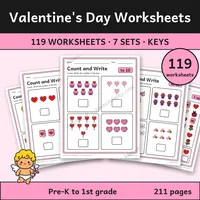
Print the cut-out cards two weeks before, so children whose families do not send cards can make theirs during the week. Print the graph and beginning sounds pages the day before, along with the Cupid maze or the heart color by number page for anyone who finishes early. All of those are on our free worksheets page. The Valentine's Day Worksheets set has more than 100 pages for Pre-K to first grade: counting, ten frames, skip counting, adding and taking away, beginning sounds, mazes, word searches, color by number, valentine cards to cut out and coloring pages, with answer keys and a black-and-white edition. For many schools the 100th day of school lands in late January or February, so if yours is close, these 100th day of school activities are ready to go.
What the research says
- Kindergartners are to classify objects into given categories, count the number of objects in each category and sort the categories by count. [1]
- Each of the kindergarten writing standards W.K.1, W.K.2 and W.K.3 begins with "Use a combination of drawing, dictating, and writing". [2]
- Recognizing a line of symmetry and identifying line-symmetric figures is a fourth grade geometry standard, not a kindergarten one. [3]
- Schools should develop plans for food allergies, and strict avoidance of the food allergen is the only way to prevent a reaction. [4]
Sources
- Common Core State Standards for Mathematics, Kindergarten, Measurement and Data, K.MD.B.3.
- Common Core State Standards for English Language Arts, Writing, Kindergarten, W.K.1 to W.K.3.
- Common Core State Standards for Mathematics, Grade 4, Geometry, 4.G.A.3.
- Centers for Disease Control and Prevention, Food Allergies in Schools.
Common questions
- How do you do a Valentine's Day card exchange in kindergarten?
- Send a class list home two weeks before with the rule that a child who brings cards brings one for everyone. On the day, collect the cards at the door, have children sort them by matching names to a name strip with photos, and deliver one table at a time.
- What if a child does not bring any Valentine cards?
- Have them make cards at school from cut-out card sheets during the week before, and keep a spare stack. Check every bag before it goes home and add spares where a child has fewer than the rest.
- What Valentine's Day activities still teach skills?
- Sorting, counting and graphing paper hearts, posting picture cards in mailboxes by beginning sound, writing a kindness note to a classmate, and folding and cutting a heart to see two matching halves. Matching the names on cards to a class list is a reading task too.
- How do I include children whose families do not celebrate Valentine's Day?
- Ask the family privately what they are comfortable with, and run the afternoon as a kindness day. A child who does not exchange cards can write kindness notes to school staff instead.
- Can we have a Valentine's Day party without candy?
- Yes. Ask families for cards only, with nothing attached, and use paper hearts at the counting station. Every station in this plan uses paper, crayons and scissors.
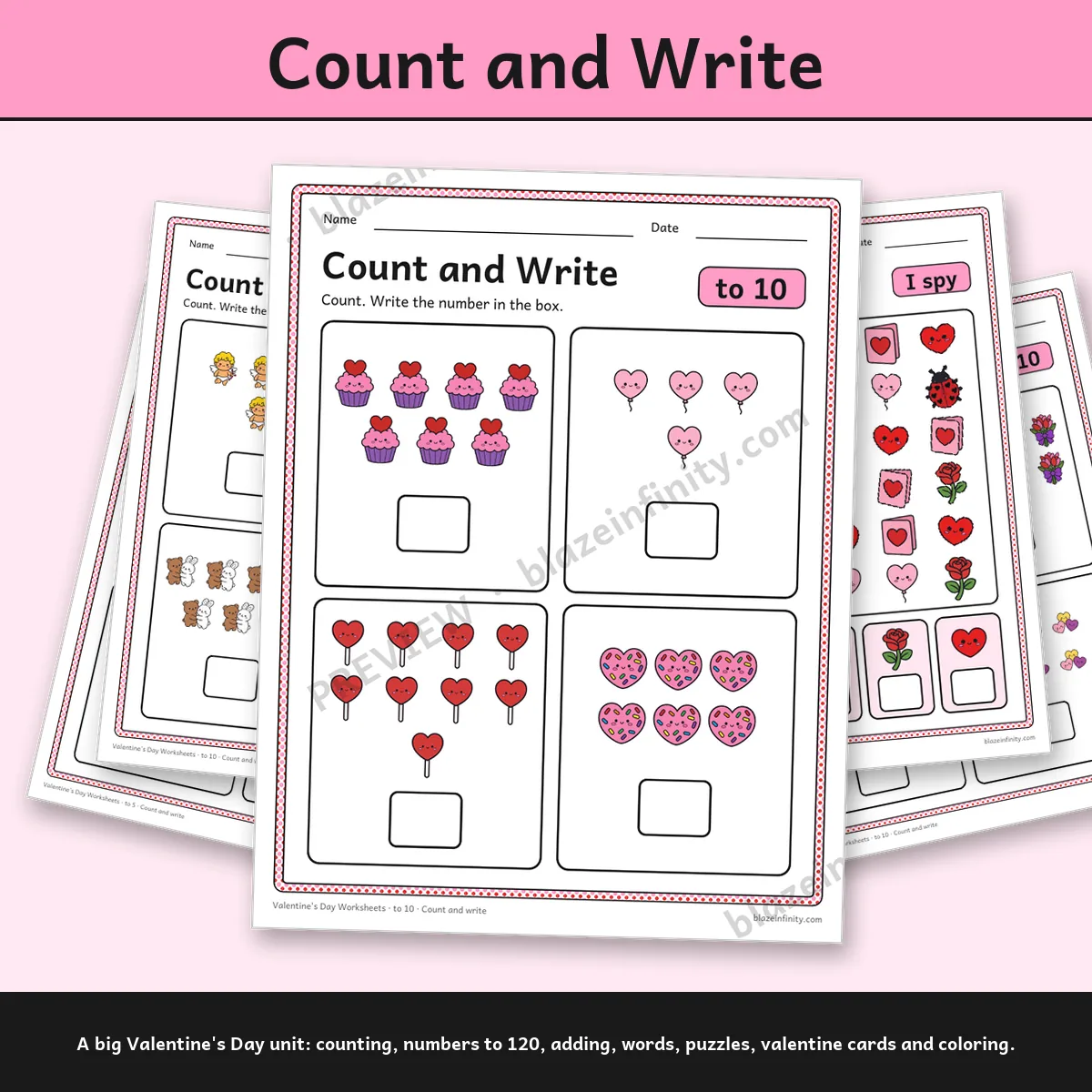
The full set for this skill
Valentine's Day Worksheets
119 Valentine's Day worksheets for Pre-K to 1st grade in seven sets: counting and ten frames, numbers to 120, adding and taking away within 10, Valentine words and beginning sounds, patterns and line tracing, mazes, word searches and codes, and coloring pages with valentine cards to cut out and writing pages.
- 24 counting pages: count and write, count and color, graphs, I spy and ten frames to 20
- 13 number pages: counting to 120, skip counting by 2s, 5s and 10s, tens and ones, number charts and measuring
- 21 adding and taking away pages: pictures, number bonds, number lines, facts and story problems within 10
- 6 word pages: beginning sounds, trace and write, read and match
- 10 pattern, line tracing and cut-and-paste pages