










Fact Families in First Grade: What They Are and How to Teach
What a fact family is, why it turns subtraction into addition, a five-step lesson from cubes to written facts, three quick checks and the usual mistakes.
In short
- A fact family is a whole, its two parts and the four facts they make. A double has only two facts.
- Fact families make subtraction a missing part: 9 − 6 is the same question as 6 and what make 9.
- Build each family with cubes, turn it around and break off a part before writing anything.
- Check the addition fact first, and make the whole come first in every subtraction fact.
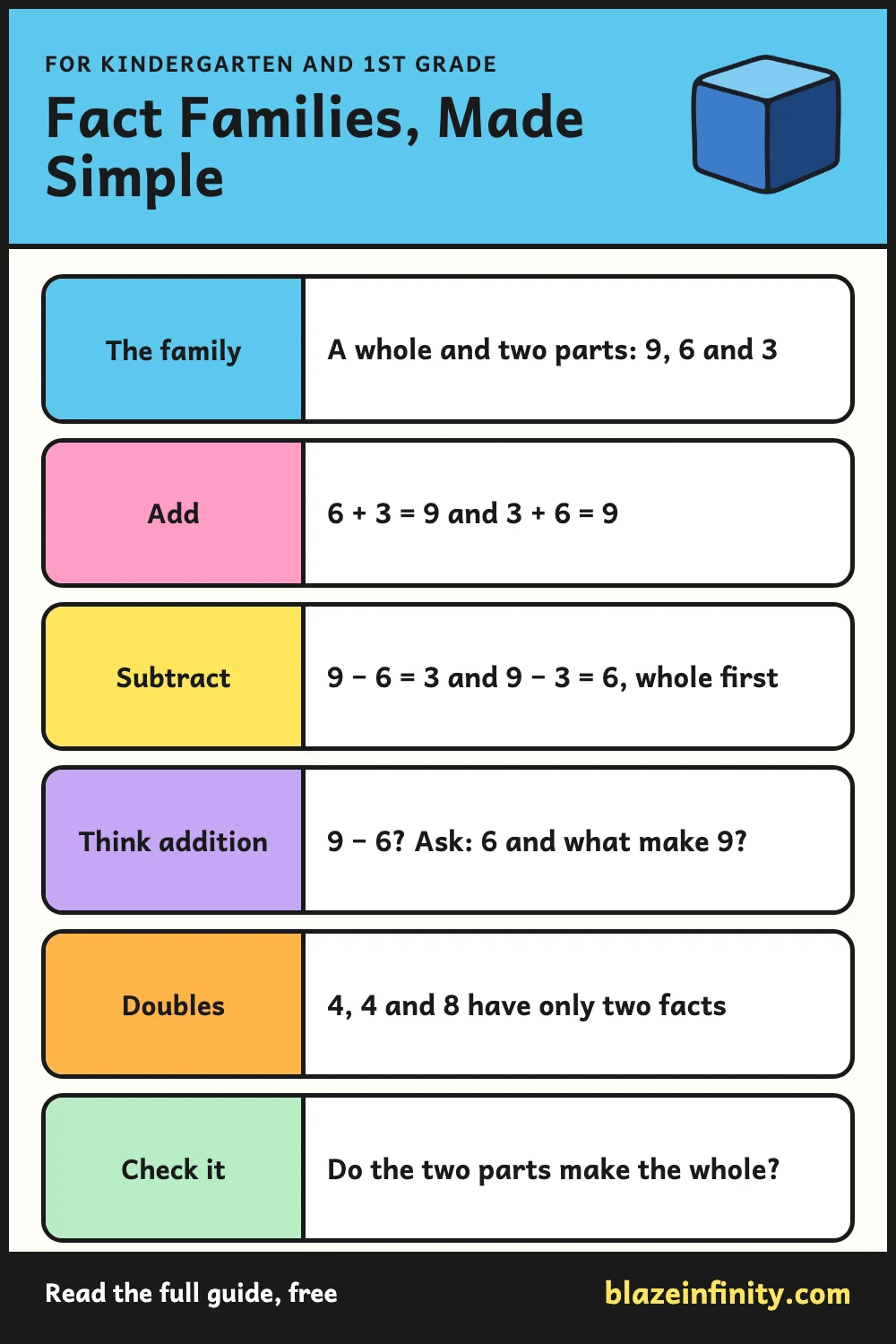
A fact family page is easy to fill in by copying the pattern. The point of a fact family is something else: it is how a child who knows 6 + 3 = 9 stops counting to find 9 − 6. Here are the questions teachers and parents ask most, in order, each with a picture.
What is a fact family?
A fact family is three numbers that belong together, a whole and its two parts, and the four number sentences they make: two addition facts and two subtraction facts. For 9, 6 and 3 the family is 6 + 3 = 9, 3 + 6 = 9, 9 − 6 = 3 and 9 − 3 = 6. In the addition facts the whole is the answer. In the subtraction facts the whole comes first. No other number can join the family, and no number can leave it.
6 + 3 = 9
3 + 6 = 9
9 − 6 = 3
9 − 3 = 6
The fact family triangle is the same three numbers as a number bond, in a new shape. For the bond itself, see how to teach number bonds.
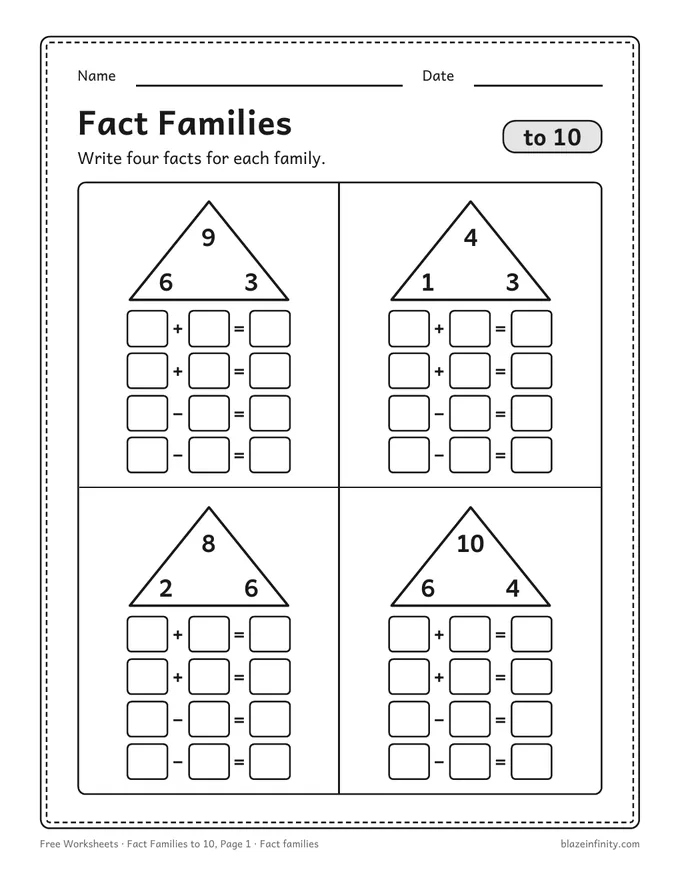
Why do fact families matter?
Because they turn a subtraction fact into an addition fact the child already knows. The Common Core standard for first grade says it plainly: children should “understand subtraction as an unknown-addend problem” (1.OA.B.4). Its own example is to subtract 10 − 8 by finding the number that makes 10 when added to 8.
So 9 − 6 = ? is the same question as 6 + ? = 9. A child who counts back six steps from 9 has a lot of room to slip. A child who thinks “6 and what make 9?” and knows the family answers 3 without counting at all. Teachers call this the think addition strategy, and fact families are where it comes from.
Read it aloud as “nine is the same as something and six.” The child can see that the missing amount is a part, so it must be smaller than 9.
Other ways to subtract, and when each one fits, are in our guide to first grade subtraction strategies.
How do you teach fact families? Five steps, from cubes to the page
Teach one family per lesson. You need snap cubes in two colors for each child and a whiteboard. As a suggestion, plan for about fifteen minutes. The example family is 9, 6 and 3.
- 1
Build the whole from two parts
Each child snaps 6 red cubes and 3 blue cubes into one train. Ask: “How many red? How many blue? How many in the whole train?” Write 6 + 3 = 9. - 2
Turn it around
The child turns the train end to end, so blue comes first. Ask: “Did we add any cubes? Did we lose any?” Write 3 + 6 = 9 under the first fact. Some classes call this the turn-around fact. - 3
Break off a part
The child snaps off the 3 blue cubes and holds them up. Say: “We had 9. We took away 3. How many are still in the train?” Write 9 − 3 = 6. Snap them back, then break off the 6 red: 9 − 6 = 3. - 4
Draw the triangle
Draw a triangle with the whole at the top and the two parts in the bottom corners. Point to each fact you wrote and ask the child to find its three numbers in the triangle. The cubes stay on the table while they look. - 5
Cover a corner
Put the cubes away. Cover the 3 with a sticky note and ask what is hiding and how they know. Then cover the 9. A child who can tell you “6 and 3 make 9” with no cubes in sight is ready for the page.
Step five is the one that builds think addition, so keep it when time is short.
Families of 10 make a good first set, because a ten frame shows both parts at once. On the page below, each ten frame is part filled and the child draws the missing dots to make 10. Ask for the family after each one: 7 + 3 = 10, 3 + 7 = 10, 10 − 7 = 3, 10 − 3 = 7. The frame with 5 dots is a double, so its family has only two facts.

Try it: three quick checks
Answer each one in your head, then open it. Each tests a different part of the idea.
Are 3, 5 and 7 a fact family? (tap to check)
No. The two smaller numbers must make the bigger one, and 3 + 5 makes 8, not 7. Any three numbers fit in a triangle, so children should check the addition fact first, every time.
Write the fact family for 6, 6 and 12. How many facts are there? (tap to check)
Two: 6 + 6 = 12 and 12 − 6 = 6. When both parts are the same, turning the addition around gives the same fact again, and taking away either part gives the same fact too. Two facts is the right answer for a double.
A child knows 8 + 6 = 14 but is stuck on 14 − 8. What do you ask? (tap to check)
“8 and what make 14?” The answer is 6, from the fact they already have. Do not ask them to count back eight steps.
What mistakes do children make with fact families?
Most come from filling in the pattern without asking which number is the whole.
If you see
Writes four facts for a double, such as 4 + 4 = 8 twice and 8 − 4 = 4 twice
The child believes every family has four facts and is filling the four lines.
Try this
If you see
Subtracts the whole from a part, such as 6 − 9 = 3
The child copied the order of the addition facts. To them the numbers can go in any order, as they can when adding.
Try this
If you see
Adds the whole and a part, such as 9 + 3 = 12 inside the 9, 6, 3 family
The child sees three numbers and adds any two. The whole is not yet the biggest number to them.
Try this
If you see
Calls any three numbers a family
The child is matching the shape of the page, not checking the numbers.
Try this
If you see
Fills in every family but still counts back to find 9 − 6
The family is a writing pattern for this child, not a tool. The two have not been joined.
Try this
When are children ready for fact families to 20?
When families within 10 come quickly and the child can find a hidden corner without cubes. The idea is the same with bigger numbers: 14, 8 and 6 make 8 + 6 = 14, 6 + 8 = 14, 14 − 8 = 6 and 14 − 6 = 8. The parts are harder to see at a glance, so go back to cubes or two ten frames for the first few.
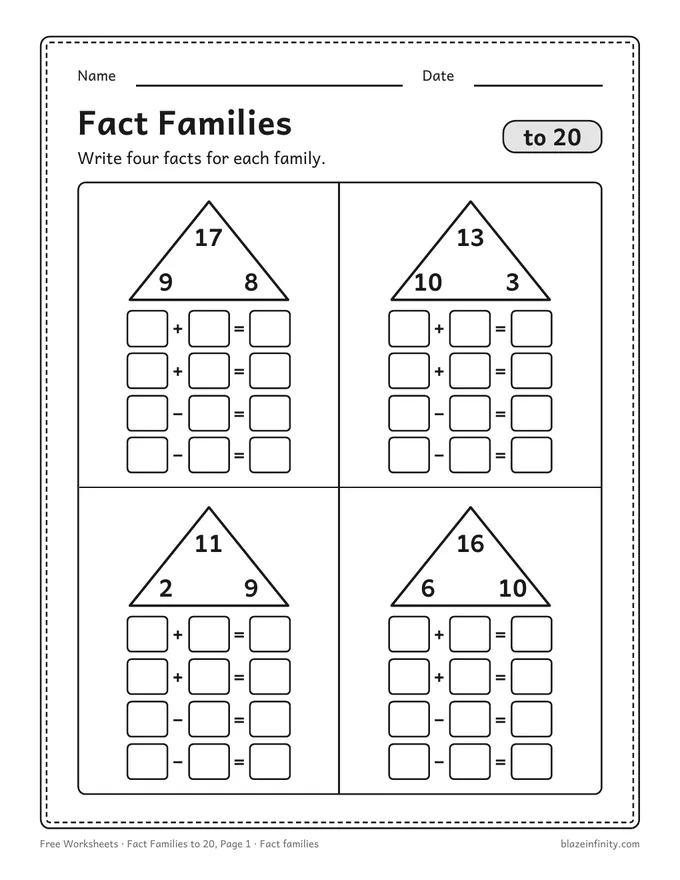
Start with families children already half know: doubles (7, 7 and 14), then ten and some more (13, 10 and 3), then the rest. The page below has four triangles with wholes from 11 to 20, such as 9, 8 and 17. None of them is a double, so each has two addition and two subtraction facts to write.
A number line is a good check when the part taken away is small. For 14 − 3, stand on 14, hop back 3 and land on 11, the same answer the family 3, 11 and 14 gives. The page below keeps the hops short: six take-away problems within 20, each taking away 1 to 5, over its own 0 to 20 number line.

When the part is big, as in 14 − 8, eight hops back is slow and easy to miscount. That is the moment to ask “8 and what make 14?” instead, and it is often when a child starts using the family on their own. If blanks in other places, such as _ + 6 = 14, still cause trouble, see how to teach missing addends.
Where to go next
Make the triangle a habit, not a unit: when an addition fact comes up in any lesson, sketch its triangle on the board and cover one corner. More free pages are on our fact family worksheets page. For the whole first grade year in one place, 1st Grade Math Worksheets covers adding and taking away within 10 and then 20, with number lines, number bonds and ten frames, and answer keys.
What the research says
- First graders are to understand subtraction as an unknown-addend problem, for example subtracting 10 − 8 by finding the number that makes 10 when added to 8. [1]
- 1.OA.C.6 lists using the relationship between addition and subtraction as a strategy (knowing that 8 + 4 = 12, one knows 12 − 8 = 4). The phrase “fact family” does not appear in the first grade Operations and Algebraic Thinking standards. [2]
- Fact families involving doubles facts consist of only two facts (7 + 7 = 14, 14 − 7 = 7). [3]
Sources
- Common Core State Standards for Mathematics, Grade 1, Operations and Algebraic Thinking, 1.OA.B.4. National Governors Association Center for Best Practices and Council of Chief State School Officers, 2010.
- Common Core State Standards for Mathematics, Grade 1, Operations and Algebraic Thinking, 1.OA.C.6.
- Everyday Mathematics (University of Chicago), Grade 2 vocabulary: fact family.
Common questions
- What is a fact family in 1st grade math?
- A fact family is three numbers, a whole and two parts, and the four number sentences they make. For 9, 6 and 3 they are 6 + 3 = 9, 3 + 6 = 9, 9 − 6 = 3 and 9 − 3 = 6.
- How many facts are in a fact family?
- Most have four: two addition facts and two subtraction facts. A family made from a double, such as 4, 4 and 8, has only two, because turning the addition around gives the same fact.
- How do you explain fact families to a child?
- Snap two colors of cubes into one train and say the addition fact. Turn the train around for the second fact, then break off each color in turn for the two subtraction facts. The child sees that the same cubes make all four.
- What is the think addition strategy for subtraction?
- The child turns a subtraction into a missing part. For 9 − 6 they ask, “6 and what make 9?” and use the addition fact they know. The first grade Common Core standard calls this understanding subtraction as an unknown-addend problem.
- What grade learns fact families?
- In most US classrooms fact families are taught in first grade, within 10 and then within 20. The standards do not use the words “fact family”; they ask children to use the relationship between addition and subtraction.
The full set for this skill
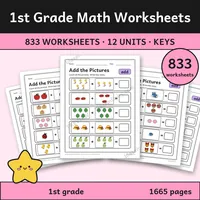
1st Grade Math Worksheets
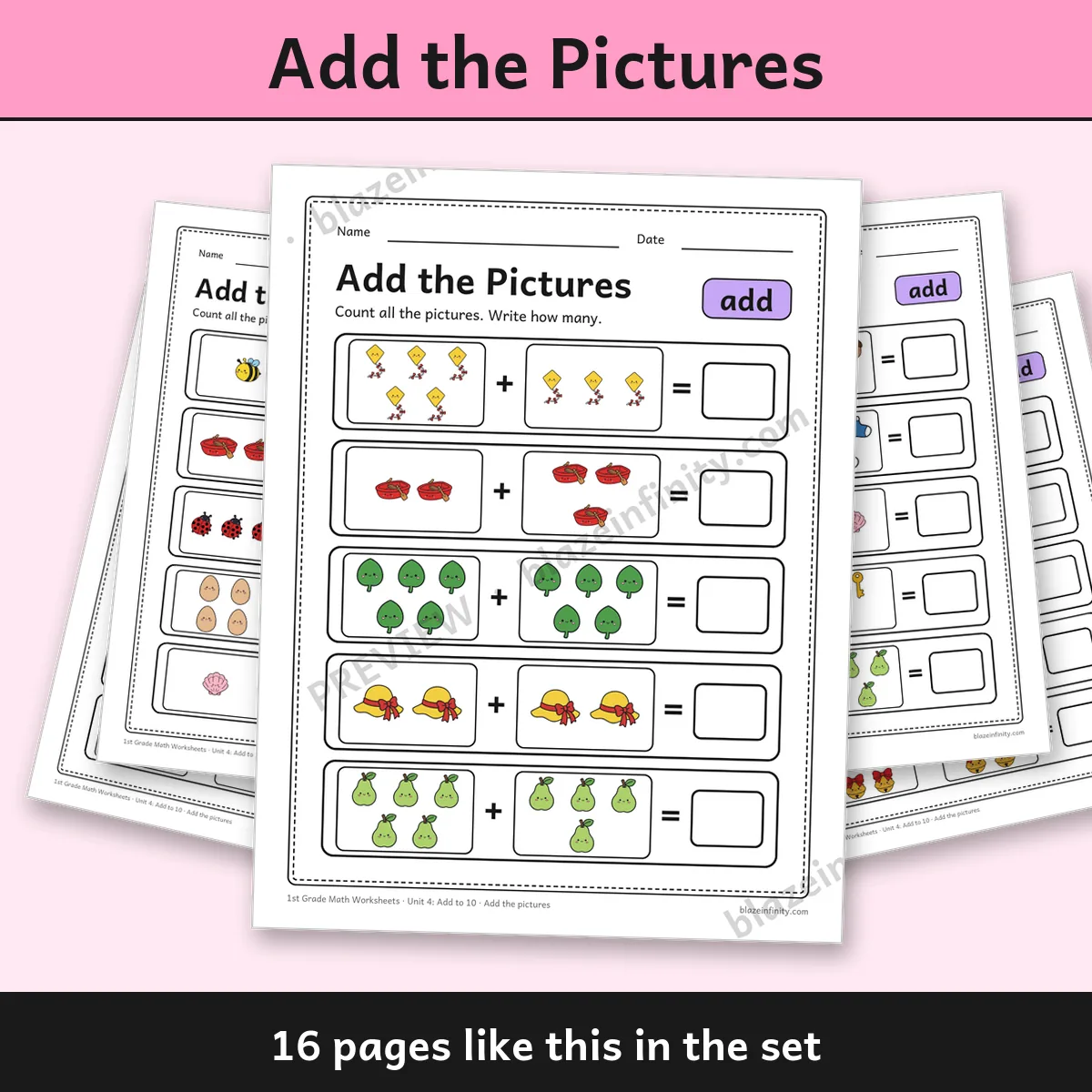
833 worksheets in twelve units. Every unit goes in steps: pictures first, then a model (ten frame, number line, number bond, blocks), then the numbers on their own. An answer key follows every page that can be marked.
- 833 worksheets in 12 units
- An answer key after every page that can be marked
- Adding and taking away within 10, then within 20
- Number lines, number bonds, ten frames and tens-and-ones blocks
- Telling time to the hour and the half hour