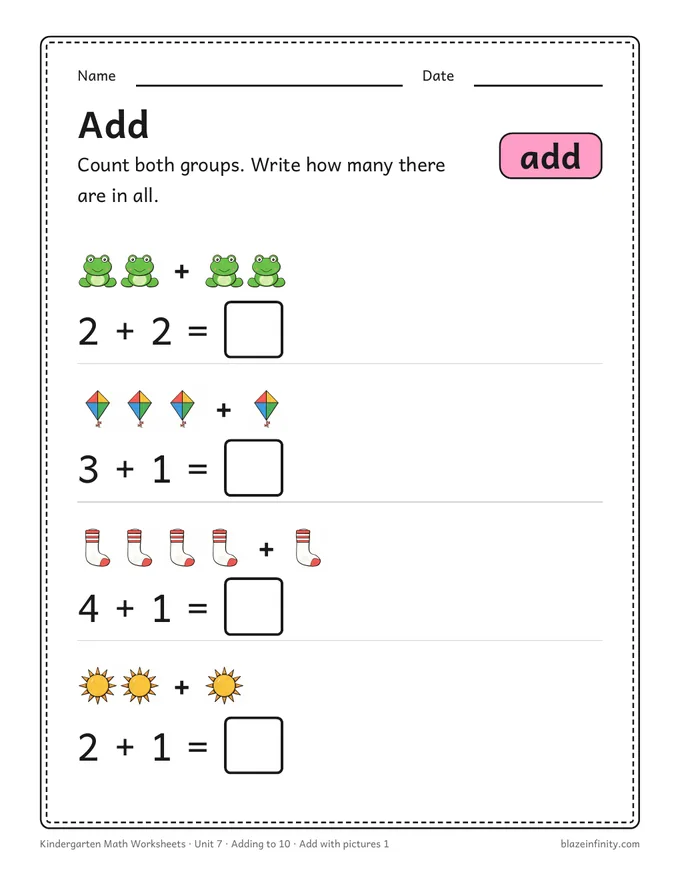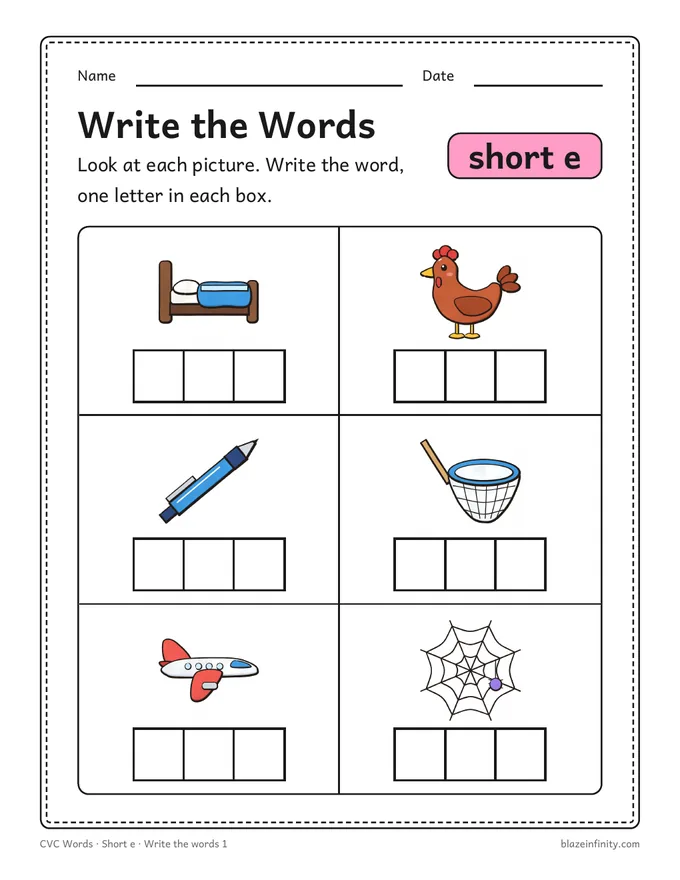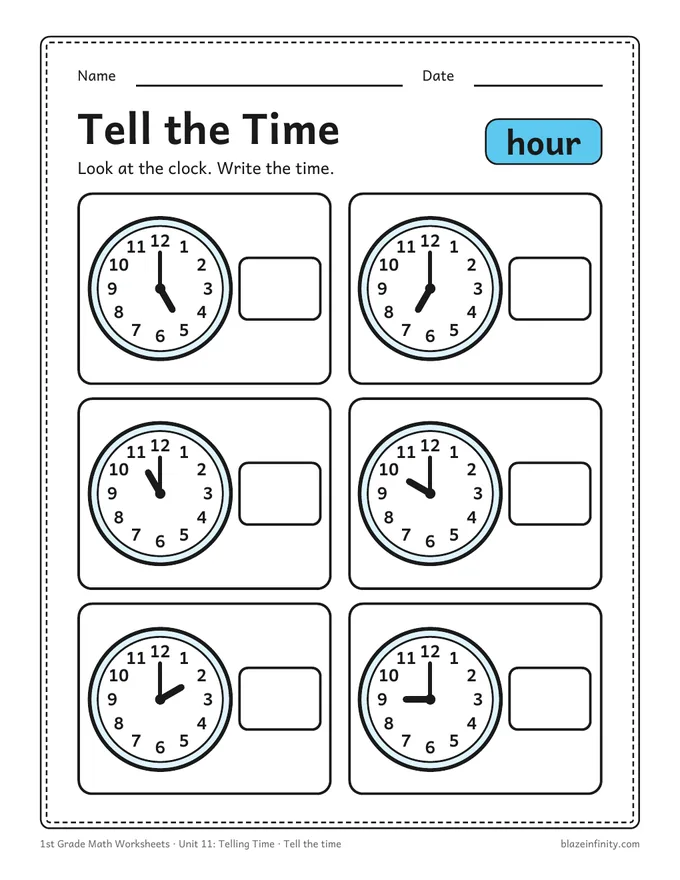





How to Teach Number Bonds in First Grade, Step by Step
A six-step number bond lesson with the exact words to say, the order to teach the numbers in, fixes for common mistakes and a five-minute daily routine.
In short
- Teach every bond three ways, in order: counters in two groups, a two-color ten frame, then the diagram.
- Start with bonds of 5 and 10, then 6 to 9 as five and some more, then teen numbers as ten and some more.
- Hide one part every day. Finding the hidden part is what turns a number bond into subtraction.
Your first graders can fill in the circles on a number bond page. Then you ask “What is 7 take away 5?” and they start counting on their fingers from one. The page got done, but the bond did not stick. That almost always means the child met the diagram before they met the objects.
The fix is to teach every bond three times: with things the child can move, with a picture, and only then with numbers in circles. Below is a six-step lesson with the words to say, the order to teach the numbers in, and what to do when it goes wrong.
What is a number bond in 1st grade math?
A number bond shows one number, the whole, split into two parts. Seven can be 5 and 2. It can also be 6 and 1, or 4 and 3. It is the same seven each time.
Why are number bonds important? A child who knows that 7 is 5 and 2 has four facts for the price of one: 5 + 2, 2 + 5, 7 - 5 and 7 - 2. They stop counting every problem from one and start using what they already know.
Here is the same bond, 7 = 5 + 2, shown three ways. Teach them in this order.
1. Counters in two groups
Seven counters on the table. The child slides five to one side and two to the other.
2. A ten frame in two colors
Five red counters fill the top row. Two yellow ones start the bottom row. The child can see seven, see the five inside it, and see the two that are left over. If ten frames are new to your class, start with what a ten frame is and how to use one.
3. The bond diagram
The whole goes in the top circle. A line runs down to each part.
Most trouble with number bonds starts when a child is handed the third picture without the first two.
Which numbers to teach first
Do not teach bonds in counting order. Five and ten come first because the ten frame, and a child's own hands, are built on them.
| Whole | When | Why this order |
|---|---|---|
| 5 | Kindergarten | Small enough to see without counting. One hand shows every bond of 5. |
| 10 | Kindergarten, then again at the start of first grade | The bonds everything else leans on: 9 and 1, 8 and 2, 7 and 3, 6 and 4, 5 and 5. |
| 6, 7, 8, 9 | First grade | Teach each as “five and some more” first (7 is 5 and 2), then find its other bonds. |
| 11 to 19 | First grade | Each teen number is ten and some more: 13 is 10 and 3. |
| 20 | First grade, last | The bonds of 10 again, one ten bigger: 7 and 3 make 10, so 17 and 3 make 20. |
At what age do children learn number bonds? It is easier to answer by grade. In most US classrooms, kindergarten works on bonds of 5 and then 10, and first grade secures 10 and moves on to 20.
How to teach number bonds to kindergarten
Stay with objects and pictures for longer and keep the wholes small. Hold up five fingers, fold some down, and ask how many are up and how many are down. Skip the diagram until the child can tell you a bond out loud.
How to teach number bonds to 20
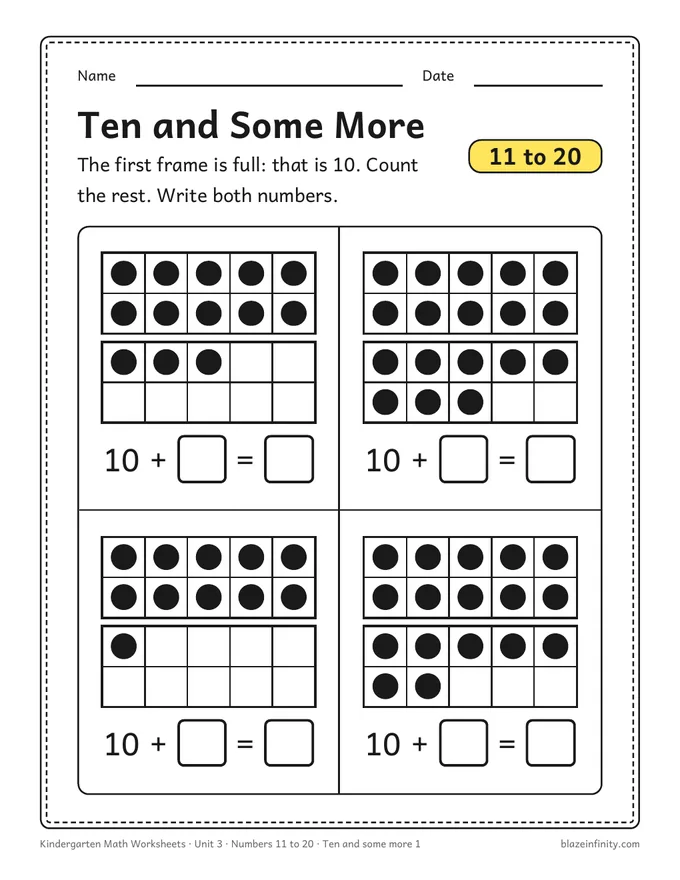
Start with the teen numbers on two ten frames. The first frame is full, and that is ten. The second frame holds the rest. Once a child sees 13 as 10 and 3, they are ready to add by making ten, which is one of the first grade addition strategies that depends on bonds.
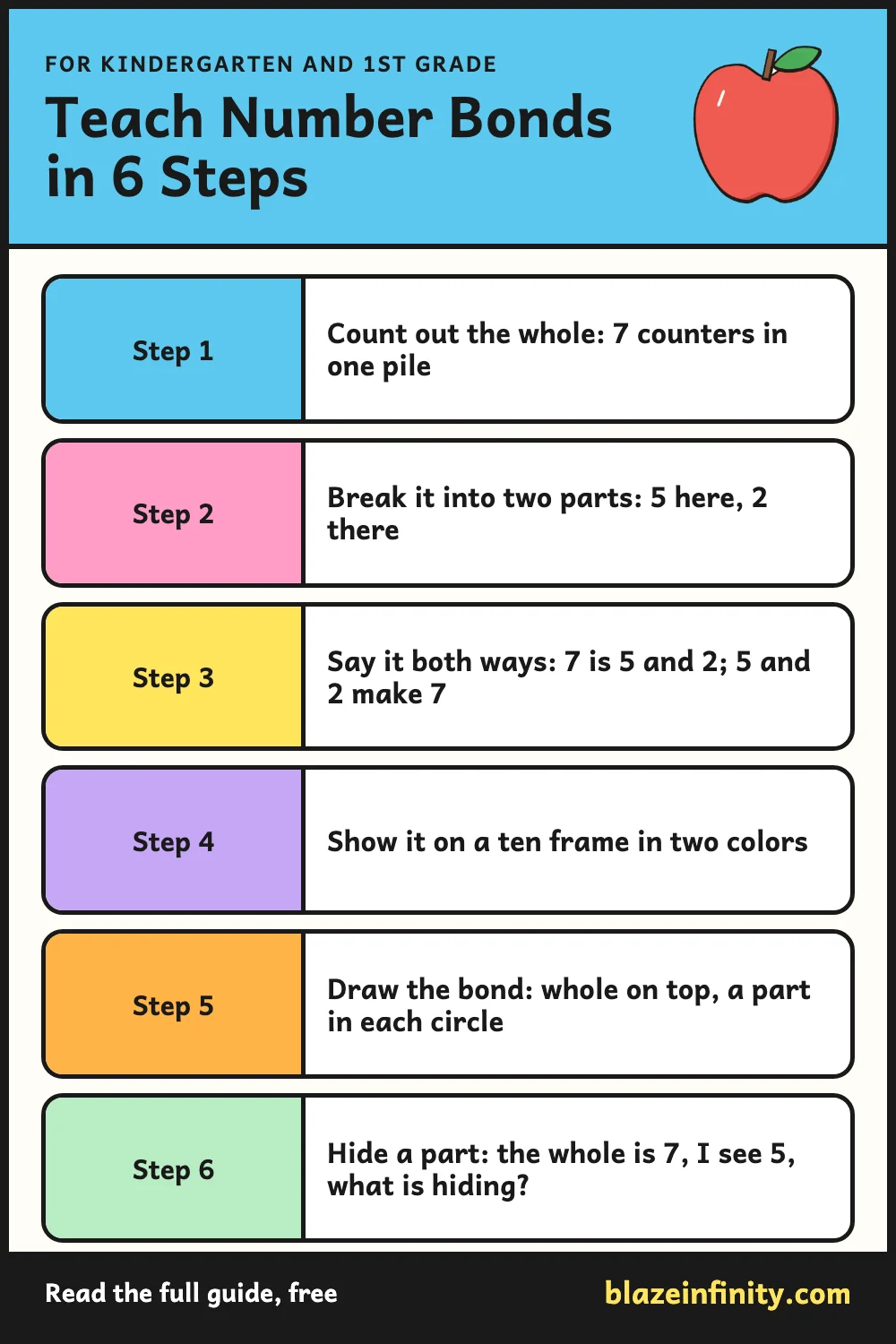
The six-step number bond lesson
This is one lesson for one whole. It takes about fifteen minutes. The example uses 7. You need seven counters for each child, a blank ten frame and a whiteboard.
- 1
Count out the whole
Each child counts seven counters into one pile. Say: “This is our whole. How many? Seven. The whole stays seven all lesson.” - 2
Break it into two parts
The child slides some counters away to make two groups. Say: “You made two parts. How many here? How many there? Did we lose any? So 5 and 2 is still 7.” - 3
Say it both ways
Push the groups together and apart again. Say: “Say it with me. Seven is five and two. Five and two make seven.” Then let the child find a different split and say that one. - 4
Show it on a ten frame
Put the same counters on the frame in two colors. Say: “Red is one part. Yellow is the other part. Point to the whole.” The child should sweep a finger over all seven. - 5
Draw the bond
Draw three circles and two lines. Say: “The whole goes on top. Each part gets its own circle. Where does the 7 go? Where do 5 and 2 go?” The child writes the numbers while the counters are still on the table. - 6
Hide a part
Cover one group with your hand. Say: “The whole is 7. You can see 5. How many are hiding?” Then erase the same part from the bond and have the child write it back in.
Step six is the one that turns a bond into subtraction, so do not skip it when time is short. Skip step five instead and draw the bond tomorrow.
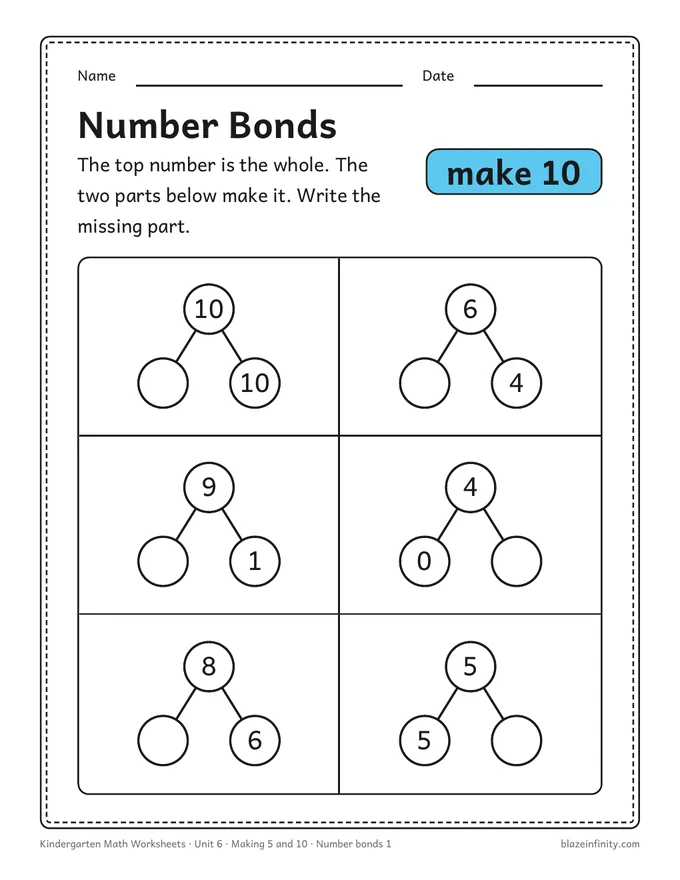
Check yourself: what did this child do?
A bond has 8 in the top circle and 3 in one of the circles below. The other circle is empty. The child writes 11 in it.
What was the child thinking, and what would you do next? (tap to check)
The child saw two numbers and added them: 8 + 3 = 11. They are treating the bond as an addition problem, not as a whole and its parts. Do not explain the diagram again. Go back to counters: count out 8, slide 3 away, and ask how many are in the other group. Then ask, “Can a part be bigger than the whole?”
When it goes wrong: three mistakes and their fixes
If you see
The child adds the whole to a part
They see two numbers and add. The top circle is not the whole to them yet.
Try this
If you see
The child is thrown when the diagram is turned
They learned “top is the answer” in place of “the whole is where the two lines meet”.
Try this
If you see
The child can fill in a bond but cannot use it to subtract
The bond and the take-away problem live in two different boxes in their head.
Try this
Are number bonds and fact families the same?
No, but they hold the same three numbers. A number bond is the picture: one whole and two parts. A fact family is the set of four number sentences you can write from that picture.
Take the bond with 7 as the whole and 5 and 2 as the parts. Its fact family is:
- 5 + 2 = 7 and 2 + 5 = 7 (parts first, whole last)
- 7 - 5 = 2 and 7 - 2 = 5 (whole first, take one part, the other part is left)
Teach the bond first. When a child can fill in a bond with any one number missing, ask them to write the two addition sentences, then the two subtraction sentences. In a subtraction sentence the whole always comes first. That one rule stops most wrong fact families, such as 5 - 7 = 2.
A five-minute daily routine
One lesson introduces a whole. A short daily routine is what makes the bonds automatic. Use the same whole for a week.
Minute 1
Show me
Say a part. Children show the other part on their fingers. “Our whole is 10. I say 6, you show...”Minutes 2 and 3
Hide and tell
Partners share ten counters. One hides some under a cup. The other looks at what is left and says how many are hiding.Minute 4
Turned bond
Draw one bond on the board with the whole in a new place and one number missing. Everyone writes the missing number on a whiteboard.Minute 5
Flip it
Point to the bond and ask for one subtraction sentence from it. Children say it aloud, whole first.
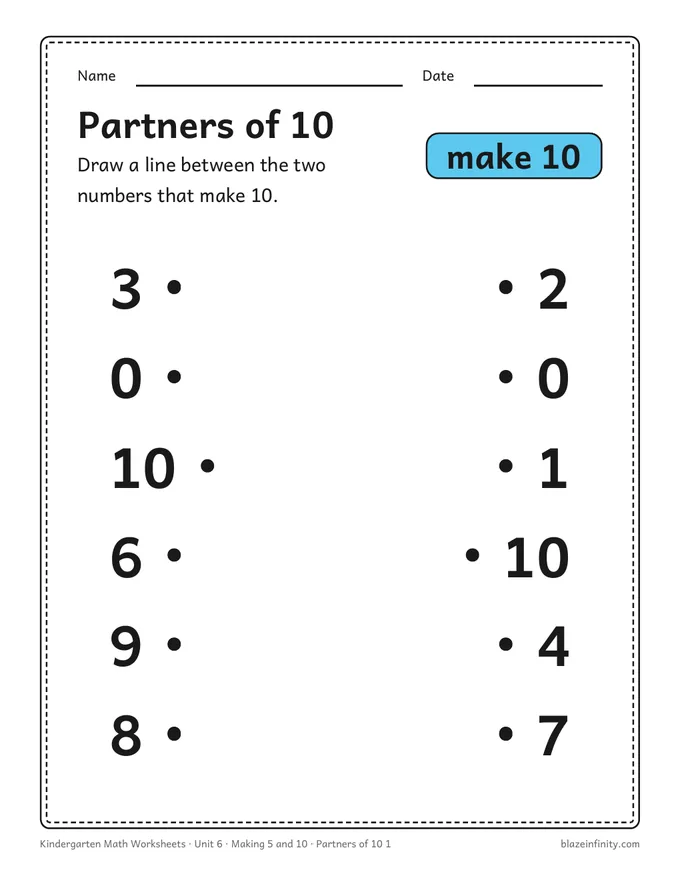
Number bonds at the kitchen table
You do not need counters or a ten frame at home. You need ten small things: dry pasta, grapes, coins or building bricks.
- Two plates. Put seven grapes on the table and two plates beside them. Your child shares the grapes between the plates and tells you: “Seven is four and three.” Then ask for a different way.
- Hidden in my hand. Count out seven coins together. Put your hands behind your back and bring out one hand with some coins showing. “How many are in my other hand?”
- Egg carton. Cut an egg carton down to two rows of five. It is a ten frame. Fill it with two kinds of pasta and ask how many of each, and how many in all.
Three or four minutes while dinner cooks is enough. If your child counts every item from one each time, the number is too big for now. Drop to five and build back up.
Where to go next
When bonds to 10 are quick, use them. Missing-part bonds are the bridge to subtraction, and “ten and some more” is the bridge to adding within 20. For children who still need objects, our math mats give counting, ten frame, adding and taking away practice with numbers 0 to 20.
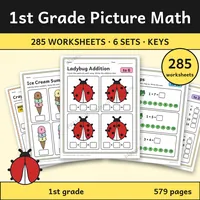
For more pages of exactly this, 1st Grade Picture Math has apple tree number bond pages and fact family pages, each with an answer key.
What the research says
- Subtraction facts are easier to master when children see them as missing-addend problems (8 + ? = 13), because each addition fact they know gives them a subtraction fact. [1]
Sources
- Baroody, A. J. (2006). Why children have difficulties mastering the basic number combinations and how to help them. Teaching Children Mathematics, 13(1), 22-31.
Common questions
- What is a number bond in 1st grade math?
- A number bond shows a whole number split into two parts, such as 7 as 5 and 2. It is usually drawn as three circles: the whole in one, and a line to each of the two parts.
- At what age do children learn number bonds?
- It is easier to go by grade. In most US classrooms, kindergarten works on number bonds of 5 and then 10, and first grade secures bonds to 10 and moves on to 20.
- Are number bonds and fact families the same?
- No. A number bond is the picture of one whole and two parts. A fact family is the four number sentences that come from it: for 7, 5 and 2 they are 5 + 2 = 7, 2 + 5 = 7, 7 - 5 = 2 and 7 - 2 = 5.
- How do you explain number bonds to a child?
- Say that a number bond is a number and the two smaller numbers hiding inside it. Show it with objects first: count out seven, slide them into two groups, and say "seven is five and two".
- Why are number bonds important?
- A child who knows one bond knows two addition facts and two subtraction facts. Bonds of 10 are also what children use to add and subtract within 20 by making ten.
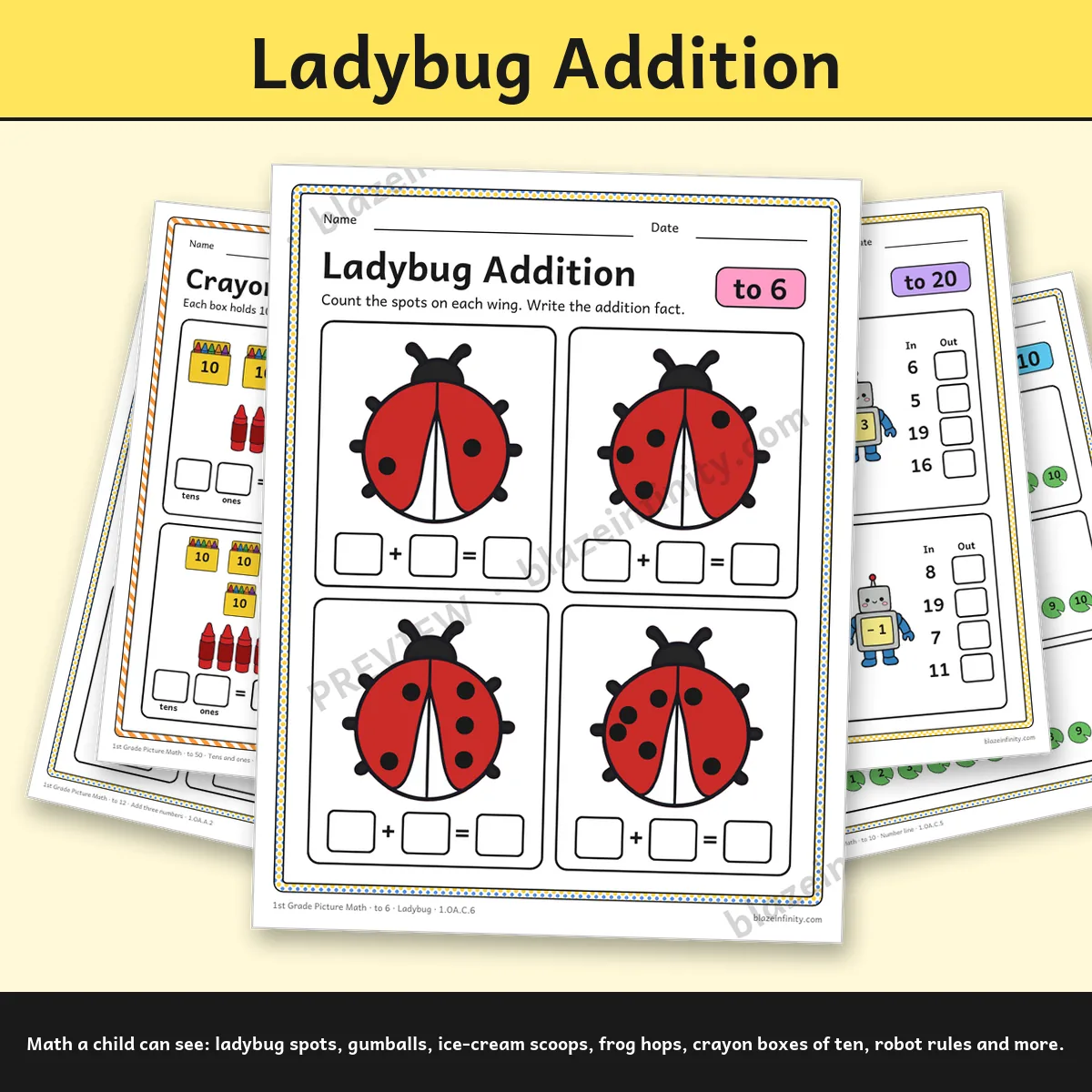
The full set for this skill
1st Grade Picture Math
285 first grade math worksheets in six sets. On every page a picture carries the math: the child counts the spots, the gumballs or the cookies, hops along the lily pads or balances the scale, and writes the number sentence beside it. An answer key follows every page.
- 285 worksheets in 6 sets, each with its own border
- An answer key after every page
- 77 adding pages: ladybug spots, gumballs, ice-cream sums with three numbers, dominoes, ten frames and frog hops on a number line
- 64 taking away and number bond pages: cookie jars, fish bowls, apple tree bonds, fact families, frog hops back and ten frames
- 42 counting pages: gumballs to 20, caterpillars that count on, back and by 2s, 5s and 10s, number trains to 120