







How to Teach Missing Addends in First Grade: 6 Fixes
Six missing addend mistakes first graders make, what each one tells you, and the picture and the sentence that fix it. Starts with a 3-question check.
In short
- A child who answers 7 + _ = 10 with 17 does not yet see 10 as the total. Show the total first.
- Teach the forms in order: blank at the end, in the middle, first, then the total on the left.
- Every missing addend is a subtraction fact: 8 + _ = 13 and 13 − 8 = _ ask for the same number.
You write 7 + _ = 10 on the board. Half the class writes 17. You explain it again, they nod, and the next day they write 17 again. The trouble is that "missing addends" is not one skill, so one explanation cannot fix it.
A child can get a missing addend wrong in about six different ways, and each one needs a different fix. This guide is organized by what you see on the paper. Find the mistake, then use the picture and the sentence that go with it.
What is a missing addend?
Addends are the numbers you add together. In 7 + 3 = 10, the addends are 7 and 3, and 10 is the total (the sum). A missing addend problem gives the child the total and one addend, and asks for the other one. Some programs call it an unknown addend. It is the same thing.
The key idea for the adult: one fact can be written with the blank in several places, and the child has to see that all of them are the same three numbers.
| What the child sees | Total (whole) | Part they know | Missing part |
|---|---|---|---|
| 7 + _ = 10 | 10 | 7 | 3 |
| _ + 7 = 10 | 10 | 7 | 3 |
| 10 = 7 + _ | 10 | 7 | 3 |
| 10 − 7 = _ | 10 | 7 | 3 |
So how do you find the missing addend in first grade math? Start at the part you know and count up to the total, keeping track of how many you counted. For 7 + _ = 10: say 7, then count 8, 9, 10. That is three counts, so the missing addend is 3. Later, children simply know it, because they know 7 and 3 make 10.
The three-question quick check
Sit with one child for two minutes. You need a pencil, paper, 10 counters and a cup. Do not teach during the check. Just watch and listen.
- 1
Paper first: write 7 + _ = 10
Say nothing and let the child answer. 17 means case 1 or case 6, and question 2 will tell you which. An answer of 2 or 4 means a counting slip, so watch the counting closely in question 2. If the answer is 3, skip to question 3. - 2
Cup next: hide 3 of the 10 counters
Count out 10 together. Cover 3 with the cup while the child looks away. Say: “There are ten in all. You can see seven. How many are hiding?” A guess, or a shrug, is case 1. Correct here but 17 on paper is case 6. Recounting the seven from one and getting lost is case 3. An answer that is one off is case 5. - 3
Move the blank: write _ + 3 = 8, then 8 = 5 + _
Trouble with the first one is case 2. Trouble with the second one, or a child who tells you it is written backwards, is case 4.
Most children land in one case. A few land in two. Fix the lower-numbered one first, because the cases are roughly in the order the understanding grows.
Six mistakes and what to do about each
Each row gives what the child writes, what it tells you, one picture and one sentence to say. Use the same sentence every time. Children hang on to the words.
If you see
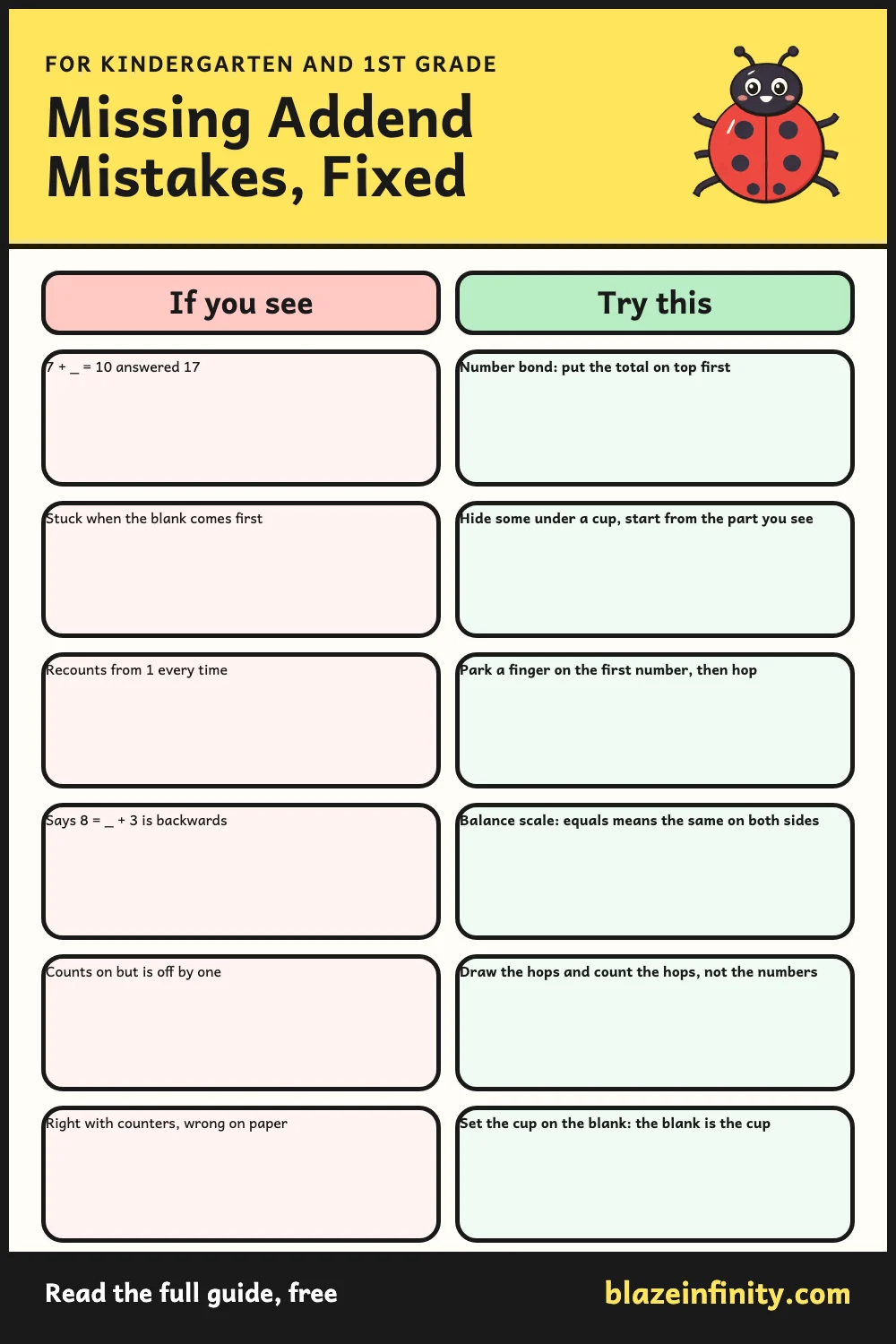
Case 1. Adds both numbers: 7 + _ = 10 is answered 17.
The child sees a plus sign and two numbers and does the only thing a plus sign has ever asked for. They do not yet see 10 as the total.
Try this
If you see
Case 2. Fine with 5 + _ = 8, lost with _ + 3 = 8.
The child solves by starting at the first number and counting on. When the first number is the blank, there is nowhere to start.
Try this
If you see
Case 3. Cannot start from the first number: for 6 + _ = 9, counts 1, 2, 3 all the way up and loses track.
The child does not yet trust that 6 can stand for six things already counted. This is a counting-on problem, not a missing addend problem.
Try this
If you see
Case 4. Reads the equal sign as “the answer comes next”: 8 = _ + 3 is answered 11, or the child says it is backwards.
Every equation the child has seen so far ended with = and then an answer. To them the equal sign means “now write the answer”.
Try this
If you see
Case 5. Counts on but is off by one: 8 + _ = 12 is answered 5.
The child says “8, 9, 10, 11, 12” and puts up a finger for each number said, including the 8. Five numbers said, four steps taken.
Try this
If you see
Case 6. Correct with counters every time, but still writes 17 on paper.
The child understands the idea. Nobody has shown them that the blank on the paper is the cup.
Try this
A child solves 5 + _ = 9 on her fingers and writes 5. Which case is she in, and what did her counting sound like? (tap to check)
Case 5. She said “5, 6, 7, 8, 9” and raised a finger for each number, so the starting number was counted as a step. Have her tuck the 5 away in a closed fist first, and only raise a finger when she says 6. If counting on is new to her, the counting-on section of our addition strategies guide is the place to back up to.
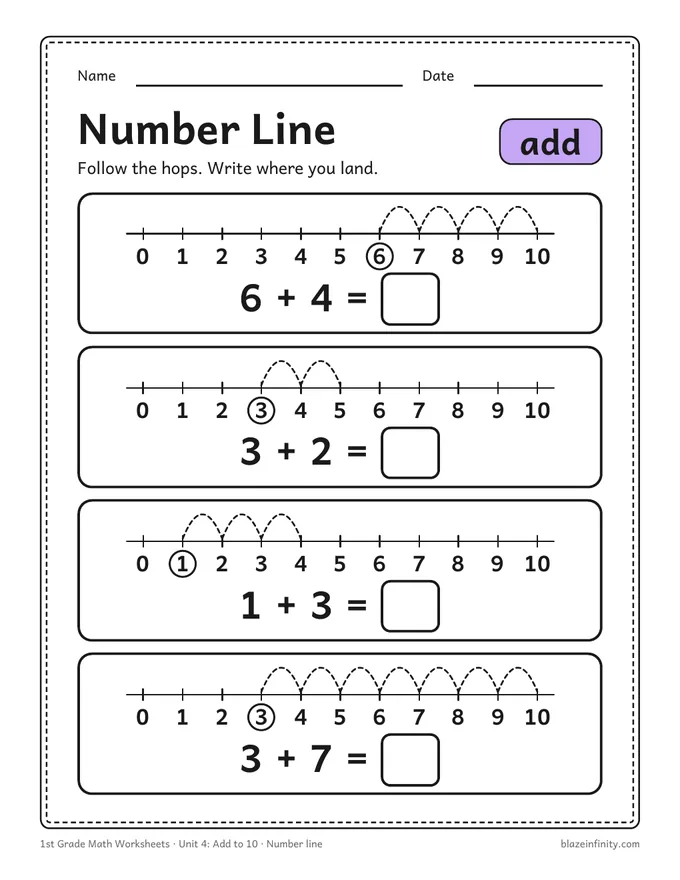
The order to teach the forms in
Many case 2 and case 4 children were simply shown every form in the same week. Teach one form until it is easy, then move the blank one step.
First
Blank at the end: 4 + 5 = _
Ordinary addition. Make sure the child can count on from the larger number before you move the blank at all.Second
Blank in the middle: 4 + _ = 9
The first true missing addend. The child can still start at the first number and count up, which is why this form comes before the next one.Third
Blank first: _ + 5 = 9
There is no first number to start from. The child has to see that the parts can trade places, so starting from 5 is allowed.Fourth
Total on the left: 9 = 4 + _
Same numbers, but now the equal sign comes early. Do not start this until the child reads = as “is the same as”.
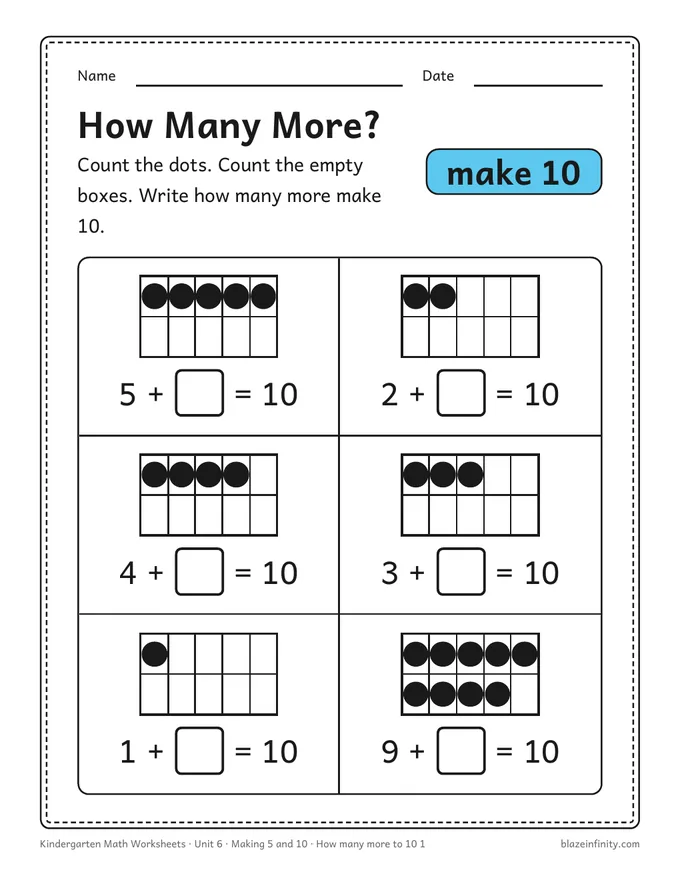
Stay inside totals of 10 while the forms are new, so the child is thinking about the blank and not about hard counting. The empty boxes on a ten frame show the missing part of 10 without any counting at all.
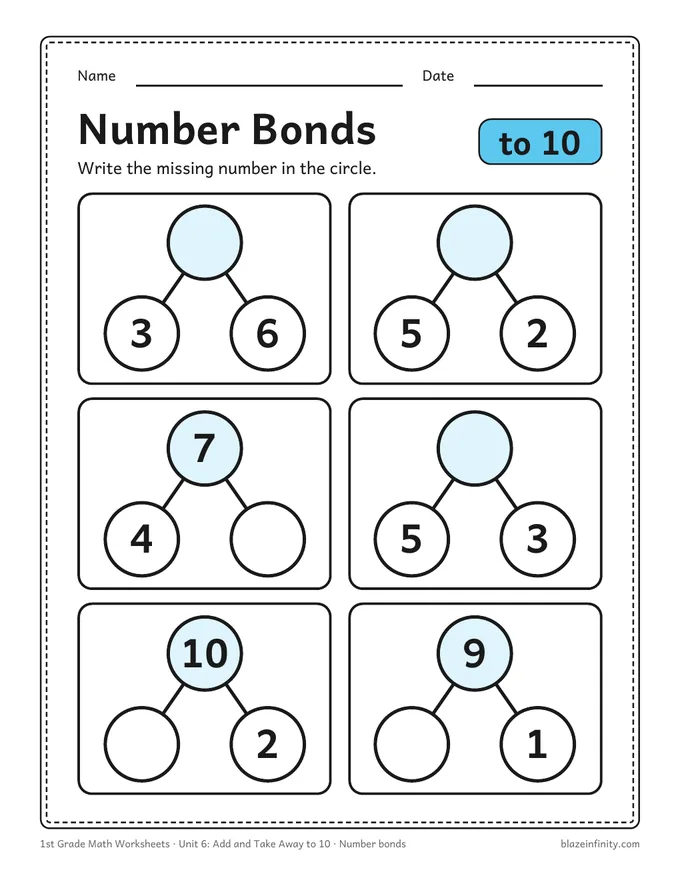
How missing addends become subtraction
Here is the payoff for all this work. Write 13 − 8 = _ and most first graders start counting backward, which is slow and easy to get wrong. Now ask the same child, “8 and how many more make 13?” That is 8 + _ = 13, and a child who knows 8 + 5 can answer straight away.
Arthur Baroody makes this point in a 2006 article in Teaching Children Mathematics: subtraction facts are easier to master when children see them as missing-addend problems, because each addition fact they know gives them a subtraction fact.
To build the bridge, put the two equations side by side over one bond diagram:
- 8 + _ = 13 asks for the missing part.
- 13 − 8 = _ asks for the same missing part.
Then teach the child to say “think addition” whenever a subtraction fact stalls. Our guide to first grade subtraction strategies shows where this sits beside counting back and using ten.
Missing addend word problems for grade 1
In a story, the missing addend usually hides behind the words “how many more”. Children who were taught that “more” means add will add the two numbers they see, which is case 1 wearing a costume. Have them act the story out and write the equation in the order the story happens, with a blank where the story has a gap.
Story 1: the sticker chart
“Maya has 6 stickers on her chart. She needs 10 stickers to fill it. How many more stickers does she need?” The story starts with 6, something unknown is added, and it ends at 10. So the equation is 6 + _ = 10, and the answer is 4. The wrong answer you will see is 16.
Story 2: the frogs on the log
“5 frogs sit on a log. More frogs hop on. Now there are 12 frogs. How many frogs hopped on?” The equation is 5 + _ = 12, and the answer is 7. Ask before solving: “Will the answer be more than 12 or less than 12?” A child who can say “less, because 12 is all of them” is ready to solve it.
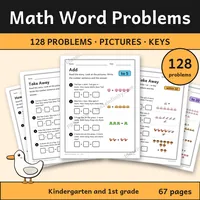
When stories like these are easy, mix them with ordinary add and take-away stories so the child has to decide what each one is asking. There are more of each kind in our math word problems.
How you know it is fixed
Run the quick check again two weeks later, with different numbers. You are looking for all of these.
The child has missing addends when they can
- Point to the total in an equation before solving it
- Solve with the blank in the middle and with the blank first
- Read 9 = 4 + _ without saying it is backwards
- Count on from the known part without recounting from one
- Explain why the missing part must be smaller than the total
- Turn 13 − 8 into “8 and how many more make 13?”
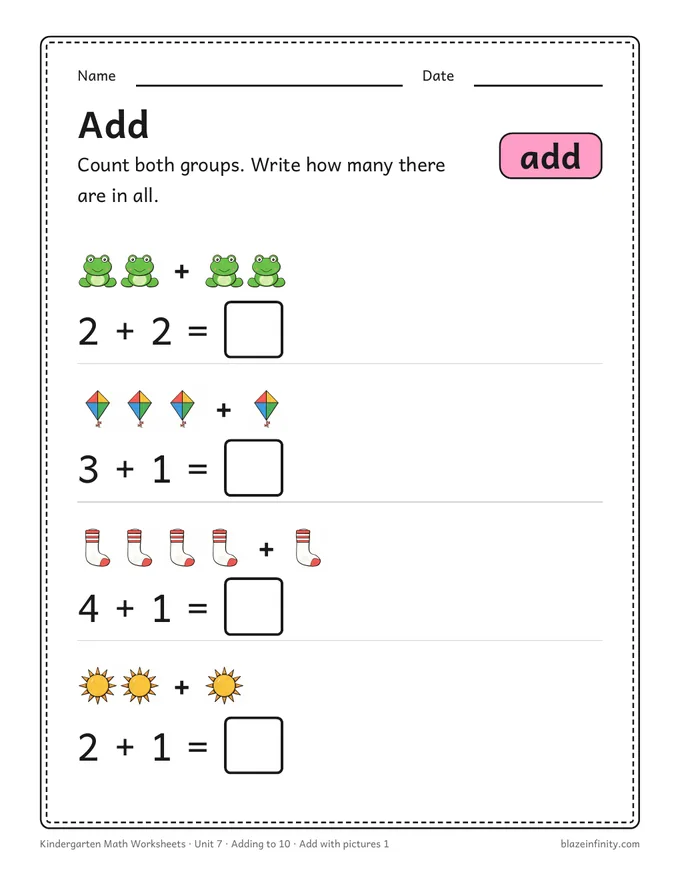
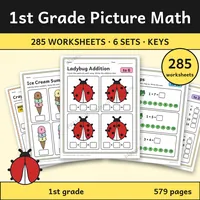
After that, the child needs practice with the same pictures until the facts come without counting. The 1st Grade Picture Math set has more pages of exactly what this guide taught: Missing Spots ladybug pages, fish bowl “How Many More?” pages, Balance the Scale pages, frog number-line pages and robot in-and-out rule pages.
What the research says
- Subtraction facts are easier to master when children see them as missing-addend problems (8 + ? = 13), because each addition fact they know gives them a subtraction fact. [1]
Sources
- Baroody, A. J. (2006). Why children have difficulties mastering the basic number combinations and how to help them. Teaching Children Mathematics, 13(1), 22-31.
Common questions
- What are addends in 1st grade math?
- Addends are the numbers being added together. In 7 + 3 = 10, the addends are 7 and 3, and 10 is the sum, also called the total.
- What is a missing addend?
- It is an addition problem where the total and one addend are given and the other addend is blank, such as 7 + _ = 10. Some programs call it an unknown addend.
- How do you find the missing addends in 1st grade math?
- Start at the addend you know and count up to the total, keeping track of how many counts you made. For 7 + _ = 10, count 8, 9, 10. That is three counts, so the missing addend is 3.
- Why does my child add the two numbers in a missing addend problem?
- They see a plus sign and two numbers and do what a plus sign has always asked for. Show the total first with a number bond and ask whether a part can be bigger than the total.
- How are missing addends related to subtraction?
- They ask the same question. 8 + _ = 13 and 13 − 8 = _ both ask for the part that goes with 8 to make 13, so a child who knows 8 + 5 = 13 already knows 13 − 8.
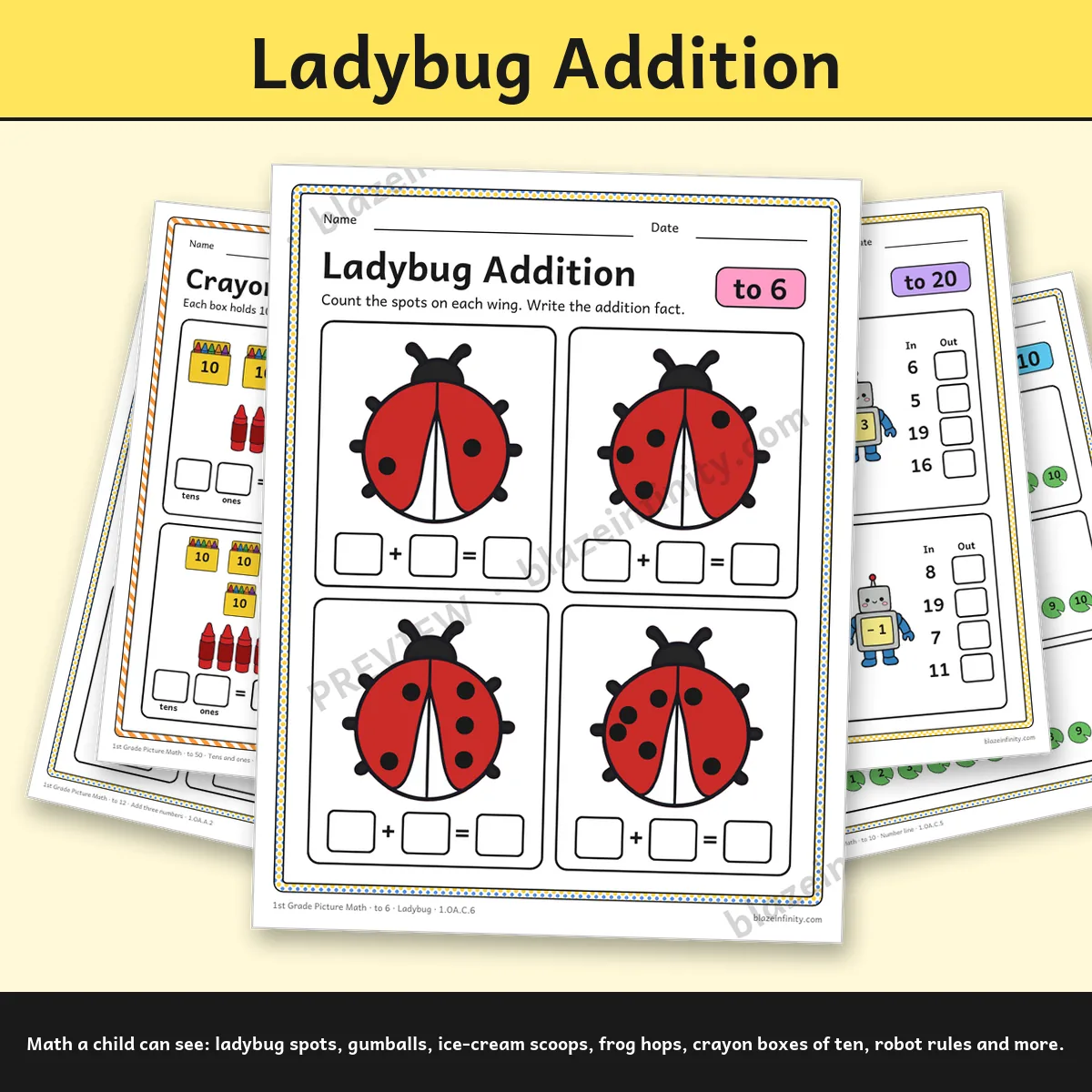
The full set for this skill
1st Grade Picture Math
285 first grade math worksheets in six sets. On every page a picture carries the math: the child counts the spots, the gumballs or the cookies, hops along the lily pads or balances the scale, and writes the number sentence beside it. An answer key follows every page.
- 285 worksheets in 6 sets, each with its own border
- An answer key after every page
- 77 adding pages: ladybug spots, gumballs, ice-cream sums with three numbers, dominoes, ten frames and frog hops on a number line
- 64 taking away and number bond pages: cookie jars, fish bowls, apple tree bonds, fact families, frog hops back and ten frames
- 42 counting pages: gumballs to 20, caterpillars that count on, back and by 2s, 5s and 10s, number trains to 120