




How to Teach Patterns in Kindergarten: 6 Levels, AB to ABC
Six levels of pattern skill for kindergarten, from copying an AB pattern to making their own, with examples, words to say and mistakes to watch for.
In short
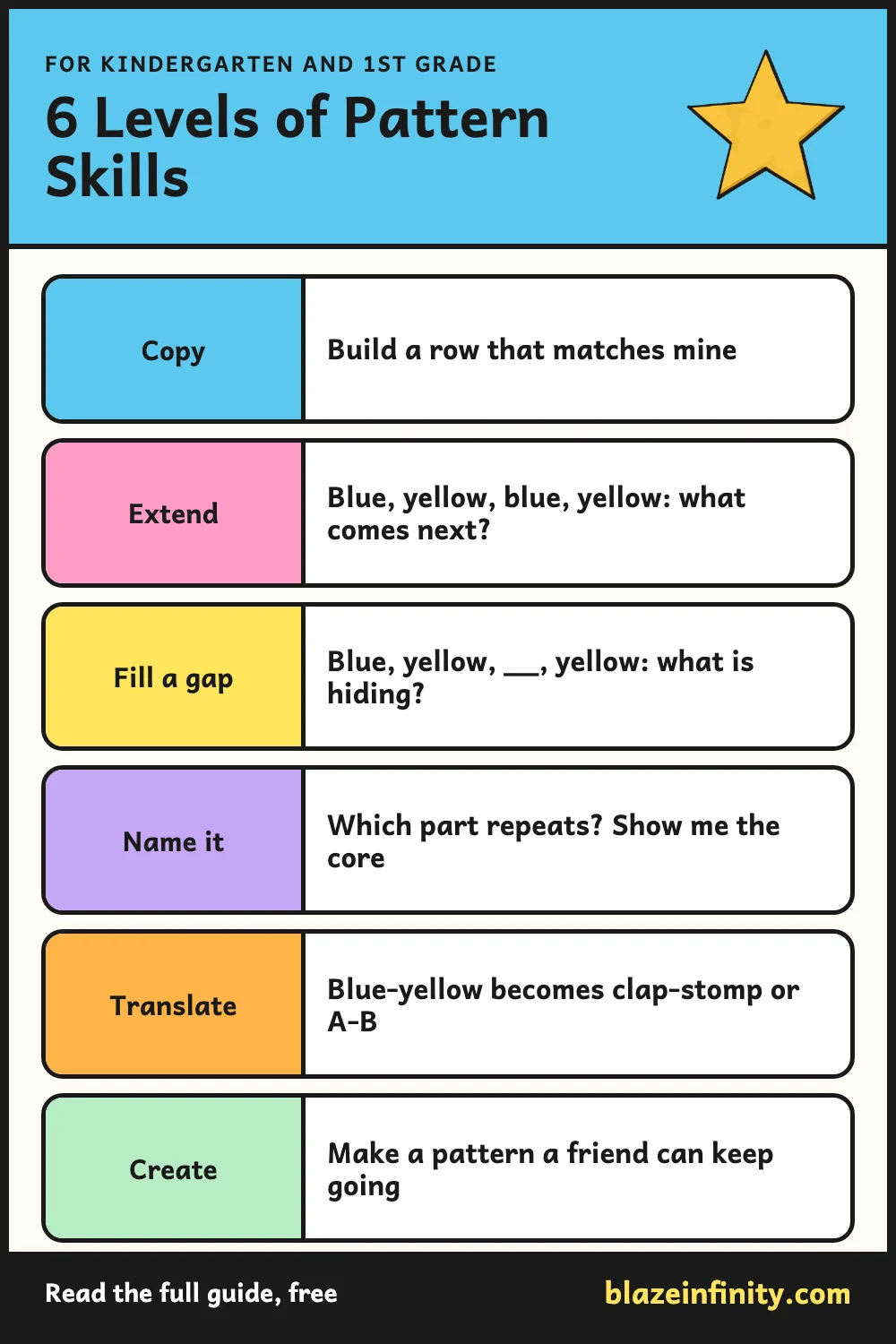
- Teach patterns in six levels: copy, extend, fill a gap, name the core, translate, create.
- Show the core three times and read the row aloud before you ask what comes next.
- Move past AB early, or children learn that a pattern just means taking turns.
You lay out blue, yellow, blue, yellow on the rug and ask what comes next. The whole class shouts “blue.” A week later the same children cannot finish blue, blue, yellow, and nobody can tell you why blue was right the first time. They were not reading the pattern. They were chanting it.
Patterning is not one skill. This guide splits it into six, in the order we would teach them, from easiest to hardest. Each one has an example you can see, the words to say, and the mistake that tells you a child is not there yet. Find where a child gets stuck and teach from there.
The four pattern types to know first
Every repeating pattern has a core: the shortest chunk that happens again and again. Teachers name the core with letters. One letter stands for one kind of thing, whatever the thing is.
Start with AB patterns. After that, some teachers go to ABC, because nothing is doubled, and some go to AAB and ABB. Either order works. What matters is that children leave AB, because a child who has only seen AB can come to think a pattern means “take turns.”
Two habits help at every level. First, show the core at least three times before you ask a question. Two repeats are not enough to be sure what repeats. Second, read the row aloud together, touching each piece. Children often hear a pattern before they see it.
Level 1: Copy a pattern
You build a row. The child builds the same row right under yours, piece below piece. Nothing has to be worked out yet. The child only has to notice that order matters.
Not there yet: the child uses the right colors in the wrong order, or makes a pile. That child sees which things are in the row but not the order they come in. Build the next row together, one piece each, saying every piece as it goes down.
Level 2: Extend it (what comes next?)
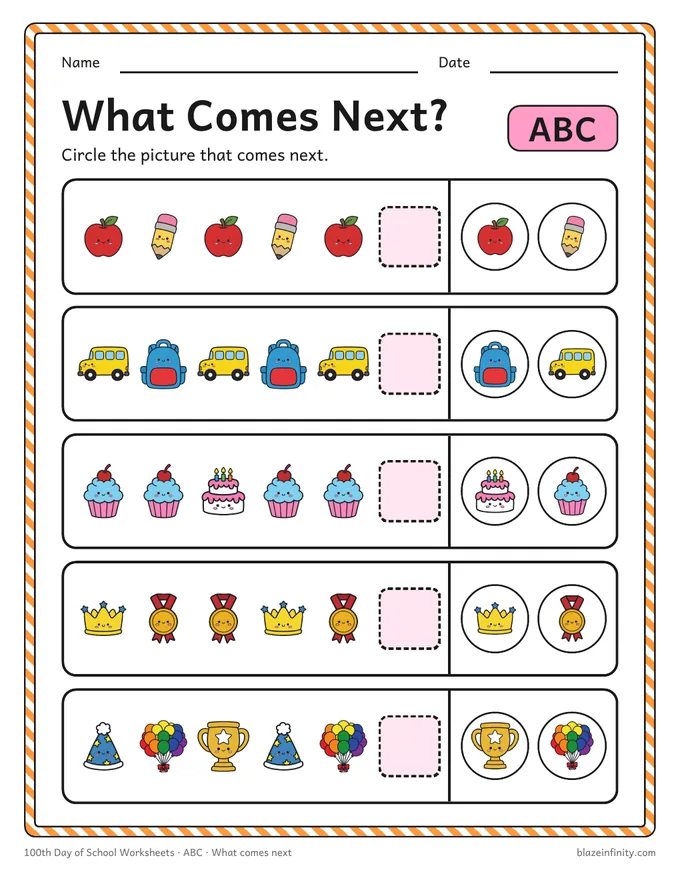
This is the level most pattern pages test. The row stops and the child keeps it going.
The second question is the one that counts. “Because it goes blue, yellow” is an answer. “Because I like blue” is a guess that happened to be right.
Not there yet: the child repeats the last piece, like this.
That child is looking at one piece, the one beside the gap, and not at the row. Go back to reading aloud and let the voice carry on past the last piece.
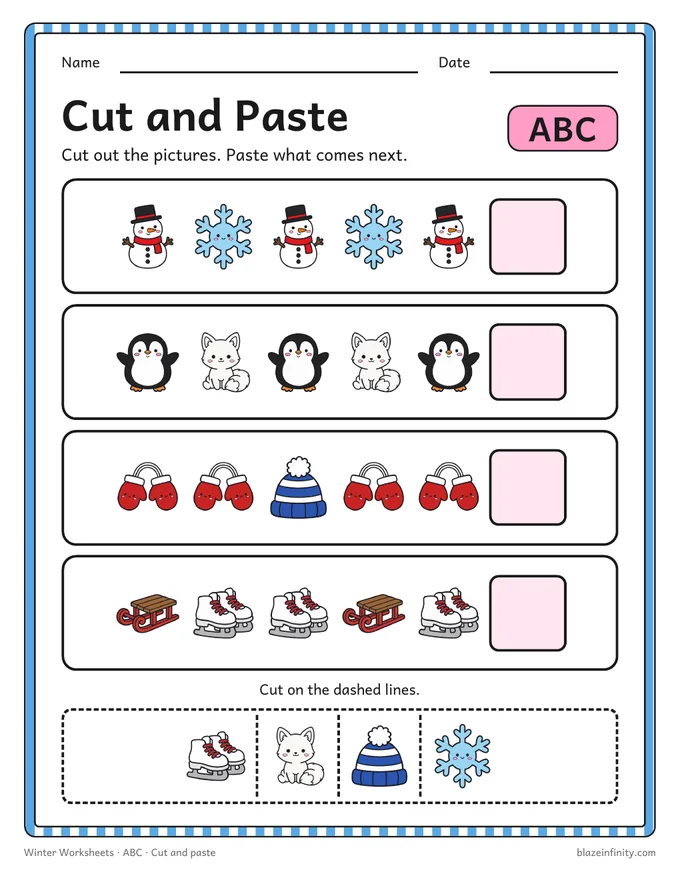
When children can do this with cubes, move to paper. Our free pattern worksheets for kindergarten ask the child to circle the picture that comes next. On cut and paste pattern pages, the child cuts out the pictures and pastes the next one. Make one rule for those: lay a picture on every box and read each row aloud before any glue comes out.
Try one yourself
Here is a row that stops in the middle of its core. Decide what comes next before you open the answer.
What goes in the empty box? (tap to check)
Level 3: Fill a gap in the middle
Now the hole is inside the row. This is harder than it looks, because the child has to read what comes before the hole and what comes after it, and find the piece that fits both.
With real objects, build the row, ask the child to look away, and cover one piece with a cup. Lift the cup to check.
Not there yet: the child copies the piece on one side of the hole. In the row below, the missing piece is a yellow square, and that child will often say blue because blue is right beside the hole.
Level 4: Name the part that repeats
A child can extend a pattern by feel for a long time without knowing what the pattern is. Level 4 asks them to find the core and show where it starts and stops. Snap cubes make it easy to prove.
- 1
Build the row as one long train
Use snap cubes in two colors: blue, blue, yellow, three times over. - 2
Ask for the part that keeps coming back
Say: “Which part happens again and again? Break the train every time it starts over.” - 3
Stand the pieces side by side
If every piece looks the same, the child found the core. Here that is three towers of blue, blue, yellow. If the towers do not match, snap the train back together and try a different break.
A child looks at the row above and says the pattern is “blue and yellow.” Is that the core? (tap to check)
Not there yet: the child points at the whole row, or breaks the train into pieces that do not match each other.
Level 5: Translate it
Translating means keeping the pattern and changing the things. If a child can turn a row of colors into sounds, they understand that the pattern is the order, not the cubes.
Then go the other way. Clap, clap, pat, clap, clap, pat, and ask the child to build it with cubes. Letters come last: “Blue is A and yellow is B, so this is an AB pattern.”
Not there yet: the child can clap along but says a row of bears and a row of cubes are different patterns because they look different. Put the two rows one under the other and read both with the same two words.
Level 6: Make their own
The last level has no row to start from. The child invents a pattern, and someone else has to be able to carry it on.
Before you read on, look at this row a child made and decide whether it is a pattern.
Is this a pattern? (tap to check)
Not there yet: the row uses two colors with no core, or it is the same AB pattern every single time. For the second child, hand over three colors and ask for a pattern that is not AB.
Four mistakes and what each one tells you
If you see
Copies the last item instead of continuing.
The child looks only at the piece next to the gap.
Try this
If you see
Can do AB but not AAB.
The child has learned “take turns,” not “find what repeats.”
Try this
If you see
Cannot say what repeats.
The child extends by feel and is still at Level 2 or 3.
Try this
If you see
Makes a random row and calls it a pattern.
To this child, a pattern is any row of colors.
Try this
Patterns all day, without worksheets
Most pattern practice costs no time at all, because it fits into things you already do.
- Line-up order. Line children up stand, sit, stand, sit, or hands up, hands down. Stop partway and ask the next child what they should do. Later, let a child choose the core.
- Snack. Cracker, cereal piece, cracker, cereal piece on a napkin (use whatever your allergy list allows). Children make a row, read it to a neighbor, then eat it from one end.
- Calendar. The days of the week are a core of seven that starts over every week. If you use colored date cards, put them up in a pattern and ask what color tomorrow will be.
- Songs and rhythm. Clap, pat, clap, pat while you wait in the hall. A song that goes verse, chorus, verse, chorus is an AB pattern too.
One worksheet, three levels
A “what comes next” page is a Level 2 page, but you can ask more of it. Read each row aloud first. Circle the answer. Then pick one row and ask for its core. Last, clap that row. That is Levels 2, 4 and 5 from one page.
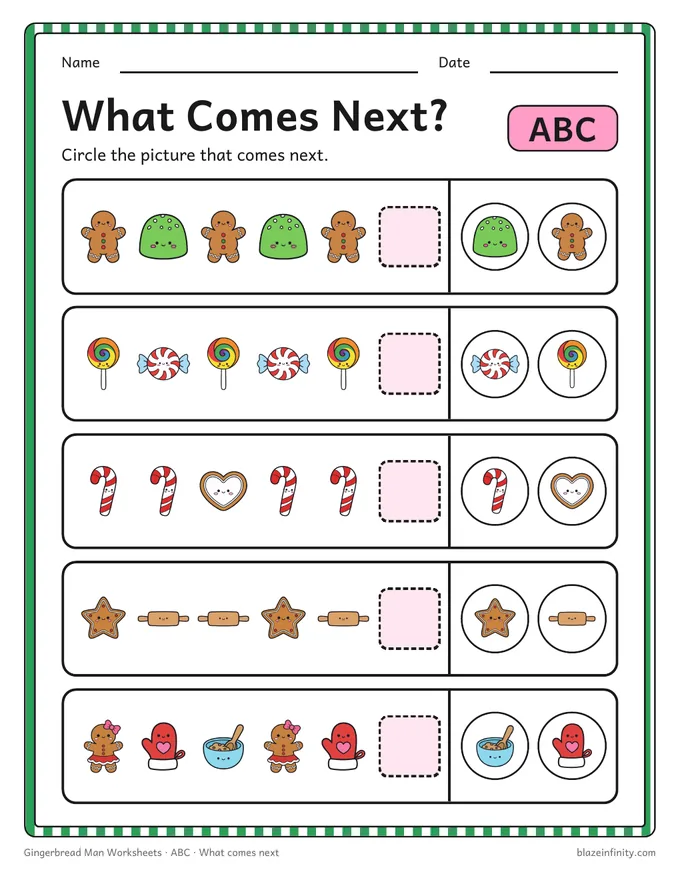
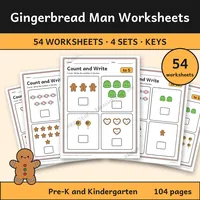
The gingerbread man worksheets include pattern pages, and our list of winter activities for kindergarten has more ideas for the cold months.
Where patterns show up in later math
The number system repeats too, so the habit of looking for what repeats has plenty to work on.
Count past twenty and the ones go one, two, three, up to nine, then start over in every new set of ten. Skip counting by twos is a pattern you can say and clap. Odd and even numbers take turns like an AB pattern. A ten frame is filled the same way every time so that children can know a number by how it looks.
The habit carries on from there. When first graders learn addition strategies, the question “what stays the same and what changes?” is the same question they asked about a row of cubes.
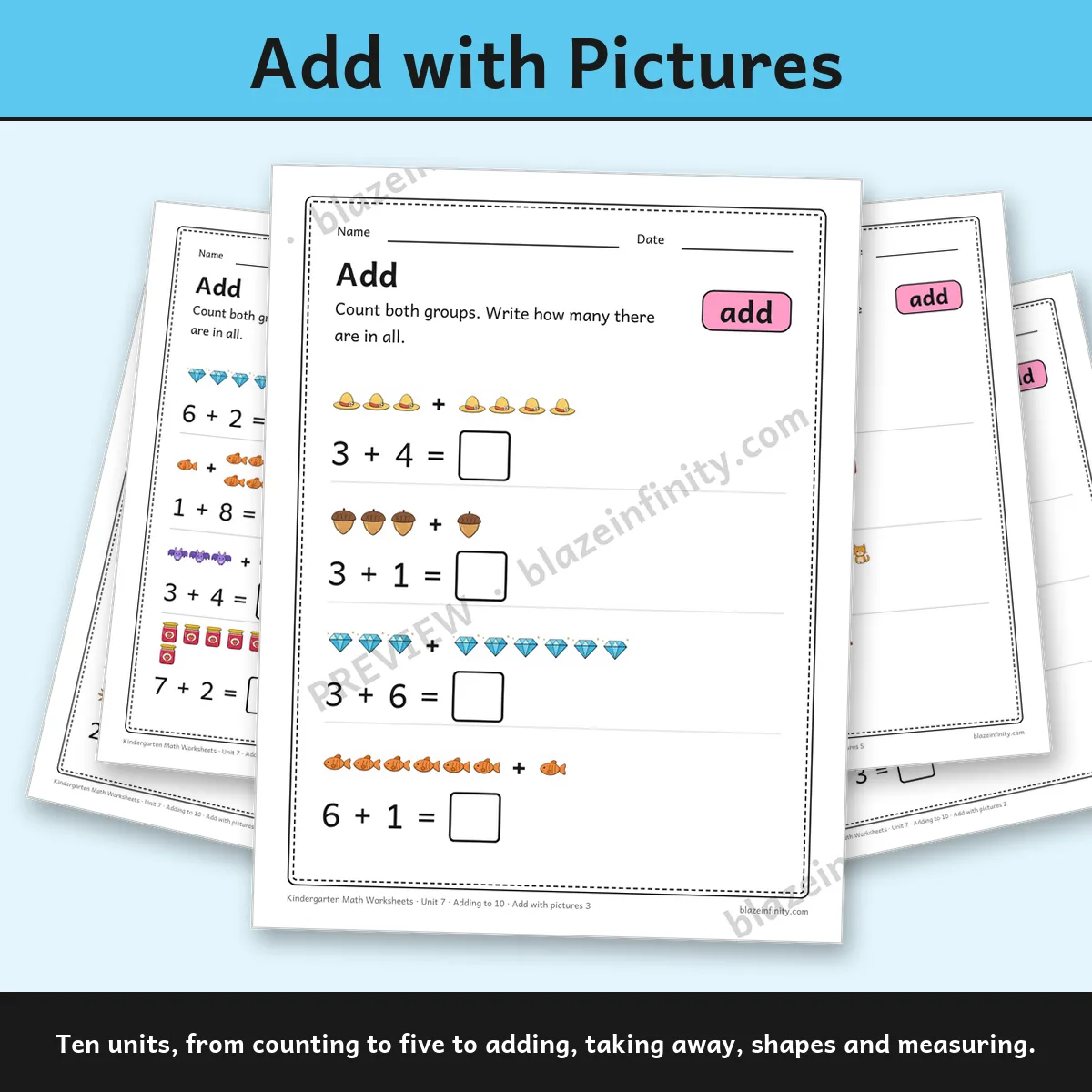
Patterns will not teach counting or adding by themselves, so give them a few minutes a day and keep them going all year. When you want more kindergarten math pages in one place, the Kindergarten Math Worksheets set has 300 worksheets. It does not have pattern pages; it is the rest of the kindergarten math year.
Common questions
- What is an AB pattern?
- An AB pattern has two different things that take turns, such as blue, yellow, blue, yellow. The part that repeats, blue then yellow, is called the core.
- What order should I teach patterns in?
- Start with AB. Then teach ABC, AAB and ABB in whichever order suits your class. Within each type, go from copying to extending, filling a gap, naming the core, translating and making their own.
- What is the core of a pattern?
- The core is the shortest chunk that repeats. In blue, blue, yellow, blue, blue, yellow, the core is blue, blue, yellow. Breaking a snap cube train into matching pieces is an easy way to show it.
- How do I teach patterns to preschoolers?
- Use real objects and the body before paper. Build a short AB row together, say it aloud while touching each piece, and let the child copy it. Clapping and stomping patterns work well at this age.
- Are pattern worksheets enough by themselves?
- No. Most pattern worksheets practice one level, what comes next. Children also need to build, name, translate and invent patterns with objects, sounds and movement.
The full set for this skill
Kindergarten Math Worksheets
300 worksheets in ten units. Every unit goes in steps: pictures first, then ten frames and number lines, then numbers on their own. Each unit ends with mixed review and two check-ups.
- 300 worksheets in 10 units, with answer keys
- Steps in every unit: pictures, ten frames, number lines, then numbers
- Story problems for adding and taking away
- Mixed review and two check-ups in every unit
- A progress record for each child