










Kindergarten Writing Examples: What It Looks Like by Stage
Typical kindergarten writing examples for each stage, from drawing to a first sentence, plus what to expect in fall, winter and spring and 7 simple activities.
In short
- Have the child read each piece to you first: their reading tells you which stage it is.
- Praise one thing that fits the stage, give one next step, and do not correct every word.
- Spelling by sound is expected in kindergarten. Hold children only to the words you have taught.
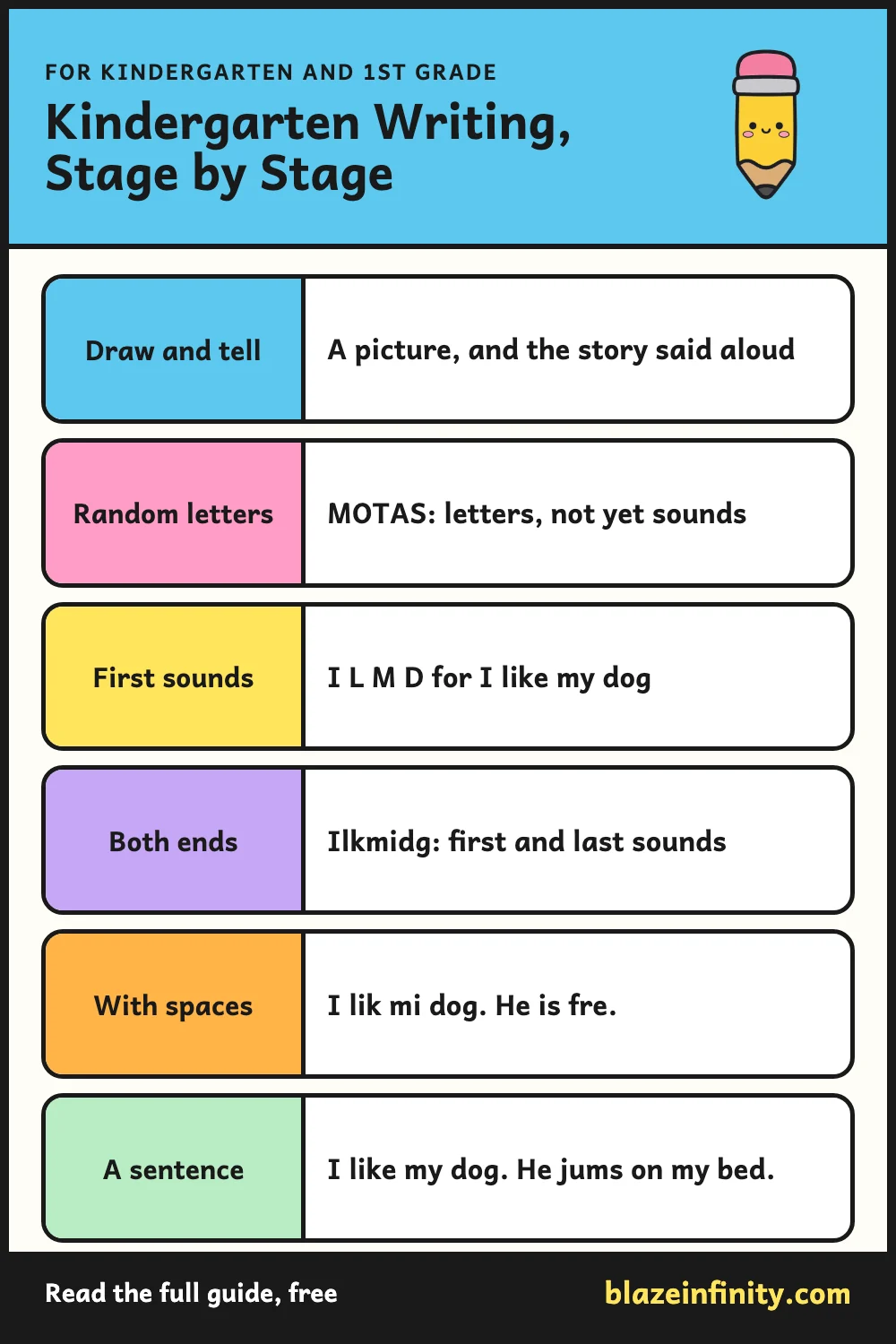
Kindergarten writing looks like a lot of different things, and most of them are right. In September one child draws a dog and tells you all about it, another writes a row of letters from her name, and a third writes D under the dog. By May, many children write a sentence you can read without help, spelled the way it sounds: I lik mi dog. Below is each stage with a short example, what it tells you, and the one next step that moves the child on.
This guide is about what children write, not how they form letters. For that, see what kindergarten handwriting should look like and how to teach letter formation.
What should kindergarten writing look like? The stages, with examples
Children move through these stages in about this order, but not in neat steps. A child may write first sounds on Monday and go back to a scribble on Tuesday when the topic is hard. Judge by what the child does most days.
| Stage | Typical example | What it tells you | Next step |
|---|---|---|---|
| Drawing and talking | A dog and a sun, no letters. Told aloud: "My dog runs fast." | The child has a message and knows a picture can carry it. | Write their words under the picture as they say them, then read it back together. |
| Scribble and letter-like shapes | A wavy line, or shapes like O, T and a backward E, read back as "My dog runs fast." | The child knows writing is different from drawing, and may already write left to right. | Ask for one real letter, such as the first letter of their name. |
| Random letters | MOTAS under the dog, mostly letters from the child's name. | Words are made of letters, but letters do not yet stand for sounds. | Stretch one word together: "Fffast. What do you hear first?" |
| First sounds | D for dog. I L M D for "I like my dog." | The child hears the first sound in a word and knows a letter for it. | Ask for the last sound too: "What do you hear at the end?" |
| Beginning and ending sounds | Ilkmidg for "I like my dog," or DG for dog. | The child hears both ends of a word. Vowels and spaces are often missing. | Draw a line for each word before writing. Listen for the middle sound. |
| Phonetic spelling with spaces | I lik mi dog. He is fre. ("He is furry.") | Most sounds are heard in order, and the child knows where words end. Short words such as I, is and dog are often right. | Teach a few heart words, such as the, my and like, and a period at the end. |
| A simple sentence | I like my dog. He jums on my bed. | Taught words are right, harder words are spelled by sound, with a capital and a period. | A second sentence that tells more: "What does he do next?" |
Spelling by sound, often called invented spelling, is not a habit to break. It is phonics in use: to write dg for dog, a child listens for the sounds in the word and picks a letter for each one they hear. The Common Core kindergarten standards, which many states use or have adapted, ask for exactly this: a letter for most consonant and short vowel sounds, and simple words spelled phonetically. So most next steps in the table are about hearing one more sound, not about spelling the word right. If a child cannot yet hear the first sound in a spoken word, the gap is in listening, not writing; phonemic awareness vs phonics explains what to practice.
Kindergarten writing expectations: fall, winter and spring
Children vary a lot. A summer birthday or a first year in an English-speaking school can put a child a stage or two behind a classmate, and both can be fine. Take this as a rough picture of a typical class, not a test.
- Fall: most children draw and tell, and many write their name. Some write random letters or a first sound under a picture. A page of scribble that the child reads back to you as a story is a good start.
- Winter: many children label pictures with first sounds and begin to add ending sounds. A few heart words, such as I, a and the, appear spelled right. Spaces come and go.
- Spring: many children write one or two sentences in phonetic spelling that an adult can read, with most spaces in place and some capitals and periods. The standards picture the end of the year as a mix of drawing, dictating and writing to tell about a topic, a book or an event.
The useful question is not "Is this child at grade level?" but "Is this child moving?" Keep one piece from each month in a folder. A child who goes from a picture in October to D in January is making real progress. A child whose writing looks the same in March as in October needs a closer look at letter sounds and at hearing sounds in words.
How to respond to a piece of kindergarten writing
What you say in the minute after a child shows you a page shapes what they write tomorrow. Use the same three steps every time.
- Ask the child to read it to you, before you look closely. A child who wrote Ilkmidg knows it says "I like my dog," and you will see far more once you have heard it.
- Praise one thing that fits their stage, and name it. Not "Good job," but "You heard /d/ at the start of dog and wrote a d." That tells the child what to do again.
- Give one next step, and only one. "Say dog slowly. What do you hear at the end?" The child adds the g, and you stop there.
What goes wrong is correcting everything. A page with every word fixed teaches a five-year-old that writing is a way to be wrong, and the next page is shorter, or uses only words they can already spell. If you want a record, write the message in small, standard spelling at the bottom and say: "I'm writing what you told me so I remember it." That is a note for you, not a correction.
The exception is words you have taught. If the is on the word wall and the child writes tha, point: "That one is on our wall. Can you check it?" Hold children to those few heart words and let everything else be spelled by sound.
If you see
All the words run together
The child hears sounds but not where one word ends.
Try this
If you see
The same safe sentence every day, such as I love Mom
The child sticks to words they know they can spell.
Try this
If you see
Only a picture, still, in spring
The child may not hear first sounds yet, or may not believe they can write.
Try this
Simple kindergarten writing activities, stage by stage
Each of these seven aims to move a child one stage on. Run the same activity for a week before you change it, so children put their effort into writing, not into learning a new task.
1. Draw, Tell, Write It Down
Teaches: a picture carries a messageYou need: paper with a drawing box and lines10 minutes
For the drawing and scribble stages. The child draws and tells you one sentence. You write it under the picture, saying each word as you write, then you both point and read. Next time, the child writes the first letter of one word before you write the rest. The standards count dictating as kindergarten writing.
2. Label It
Teaches: first soundsYou need: the child's own drawing; sticky notes10 minutes
The child labels three things in their picture. One letter per label is fine. Say: "Say sun slowly. What do you hear first? Write that and stick it on the sun." When first sounds are steady, ask for last sounds too.
3. Stretch and Write
Teaches: beginning, middle and ending soundsYou need: a whiteboard with three boxes in a row5 minutes
Say a short word, like cat. The child says it slowly, touching a box for each sound, then writes a letter in each box. The middle vowel is the hardest to hear; it may stay missing for weeks. See CVC words for which short words to start with.
4. Lines for Words
Teaches: spaces, one word at a timeYou need: paper; a pencil10 minutes
The child says a sentence. Count the words on your fingers together, then the child draws a short line for each word and writes one word on each line, saying it first. The lines make the spaces.
5. Word Box Sentence
Teaches: a whole sentence, with helpYou need: a picture with a word box15 minutes
For children who write beginning and ending sounds. Talk first: "What is the fox doing? Say the whole sentence." The child copies the box words and spells the rest by sound, so the hardest spelling is taken care of and they can think about the sentence.
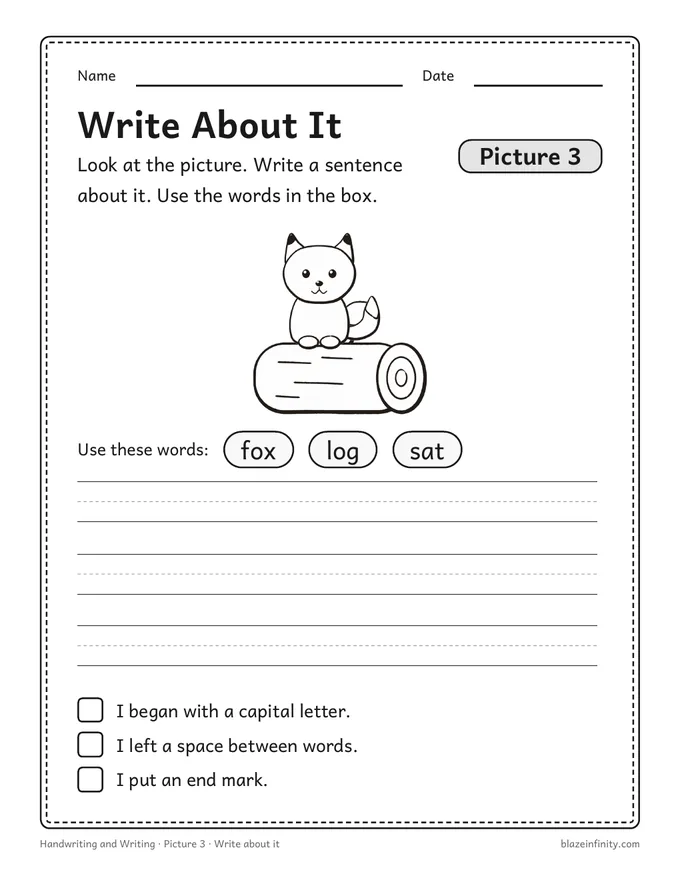
The fox page has a fox on a log, the words fox, log and sat in a box, and three checks: a capital letter, spaces and an end mark. Read the checks with the child after they write, not before; three rules up front is too many. The next day, the hen page in the same picture writing prompts set gives the same task with a new picture.
6. Build the Sentence
Teaches: word order, and what a sentence isYou need: a sentence cut into word cards; glue10 minutes
Write a sentence the class said, cut it into words and mix them up. The child puts them in order, reads it, then writes it. Point out the clues: the first word has a capital, and the last has the period.
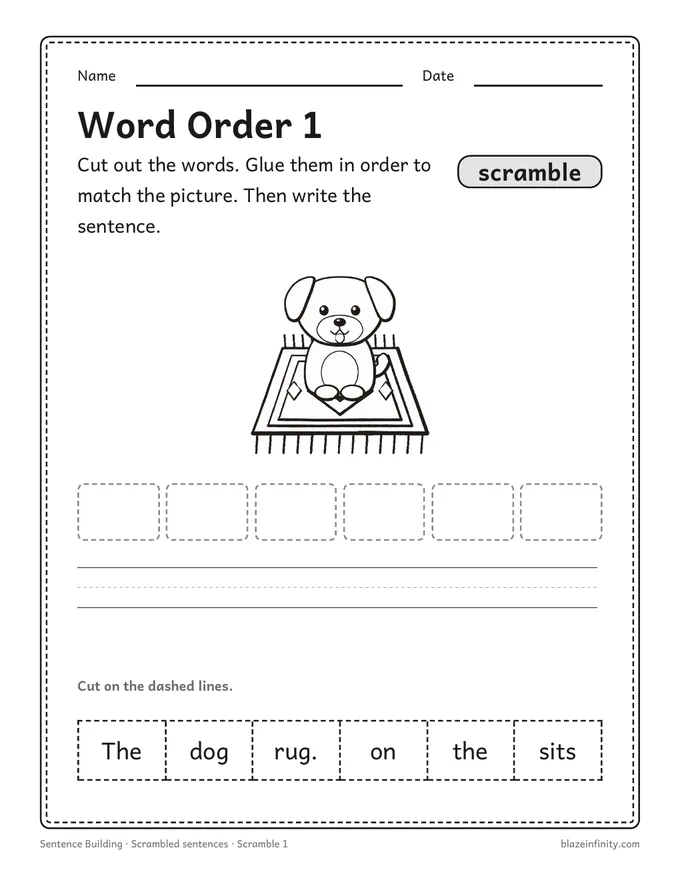
Here the child cuts out six word cards, glues them in order to match a dog on a rug, and writes the sentence. Use it when a child spells by sound but leaves words out or runs them together: each card is one word with space around it.
7. Share the Pen
Teaches: how a writer thinksYou need: chart paper; a marker10 minutes
Write a short morning message with the class. You write most of it; children come up to write what they can: a first sound, a heart word, the period. Think aloud: "I need a space before the next word." Children see every step a writer takes, and each one writes a part they can already do.
A note for first grade
The stages keep going. By the end of first grade, many children write several sentences on one topic with a clear ending, and spelling moves from sounds alone to taught patterns: short vowels, sh and ch, and more heart words spelled right. The response routine stays the same; only the next steps change, from "What do you hear at the end?" to "Add a sentence that tells how it felt." In both grades, write every day: the What Works Clearinghouse guide on teaching elementary students to be effective writers lists daily writing time as its first recommendation, alongside teaching spelling and sentence construction.
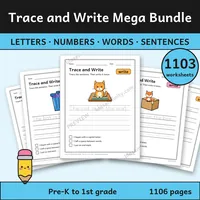
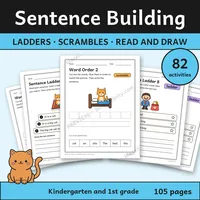
For printed pages that go from single letters to a sentence about a picture, Handwriting and Writing has every letter and number, 60 pictured words, 20 traced sentences and 20 picture writing prompts like the fox page: 91 pages in all. For the draw and tell stage, Directed Drawing and Writing has 58 pages, each with step pictures, a drawing box and a sentence to finish with a word box. Sentence Building has children build sentences one word at a time: 20 sentence ladders, 20 cut-and-paste scrambles and a read, write and draw page for each of 42 phonics skills. More free pages are on our free worksheets page.
What the research says
- Kindergartners use a combination of drawing, dictating and writing to compose opinion pieces (W.K.1), informative texts (W.K.2) and narratives of an event told in order (W.K.3). [1]
- Kindergartners write a letter or letters for most consonant and short-vowel sounds (L.K.2.c) and spell simple words phonetically, drawing on knowledge of sound-letter relationships (L.K.2.d); they capitalize the first word in a sentence and the pronoun I and recognize end punctuation (L.K.2.a, L.K.2.b). [2]
- Recommendations include providing daily time for students to write (recommendation 1) and teaching students to become fluent with handwriting, spelling and sentence construction (recommendation 3). [3]
Sources
- Common Core State Standards for English Language Arts, Writing, Kindergarten.
- Common Core State Standards for English Language Arts, Language, Kindergarten.
- What Works Clearinghouse practice guide, Teaching Elementary School Students to Be Effective Writers (Institute of Education Sciences).
Common questions
- What should kindergarten writing look like?
- It depends on the time of year. Early on, most kindergarten writing is a drawing with a story told aloud, a name and a few letters. By spring, many children write one or two sentences spelled by sound, such as I lik mi dog, with spaces between most words.
- What are the kindergarten writing expectations by the end of the year?
- The Common Core standards ask kindergartners to use a mix of drawing, dictating and writing to tell about a topic, a book or an event, and to spell simple words phonetically. In practice, many children end the year writing a sentence or two that an adult can read.
- Should I correct spelling in kindergarten writing?
- Not most of it. Praise the sounds the child heard, give one next step, and write the standard spelling as a small note at the bottom if you need a record. Do hold children to the few heart words you have already taught.
- What are some simple kindergarten writing activities?
- Draw and tell while you write the child's words down, label a picture with first sounds, stretch short words into sound boxes, draw a line for each word before writing a sentence, write about a picture with a word box, and put a cut-up sentence back in order.
- How do I help a kindergartner who says they can't write?
- Tell them to write the sounds they hear and that you will be able to read it. Then say one word slowly together and ask only for the first sound. One letter they wrote themselves is a real start.

The full set for this skill
Handwriting and Writing
Letters and numbers, pictured words, traced sentences and picture prompts. Every tracing line is a single row of dots on a three-line rule.
- Trace and write every letter, Aa to Zz
- Numbers 0 to 9
- 60 short vowel words beside their pictures
- 20 sentences to trace and copy, each with a matching picture
- 20 picture prompts with a word box