









Penguin Activities for Kindergarten: A Nonfiction Mini-Unit
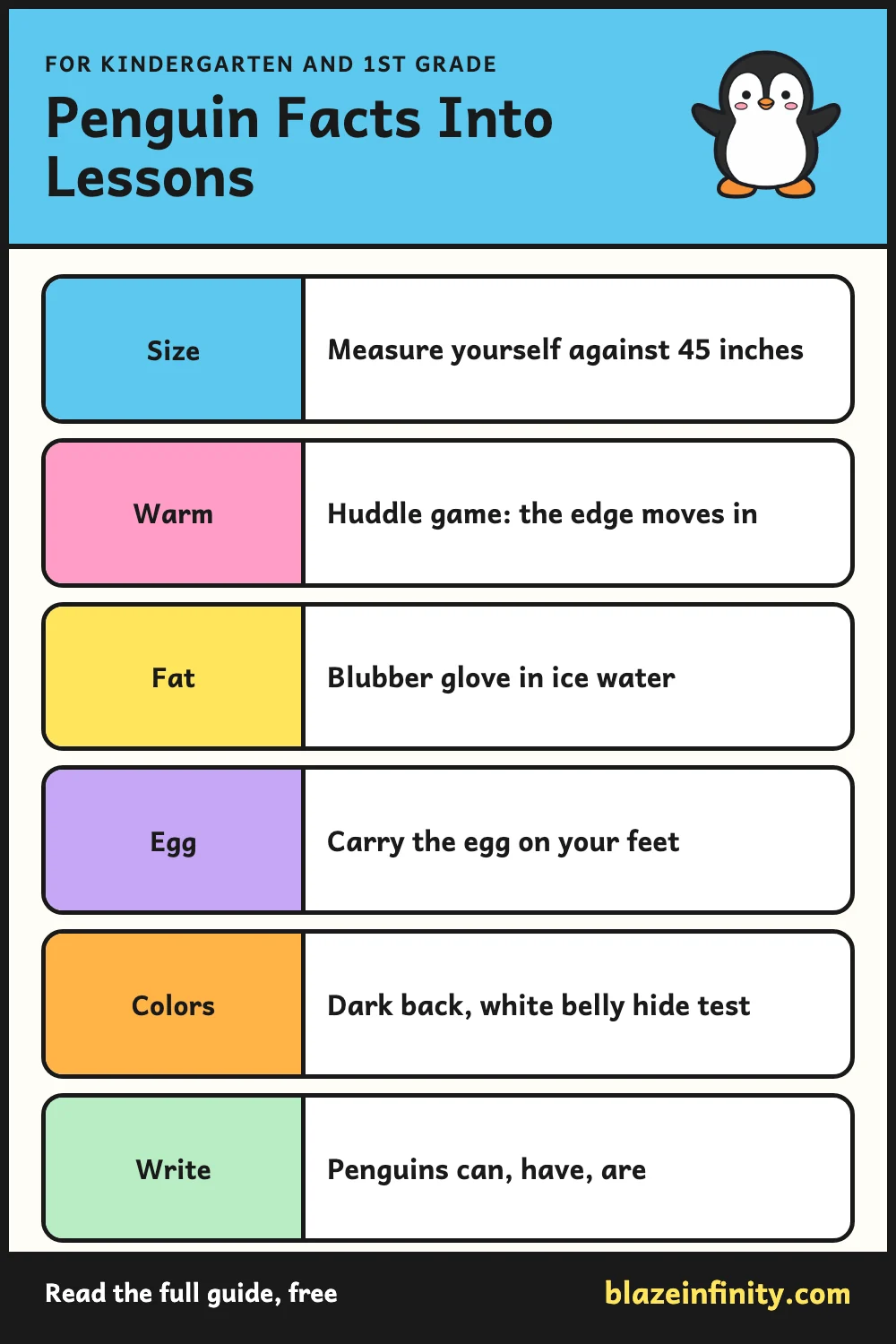
Six true penguin facts for kindergarten, each turned into a lesson: measure against an emperor, huddle to keep warm, a blubber glove and an egg relay.
In short
- Teach one true penguin fact at a time, then do one activity that lets children see, feel or measure it.
- The emperor penguin is about 45 inches tall, so a paper strip on the wall turns size into a measuring lesson.
- End with Penguins can, have, are writing and a fiction or nonfiction sort, so children use the facts they learned.
Many penguin units are built from crafts and cartoons, and some children come out of them thinking penguins live in igloos. This one is built from facts: six true things a five-year-old can hold on to, and one activity per fact that lets children see it, feel it or measure it. Then come a writing lesson, a fiction and nonfiction sort, and changes for preschool and first grade. Run it as one fact a day, or two a day for three days. Each activity takes 5 to 20 minutes, and none needs food.
Six penguin facts for kindergarten, and the lesson for each
Teach the fact first, in the words in the second column, then do the activity.
| The fact | Say it like this | The lesson | Skill |
|---|---|---|---|
| Size | The biggest penguin is the emperor penguin. It stands about 45 inches tall. The smallest penguin is about 12 inches tall, as tall as a ruler. | Stand next to an emperor | Measuring: taller and shorter |
| Where they live | There are 18 kinds of penguins. Nearly all live in the southern half of the world, and only 5 kinds live in Antarctica. | Globe check | Maps; parts of a number |
| Keeping warm | Emperor penguins stand close together in a big group called a huddle. The ones on the cold edge take turns moving to the sheltered side. | The huddle game | Science; adding |
| Fat and feathers | Penguins have a layer of fat and a coat of short feathers that keeps the water out. | The blubber glove | Predicting and observing |
| The egg | The emperor penguin dad holds the egg on his feet for about 65 days. | The egg relay | Movement; counting to 65 |
| Black and white | A penguin has a dark back and a white belly. It helps the penguin blend in with the sea. | The hide test | Observing; describing |
Turning each fact into a lesson
1. Stand next to an emperor penguin
Teaches: comparing heights: taller, shorter, about the sameYou need: a 45-inch strip of paper; a 12-inch strip; masking tape; a class chart with three columns15 minutes
Tape the 45-inch strip to the wall, touching the floor, with a penguin head drawn at the top. Tape the 12-inch strip beside it for the little penguin. Say: "This is how tall an emperor penguin is. Are you taller, shorter or about the same?"
One at a time, children stand with heels against the wall while a partner compares the top of their head with the strip, then put a sticky note in the right column. Then everyone stands next to the little penguin, and every child is taller.
What goes wrong: children stand on tiptoe, or the strip slips up the wall and the penguin grows. Check that the strip touches the floor, say "heels down, back on the wall," and have the partner hold a book flat on the child's head.
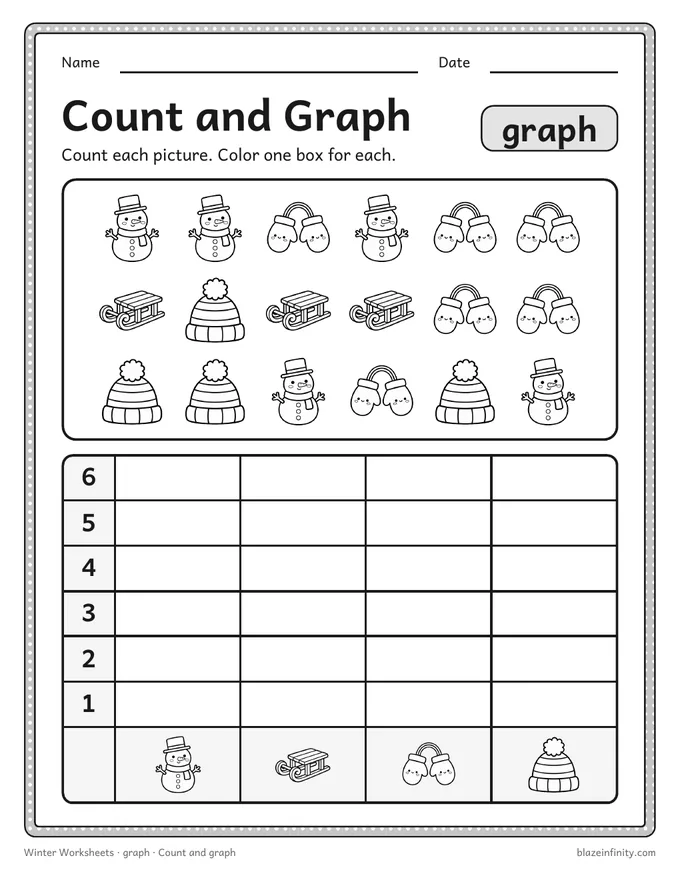
Use that page the day after the height chart: children who have built a graph from their own sticky notes know what coloring one box for each picture means.
2. Globe check
Teaches: where penguins really liveYou need: a globe or world map; 18 linking cubes, 5 in one color5 minutes
Run your finger along the equator: "Nearly all penguins live below this line, in the southern half of the world." Put a finger on Antarctica: "Some penguins live here, on the ice." Then find the Galapagos Islands: "One kind lives here, on islands right by the line. Some of them live just above it, the only penguins that do."
Show a train of 18 cubes, one for each kind of penguin, with the 5 Antarctic kinds in a different color. Ask: "How many kinds do not live in Antarctica?" Count the rest together: 13.
What goes wrong: a child points to the North Pole, because snow means penguins. Turn the globe: "Penguins live at the bottom. No wild penguins live at the top."
3. The huddle game
Teaches: how a group keeps warm; adding two partsYou need: open floor space; a paper fan or a folder to make "wind"10 minutes
Ten children stand close together, arms folded across their chests like flippers, while the rest of the class watches and takes the next turn. Say: "You are emperor penguins in a snowstorm. The outside is cold and the middle is warm." Wave the folder at one side and call "Wind." The children on that edge shuffle around the outside and tuck in on the other side.
After two or three turns, count: "How many are on the edge? How many in the middle?" If 7 are on the edge and 3 in the middle, say it as an addition story: 7 and 3 make 10. Tell the class that for real emperor penguins, huddling can cut the heat they lose by as much as half.
What goes wrong: everyone rushes for the middle and someone gets pushed. Teach the penguin shuffle first: tiny steps, feet close together, arms folded. Only the side you wave at may move.
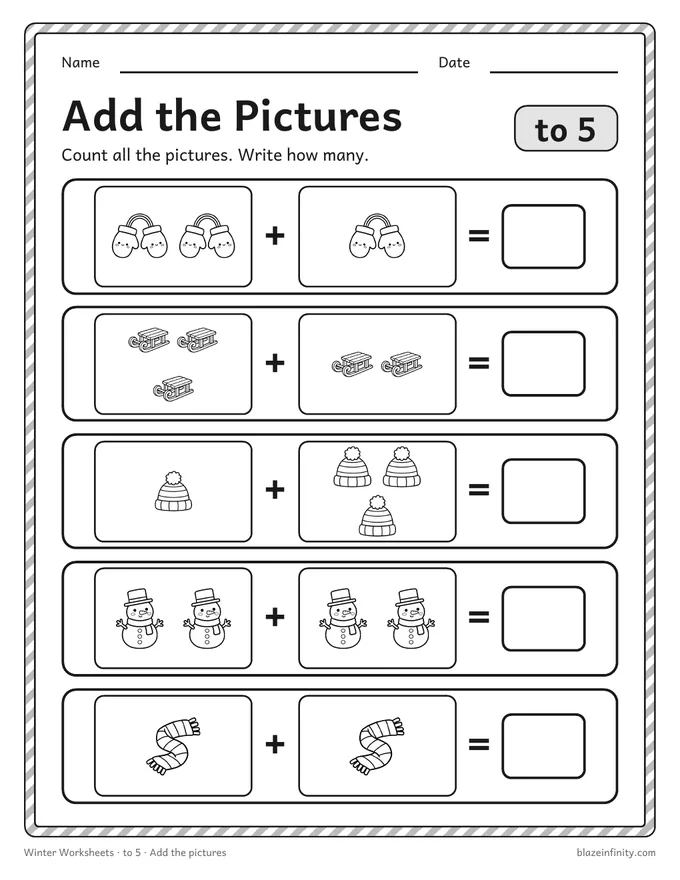
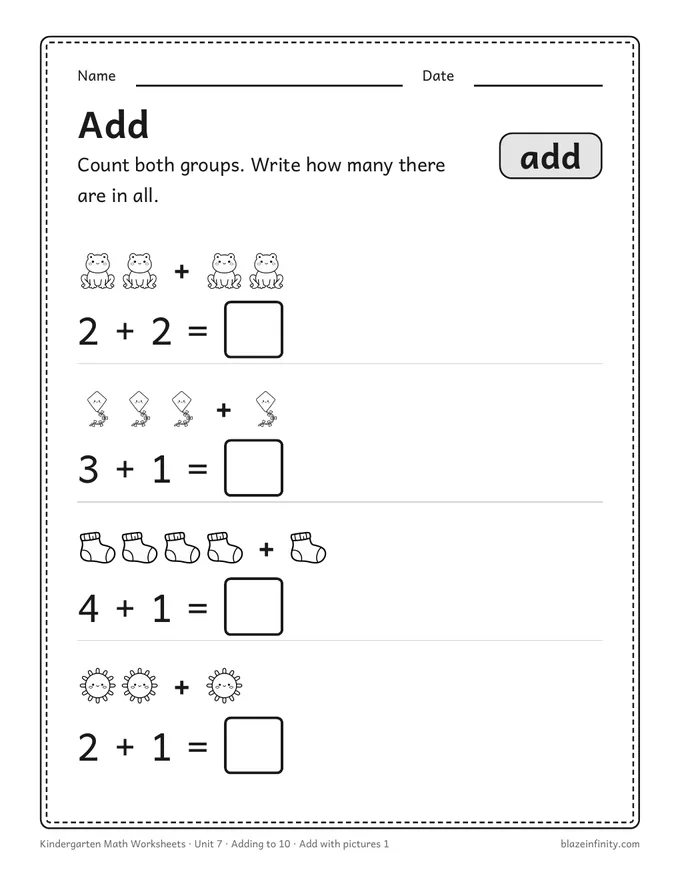
Use that page right after the huddle game, while children can still picture two groups making one. Children count both groups of pictures and write how many in all.
4. The blubber glove
Teaches: predicting, testing and saying what happenedYou need: gallon zip bags; about a cup of vegetable shortening; duct tape; a tub of ice water; paper towels20 minutes
Make two gloves before class. For the fat glove, spoon shortening into one bag, slide a second bag inside it, and tape the tops together so the shortening is sealed between the layers; the child's hand goes in the inside bag and never touches it. For the plain glove, tape two empty bags together the same way.
Ask first: "Which hand will feel cold first?" Children show one finger for the fat glove and two for the plain glove. One child at a time puts both gloved hands in the ice water while the class counts slowly to 10. Ask: "Which hand felt cold?" Then say: "Penguins have a layer of fat like this glove. It helps keep the cold out."
Add a two-minute feather test: drop water onto a paper towel and onto wax paper. The towel soaks it up; on the wax paper the water sits in drops. "Penguin feathers are short and overlap, so the water stays out."
What goes wrong: the shortening slides down and bunches at the fingertips. Squeeze it back up around the hand before each child, and stop at 10 every time.
5. The egg relay
Teaches: balance and body control; counting to 65You need: bean bags or beanie toys, one per team; cones15 minutes
Say: "The emperor penguin dad holds the egg on top of his feet and covers it with a warm flap of feathered skin. He does it for about 65 days." Each team gets one bean bag egg. The first child balances it on both feet, shuffles to the cone and back, and passes it to the next dad. One rule comes from the real birds: no hopping. Emperor penguins walk slowly and do not hop.
Afterward, show 65 days on a hundred chart: count by tens to 60, then by ones to 65, coloring the boxes as you go. Ask: "Could you stand still with an egg on your feet for this many days?"
What goes wrong: it turns into a race, and eggs fly off. Do not crown the fastest team. Say "Slow feet keep the egg," and count the teams that never dropped it.
6. The hide test
Teaches: observing and explaining with evidenceYou need: a sheet of dark blue paper; a sheet of pale blue or white paper; a paper penguin shape colored black on one side and left white on the other15 minutes
Lay the dark blue sheet on the floor: "This is the deep sea, seen from above." Put the penguin on it black side up, then white side up, and ask which is harder to see.
Now hold the pale sheet up high: "This is the bright water near the top of the sea. A fish below is looking up." Hold the penguin under it white side down, then black side down. Children see the dark back hide on the dark sea and the white belly hide against the bright water.
What goes wrong: children say the penguin is black and white "because it is pretty." Ask: "Which side was harder to see on the dark paper? Show me." The answer has to come from what they saw.
Penguin facts writing: "Penguins can, have, are"
Kindergarten informative writing asks children to use drawing, dictating and writing to name a topic and tell something about it (Common Core W.K.2). After six days of facts they have plenty to tell. Build this chart with the class, one column at a time, using only what you have taught or read together:
| Penguins can... | Penguins have... | Penguins are... |
|---|---|---|
| swim and dive | flippers for swimming | birds |
| walk with short steps | a layer of fat | birds that cannot fly |
| slide on their bellies on the ice | short feathers that keep water out | good swimmers |
| stand up tall on land | dark backs and white bellies | birds that lay eggs |
Each child finishes one sentence starter and draws a matching picture. A child who cannot write it yet tells you, and you write their words under the picture. Both meet the standard, and our kindergarten handwriting guide shows how children move from labels to a full sentence.
Fiction vs nonfiction: penguin books side by side
Pick one story book with a penguin character, such as Tacky the Penguin by Helen Lester, and one fact book with photographs. Read the story first, then the fact book, and fill in this chart together:
| Story book (fiction) | Fact book (nonfiction) | |
|---|---|---|
| What is it for? | To enjoy a made-up story | To learn true things |
| What can the penguins do? | Talk, sing, wear clothes, have names | Swim, dive, huddle, hold an egg |
| What are the pictures? | Drawings | Usually photographs |
| What do we ask after? | What happened? How did he feel? | What did we learn? How do we know? |
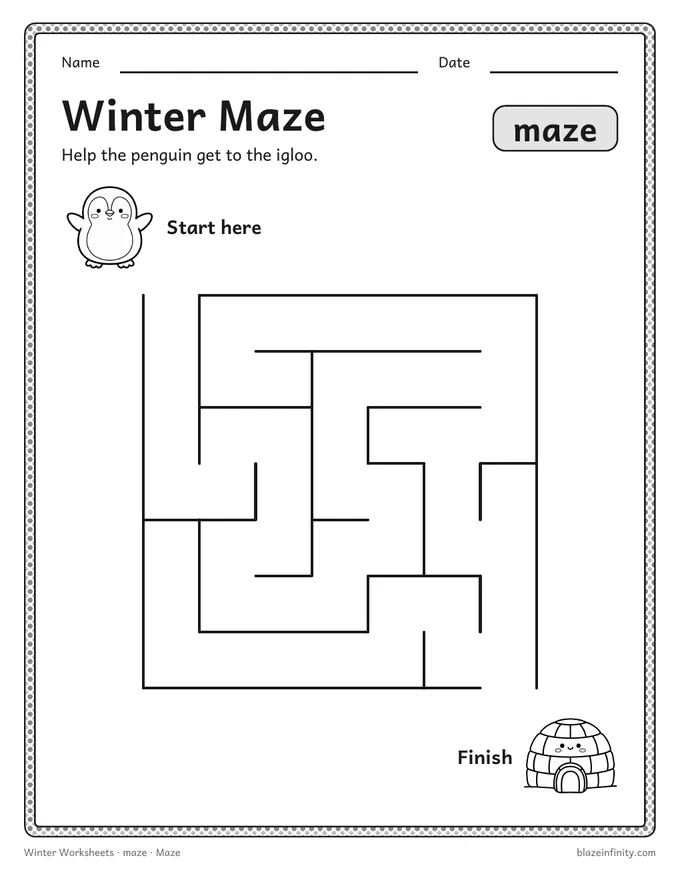
Use the maze right after the thumbs game. Children draw a line from the penguin to the igloo without crossing a wall. First ask: "Is this picture true or a story?" Real penguins do not live in igloos, so it is a story picture. The maze is also a quiet page for early finishers.
Penguin activities for preschoolers
The facts stay the same. Say each in one short sentence, and let an adult do the parts that need careful hands.
- Stand next to an emperor: skip the chart. Each child stands by the strip and says "taller" or "shorter," and you say it back in a full sentence.
- Globe check: skip the cubes. Point to the bottom of the globe: "Penguins live down here. Some live on the ice."
- The huddle game: groups of five or six, with an adult in the group to show the shuffle.
- The blubber glove: an adult holds the tub and the glove. Count to 5, not 10.
- The egg relay: no teams. Each child walks a few steps with the bean bag on their feet while the class counts.
- Writing: children draw a penguin doing one true thing, and you write down what they tell you.
Penguin activities for 1st grade
First graders do the same activities with more numbers to work out and more to write.
- Stand next to an emperor: measure the two strips with a ruler and find the difference: 45 minus 12 is 33 inches. Children write whether they are taller or shorter.
- Globe check: children write the number sentence 18 − 5 = 13.
- The huddle game: after each "wind," children write the edge and the middle as an addition sentence and check that the parts still make 10.
- The blubber glove: test three gloves (fat, cotton balls, empty), write a prediction first, and finish the sentence "The fat glove kept my hand warm because..."
- The egg relay: on the hundred chart, ask how many days are left after 60: 65 minus 60 is 5.
- Writing: a topic sentence, three facts from the chart in their own words and a closing sentence. Teach the word countershading, the name for a dark back and a white belly.
When the penguin unit is over
Leave the height strip on the wall; children keep measuring themselves against it. For more winter days, our winter activities for kindergarten cover counting, letter sounds and a melting ice experiment, and the questions in our guide to reading comprehension in kindergarten work after any read-aloud.
The maze, the graph and the addition page above are on our free worksheets page. For more practice, Winter Worksheets has more than 140 winter and New Year pages for Pre-K to 1st grade: counting, ten frames, skip counting, adding and taking away, beginning sounds, mazes, word searches and coloring, with answer keys and a black-and-white edition.
What the research says
- There are 18 species of penguins, 5 of which live in Antarctica. Penguins are only found in the Southern Hemisphere (the Galapagos penguin is the exception, below), with a waterproof coat of short, overlapping feathers and a well-developed layer of fat for insulation. [1]
- Male emperor penguins huddle to keep warm; huddling cuts heat loss by as much as 50%. Birds on the windward edge peel off one by one, shuffle down the sides of the huddle and rejoin on the sheltered side. [2]
- Emperor penguins are about 45 inches in size. The father balances the egg on his feet and covers it with his brood pouch, a warm layer of feathered skin, for about 65 days. [3]
- The emperor penguin is the largest living penguin, standing to 1.1 m (3.7 ft.). All adult penguins are countershaded: the dark back blends with the dark ocean depths seen from above, and the light belly with the brighter surface seen from below. Emperor and king penguins walk slowly and do not hop; Antarctic penguins often toboggan on their bellies. [4]
- The little penguin is the smallest penguin in the world and stands at an average height of 30 cm (about 12 inches). [5]
- The Galapagos penguin is the only penguin species living north of the equator. [6]
Sources
- Australian Antarctic Division (Australian Government). Penguins.
- Australian Antarctic Division (Australian Government). Emperor penguin.
- National Geographic Kids. Emperor penguin.
- SeaWorld Parks and Entertainment. All About Penguins: Physical Characteristics.
- Animal Diversity Web (University of Michigan Museum of Zoology). Eudyptula minor, little penguin.
- Charles Darwin Foundation. The endemic Galapagos penguin: be part of its conservation.
Common questions
- What are good penguin activities for kindergarten?
- Measure yourself against a 45-inch emperor penguin strip, play the huddle game, test a blubber glove in ice water, carry a bean bag egg on your feet, and write a page of penguin facts. Each one is built on a true fact.
- How tall is an emperor penguin?
- About 45 inches, or about 1.1 meters. It is the biggest penguin. The smallest, the little penguin, stands about 12 inches tall.
- Do all penguins live in Antarctica?
- No. There are 18 kinds of penguins and only 5 live in Antarctica. Nearly all live in the southern half of the world, and the Galapagos penguin lives near the equator.
- How do you do the blubber glove experiment safely?
- Seal the shortening between two zip bags so the child's hand never touches it, check the label against your allergy list, and keep each dip to a slow count of 10. Cotton balls can replace the shortening.
- How do I teach fiction and nonfiction with penguins?
- Read a story book with a penguin character, then a fact book with photographs, and compare them on a chart: what each book is for, what the penguins can do and what the pictures are. Then sort sentences into true and story.
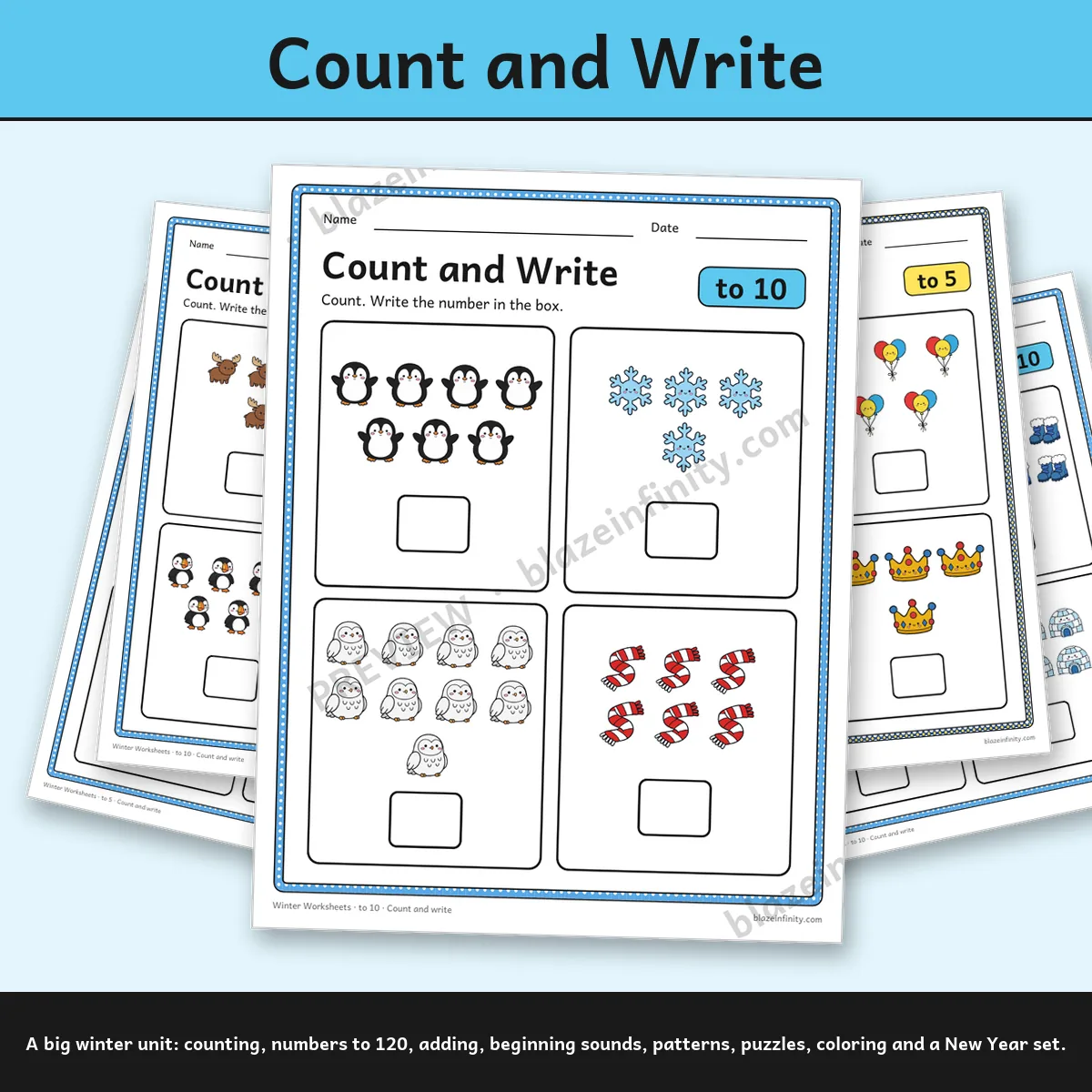
The full set for this skill
Winter Worksheets
146 winter worksheets for Pre-K to 1st grade in eight sets: counting and ten frames, numbers to 120, adding and taking away within 10, winter words and beginning sounds, patterns and line tracing, mazes, word searches and codes, coloring and writing pages, and a New Year set with a countdown, clocks and goal pages. The pictures are snowmen, mittens, arctic animals and New Year party things, so it works all January and February.
- 24 counting pages: count and write, count and color, graphs, I spy and ten frames to 20
- 13 number pages: counting to 120, skip counting by 2s, 5s and 10s, tens and ones, number charts and measuring
- 21 adding and taking away pages: pictures, number bonds, number lines, facts and story problems within 10
- 10 word pages: beginning sounds, trace and write, read and match
- 10 pattern, line tracing and cut-and-paste pages