









Tens and Ones Place Value Chart: How to Use It (Free PDF)
How to use a tens and ones place value chart in first grade, step by step: a free printable chart, seven quick activities and fixes for common mix-ups.
In short
- A tens and ones chart has two columns: tens on the left, ones on the right, and one digit in each box.
- Build with blocks first, count the tens before the ones, then write the digits and read the number two ways.
- Ten ones never stay in the Ones column: trade them for a ten before writing.
- Every box gets a digit. An empty column gets a 0, so forty is written 40, not 4.
- In second grade the chart adds a Hundreds column, and ten tens trade for one hundred.
A tens and ones place value chart is a two-column mat. Tens go on the left and ones go on the right. The child puts a ten-stick (or a bundle of ten straws) in the Tens column for each ten and a single cube in the Ones column for each one, then writes one digit under each column. Forty-five is 4 sticks and 5 cubes, and the boxes read 4 and 5.
What makes it work is how you use it: blocks before digits, tens before ones, and every number read back two ways. For the full teaching sequence, from bundling straws to the teen numbers, see teaching place value in first grade. This page is about the chart itself.
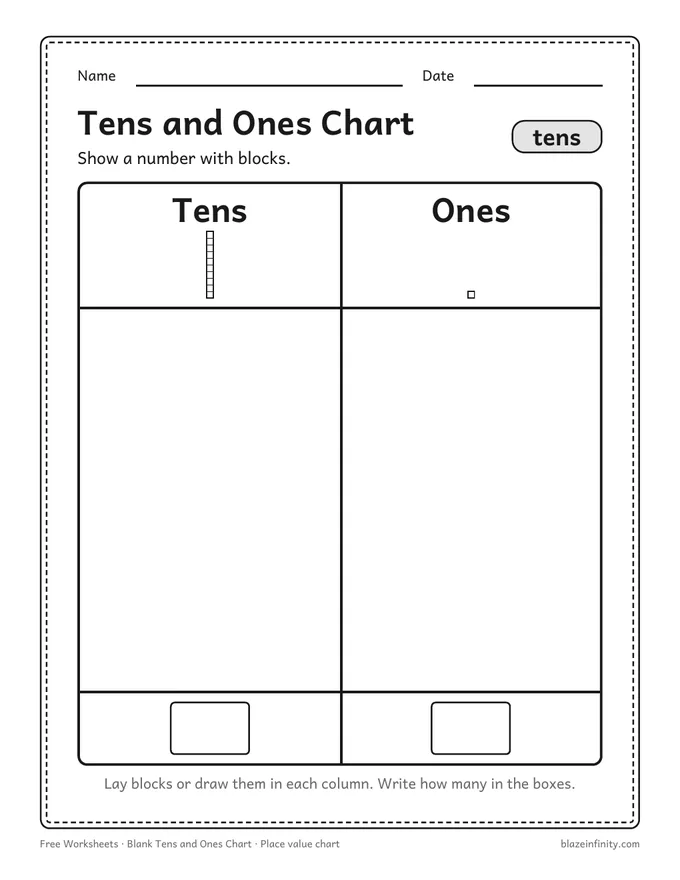
How to use a tens and ones chart, step by step
Use the same six steps for every number. The example is 45.
- 1
Set it the right way up
Tens sit on the child’s left. Point to the stick picture over Tens and the cube over Ones. Say: “Sticks of ten live here. Single cubes live here.” - 2
Say the number, then build it
“Show me forty-five.” The child puts 4 sticks under Tens and 5 cubes under Ones. Let them try before you help. - 3
Count the tens first, then the ones
Touch each stick and count by tens: “ten, twenty, thirty, forty.” Then count on with the cubes: “forty-one, forty-two, forty-three, forty-four, forty-five.” - 4
Write one digit in each box
Ask: “How many sticks? Write it under Tens. How many cubes? Write it under Ones.” The box counts blocks. It says 4, not 40. - 5
Read it back two ways
“4 tens and 5 ones. Forty-five.” Later add a third way, 40 + 5, which is expanded form. - 6
Turn it around
You write the digits and the child builds, or you build and the child writes. A child who can go both ways is reading the chart, not copying it.
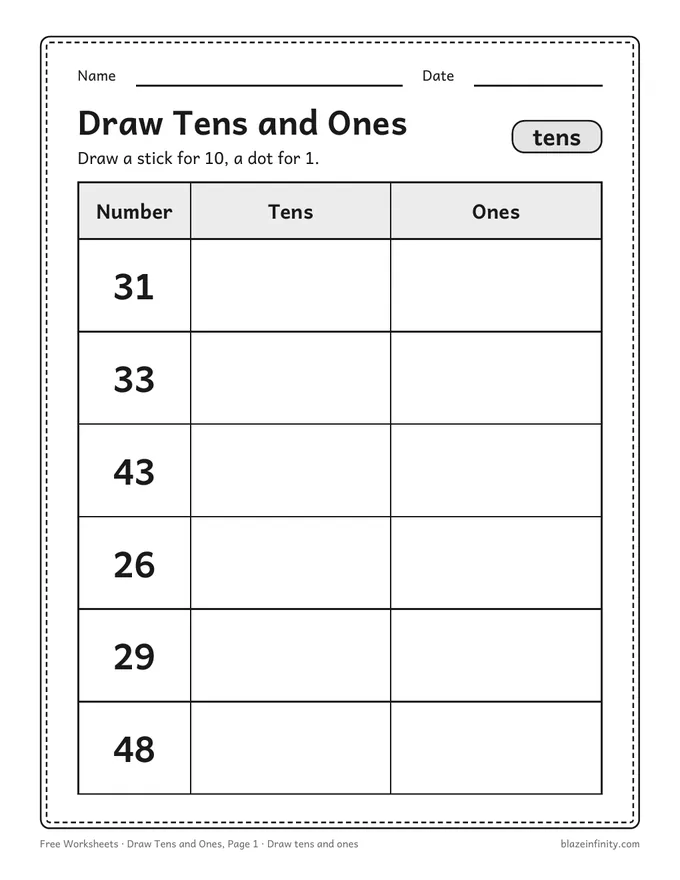
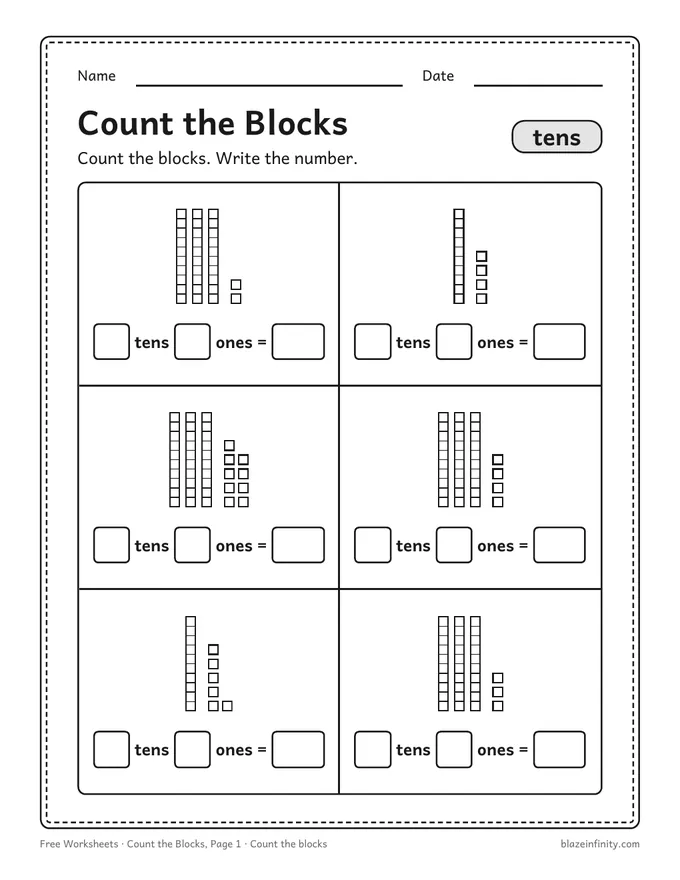
When blocks feel slow, switch to a quick drawing: a stick for each ten and a dot for each one. Then use pages where the blocks are already drawn.
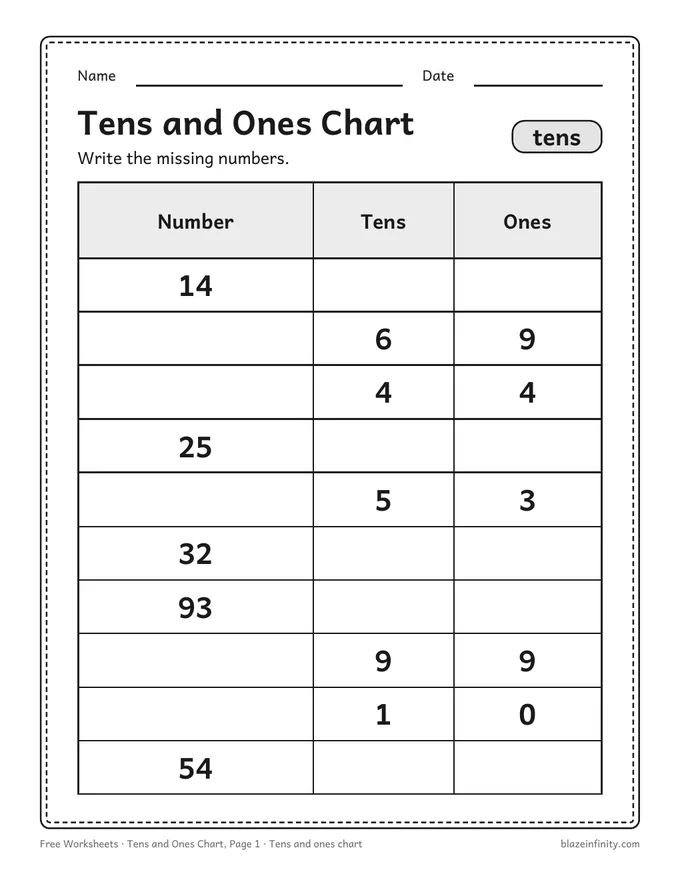
Last comes the chart with no blocks. Some rows give the number to split, others give the tens and ones to put together. If a row stumps a child, build that row on the blank chart.
Reading 45 as 40 + 5 leads to expanded form. This page practices it both ways: splitting a number, such as 86 = 80 + 6, and putting one back together, such as 60 + 1 = 61.

A child builds forty with 4 sticks, writes 4 under Tens and leaves the Ones box empty. What do you ask? (tap to check)
Ask, “How many cubes are under Ones?” None. “So what goes in the box?” Zero. Without it the boxes read 4, not 40. Every box gets a digit, even an empty column.
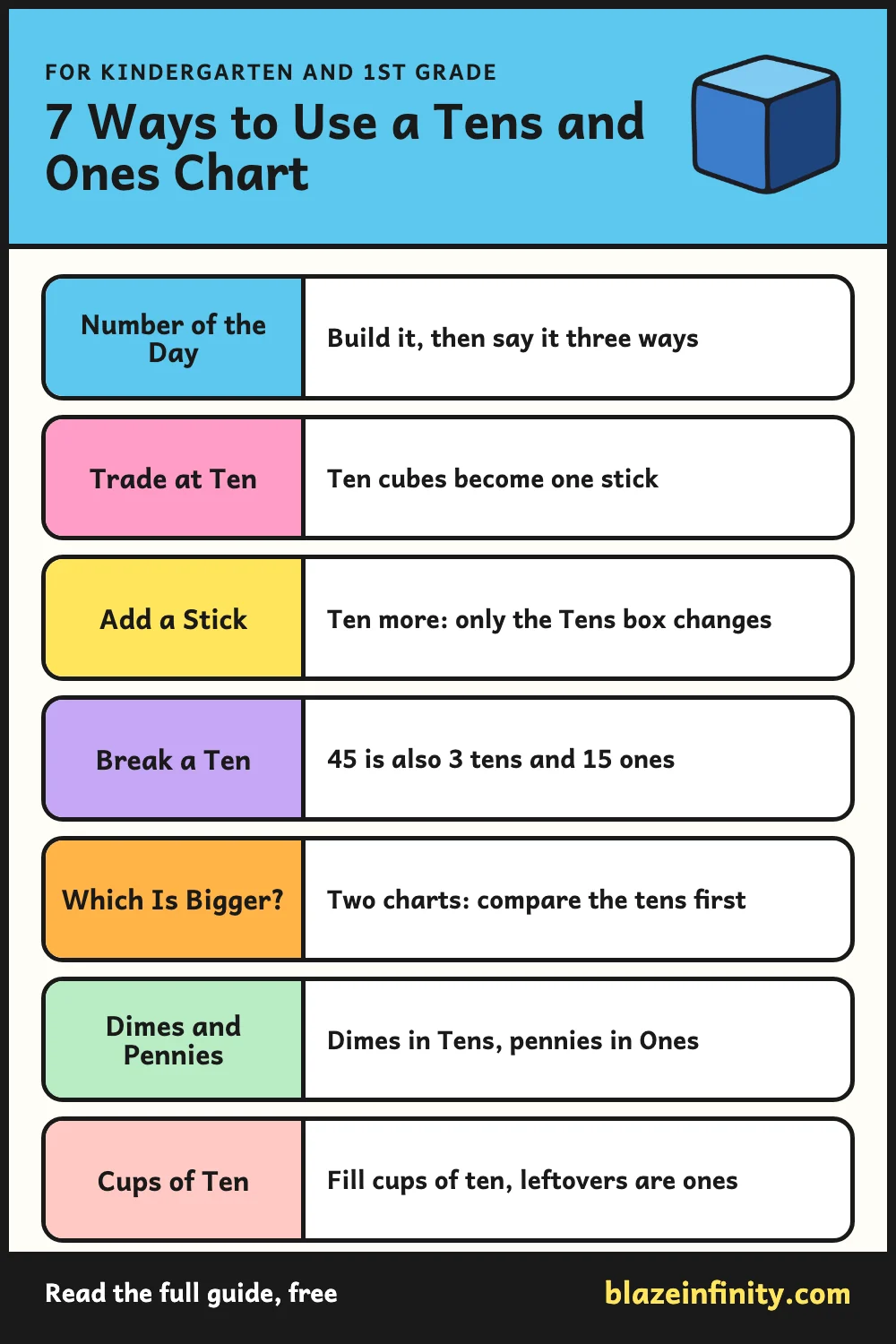
Seven ways to use the chart
Each uses one printed chart and things you already have. Times are suggestions.
Number of the Day
Teaches: Tens, ones and expanded formYou need: One chart on the board or under a document camera, blocksAbout 5 minutes
At morning meeting, the class tells you what to put in each column for today’s number. Then everyone says it three ways: “6 tens and 2 ones, sixty-two, 60 + 2.” Use the date or the number of days in school.
Trade at Ten
Teaches: Regrouping: ten ones make one tenYou need: A chart per player, one die, about 50 cubes and 10 ten-sticks10 to 15 minutes
Roll the die and add that many cubes to Ones. When Ones holds ten or more, trade ten cubes for one stick in Tens. First to 5 tens (fifty) wins. Say the total after every turn.
Add a Stick
Teaches: Ten more and ten lessYou need: A chart and blocksAbout 5 minutes
Build 26. Ask: “If I add a stick, which box changes?” Add it: only Tens changes, and it is 36. Take two away and ask again. First graders are expected to find 10 more or 10 less without counting, and this is where it starts.
Break a Ten
Teaches: The same number built a different wayYou need: Linking cubes in trains of tenAbout 5 minutes
Build 45. Unsnap one train into ten cubes under Ones. “Is it still forty-five?” Count to check: 3 tens and 15 ones is still 45. The written number stays 45. Children need this when they subtract with regrouping.
Two Charts, Which Is Bigger?
Teaches: Comparing two-digit numbersYou need: Two charts side by side, blocksAbout 5 minutes
Partners build numbers with swapped digits, such as 54 and 45. “Which has more sticks?” More tens wins, whatever the ones say. Look at the ones only when the tens match. Write the symbol between the charts.

Dimes and Pennies
Teaches: Tens and ones with moneyYou need: The chart, a handful of dimes and penniesAbout 5 minutes
A dime is ten cents, so dimes go under Tens and pennies under Ones. Ask how many cents. Add pennies until there are ten, then trade them for a dime. Good for the kitchen table.
Cups of Ten
Teaches: Grouping a big pile into tensYou need: A pile of dry pasta or cereal, a few small cupsAbout 10 minutes
Guess how many are in the pile, then count ten into each cup. Full cups go under Tens, leftovers under Ones. Count, write the digits and check the guess.
Hundreds, tens and ones for second grade
In second grade the chart grows a Hundreds column on the left. The second grade standard says 100 can be thought of as a bundle of ten tens, called a hundred. The routine stays the same: build, count the biggest blocks first, one digit per box, read it back.
The new trade is ten sticks for one flat: play Trade at Ten with sticks. Watch numbers with a zero in the middle. The standard’s own example is 706: 7 hundreds, 0 tens and 6 ones.
Expanded form grows too: 243 is 200 + 40 + 3. Say each column’s value as you point to it.

Mix-ups on the chart, and what to try
If you see
Sticks end up in the Ones column, or the child reads the chart from right to left.
Which side is which has not stuck yet.
Try this
If you see
Ten or more cubes stay in the Ones column, and the child writes 12 in the Ones box.
They have not met the rule that ten ones must become a ten.
Try this
If you see
The child writes 40 in the Tens box and reads the number as four hundred five.
They are writing what the tens are worth, not how many sticks there are.
Try this
If you see
The child counts every cube on every stick, one by one.
They do not trust that a stick is ten yet.
Try this
If you see
Every row on the chart page is right, but the child cannot build the number.
They may be copying digits left to right without knowing what they mean.
Try this
If you see
A second grader writes 26 for two hundred six.
They skipped the empty column.
Try this
Where the chart goes next
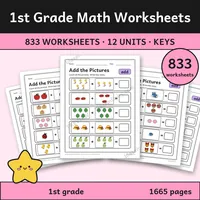
Keep the blank chart out all year, and bring the blocks back whenever a number stops making sense. All the free pages from this guide are in our free place value chart printables and free tens and ones worksheets. For a full year of practice, 1st Grade Math Worksheets has a tens and ones unit with answer keys.
What the research says
- First grade: the two digits of a two-digit number represent amounts of tens and ones; 10 can be thought of as a bundle of ten ones called a ten; 10, 20 ... 90 refer to one to nine tens (and 0 ones). [1]
- First grade: compare two two-digit numbers based on the meanings of the tens and ones digits (1.NBT.B.3); mentally find 10 more or 10 less than a two-digit number without having to count (1.NBT.C.5). [2]
- Second grade: the three digits of a three-digit number represent hundreds, tens and ones (e.g. 706 equals 7 hundreds, 0 tens and 6 ones); 100 can be thought of as a bundle of ten tens called a hundred; read and write numbers to 1000 in expanded form. [3]
Sources
- Common Core State Standards for Mathematics, Grade 1, Number and Operations in Base Ten, 1.NBT.B.2.
- Common Core State Standards for Mathematics, Grade 1, Number and Operations in Base Ten, 1.NBT.B.3 and 1.NBT.C.5.
- Common Core State Standards for Mathematics, Grade 2, Number and Operations in Base Ten, 2.NBT.A.1 and 2.NBT.A.3.
Common questions
- What is a tens and ones chart?
- It is a two-column mat for place value. Tens go in the left column and ones in the right, and a box under each column holds one digit, so 45 shows 4 tens and 5 ones.
- How do you use a place value chart in first grade?
- Say a number and have the child build it with ten-sticks and cubes in the right columns. They count the tens first, then the ones, write one digit in each box, and read the number back as tens and ones and as its name.
- Why is zero important on a place value chart?
- A zero shows that a column is empty. Without it, 40 would read as 4 and 206 as 26, so every box needs a digit, even when there are no blocks in that column.
- What grade uses a hundreds, tens and ones chart?
- Second grade, in most US classrooms. The second grade standard asks children to understand that the three digits of a three-digit number stand for hundreds, tens and ones.
- How do you explain place value to a child?
- Show that a digit’s place tells you what it counts. In 45, the 4 counts sticks of ten and the 5 counts single cubes. Build the number with real blocks before writing it.
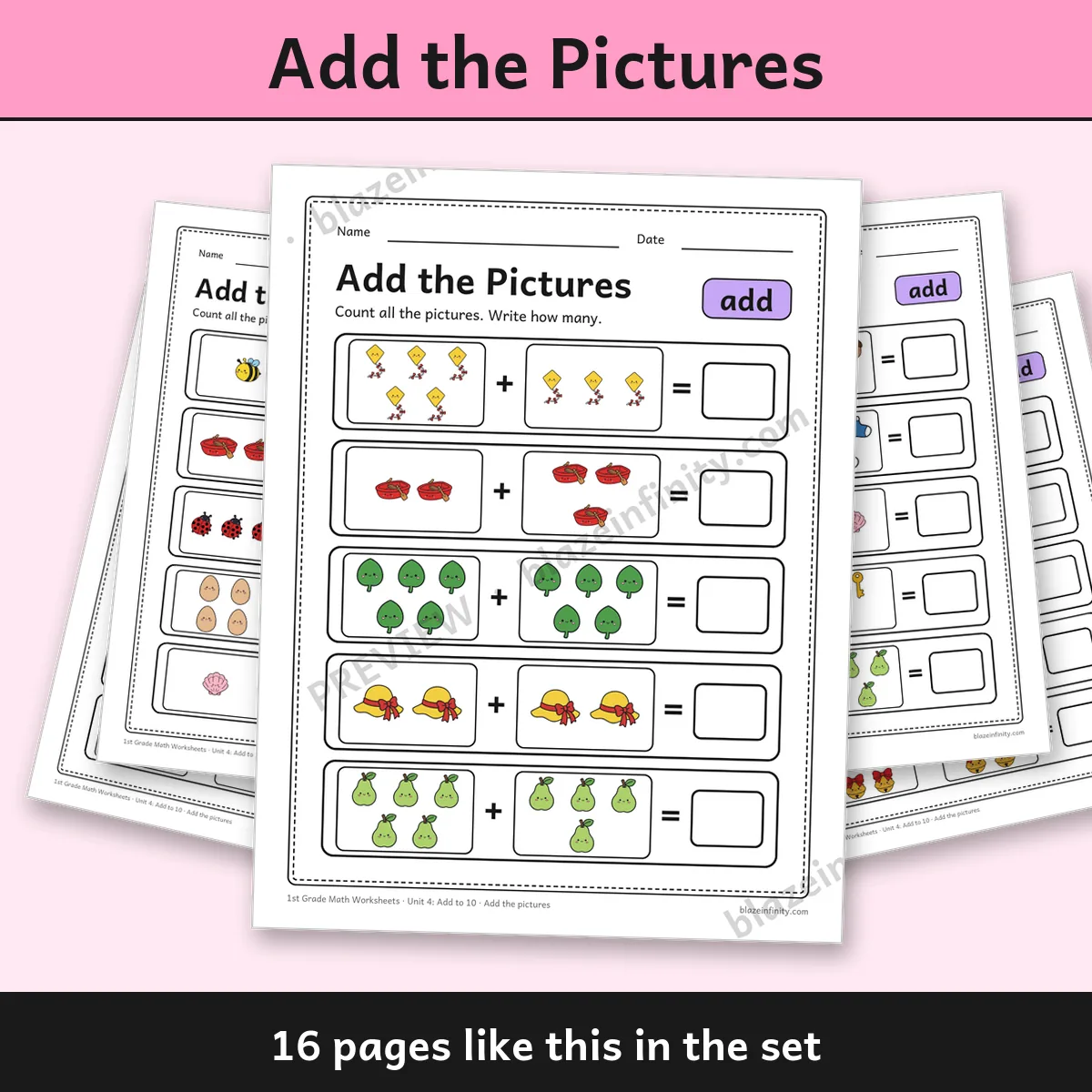
The full set for this skill
1st Grade Math Worksheets
833 worksheets in twelve units. Every unit goes in steps: pictures first, then a model (ten frame, number line, number bond, blocks), then the numbers on their own. An answer key follows every page that can be marked.
- 833 worksheets in 12 units
- An answer key after every page that can be marked
- Adding and taking away within 10, then within 20
- Number lines, number bonds, ten frames and tens-and-ones blocks
- Telling time to the hour and the half hour