









MLK Day Activities for Kindergarten: An Honest, Gentle Plan
How to teach five- and six-year-olds who Dr. King was in plain, honest words, with a read-aloud, a fair or unfair sort, dream writing and a service project.
In short
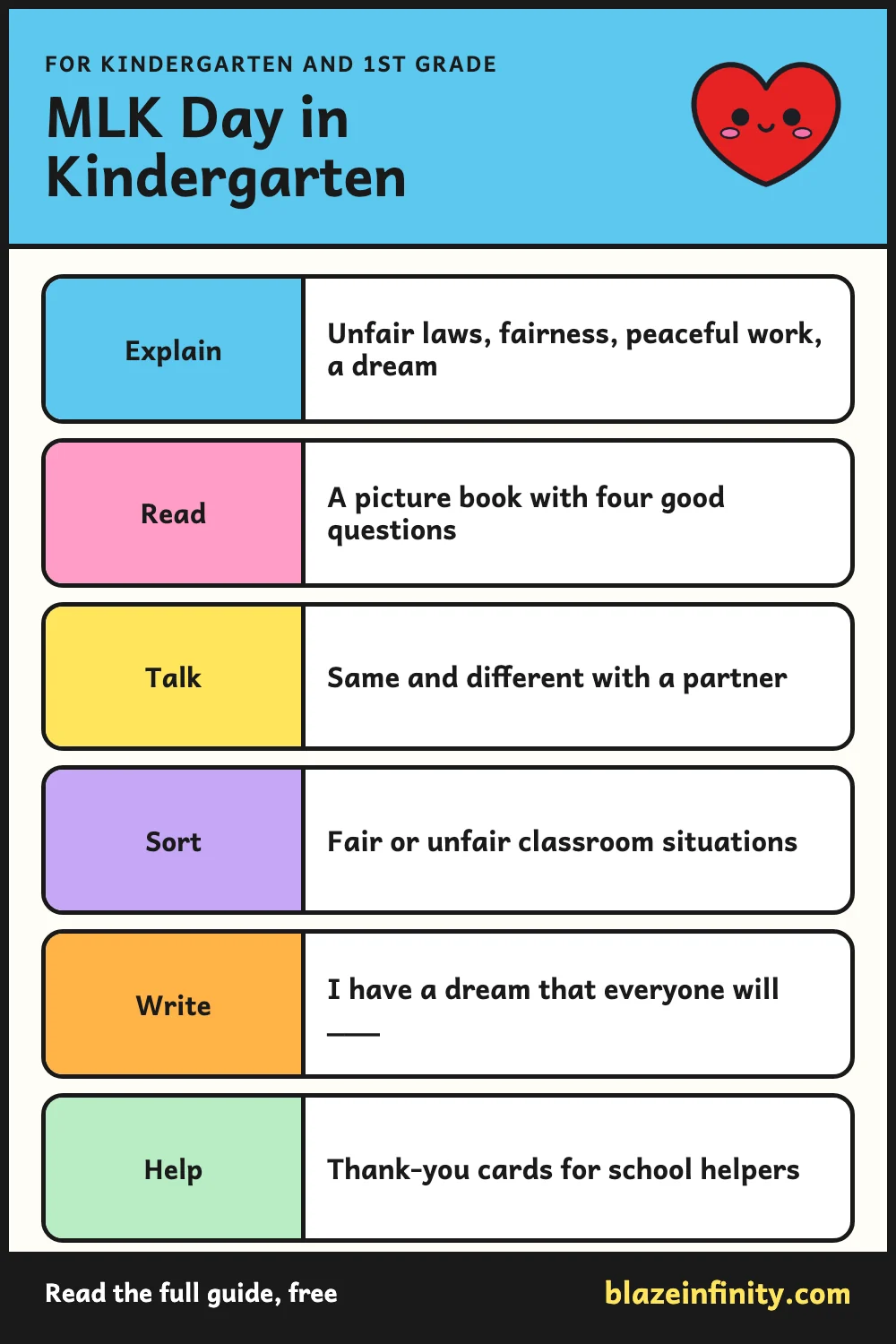
- Explain Dr. King in four short, true steps: unfair laws, fairness, peaceful work with many others, and his dream.
- Teach fairness through talk, true stories and kindness, never through activities that treat some children unfairly.
- Give children honest, calm, short answers to hard questions, then stop and listen.
Martin Luther King Jr. Day falls on Monday, January 18, 2027, the third Monday of January. Many schools are closed that day, so most kindergarten classes learn about Dr. King on the Friday before or during the week of the holiday. That Friday, January 15, is his birthday (he was born on January 15, 1929), which gives you a natural way to begin: "Today is the birthday of a man named Martin Luther King Jr. Let's find out who he was."
Five- and six-year-olds can understand more than we sometimes expect, as long as we use short, true sentences and give them something to do with what they feel. Below are the words to use, five activities, changes for preschool and first grade, and answers to hard questions.
Who was Dr. King? Words a five-year-old understands
Dr. King was a minister from Atlanta, Georgia, who became a leader of many people working together for fair laws and equal rights for Black Americans. He believed in changing unfair rules in peaceful ways: marching, speaking and singing, without hurting anyone. Young children do not need a long list of dates. They need four ideas, in order. Say them on the rug one at a time, and pause after each one to let children react.
- 1
Long ago, some laws were unfair
"A long time ago, long before you were born, many places had laws that kept people apart because of the color of their skin. Black people were not allowed to go to the same schools, sit in the same seats or drink from the same water fountains as white people. That was unfair." - 2
Dr. King wanted every person treated fairly
"Martin Luther King Jr. was a minister. He believed that every person should be treated fairly, no matter what color their skin is." - 3
He used peaceful ways, and many people helped
"He did not fight with fists. He used his words. He and many, many other people marched, gave speeches and asked for the laws to change. It took a long time and a lot of brave people, and many of the unfair laws were changed." - 4
He told everyone about his dream
"He gave a famous speech about his dream. He dreamed that one day children would be treated by how they act and how they treat others, not by the color of their skin. People are still working on that dream today, and we can help."
That script names the unfairness plainly, because a vague "people were not nice to each other" leaves children unsure what Dr. King worked for. And it ends with something hopeful and true: the work goes on, and children can be part of it by being fair and kind.
Five Martin Luther King Jr. activities for kindergarten
You can run all five across a week, or pick two for the Friday before the holiday. Each one takes 15 to 25 minutes.
1. A read-aloud with four good questions
Teaches: listening and retelling a true storyYou need: one picture book about Dr. King20 minutes
Two well-known picture books are Martin's Big Words: The Life of Dr. Martin Luther King, Jr. by Doreen Rappaport, illustrated by Bryan Collier and named a 2002 Caldecott Honor book, and My Brother Martin by Christine King Farris, his older sister, who writes about growing up with him. Read any book yourself before you read it to the class. Many include his death, so decide ahead of time how you will read that page.
After reading, ask:
- "What was unfair in this story?"
- "What did Dr. King do about it?"
- "Why do you think he used words and marches instead of fighting?"
- "What is one way you can be fair at school?"
For more questions that work after any read-aloud, see our guide to reading comprehension in kindergarten.
2. Same and different talk
Teaches: noticing and respecting differencesYou need: a partner for each child15 minutes
Partners sit knee to knee and find two ways they are the same and two ways they are different. Model it first with a child: "We both like apples. We both have a little brother. My hair is curly and yours is straight. I wear glasses and you don't."
Then ask the class: "Is it fair to treat someone differently because their hair is curly? Because they wear glasses? Because of the color of their skin?" Most children will say no. Close with: "Being different is not a reason to be treated unfairly. Dr. King worked for that too."
If a child names skin color as a difference, that is fine and true: "Yes, your skin is a different color from your partner's. People come in lots of beautiful colors." Let children share only what they offer, and never ask one child to speak for their family or for other people with the same skin color.
3. Fair or unfair sort
Teaches: the idea of fairness, in a child's worldYou need: six situations read aloud; two signs that say fair and unfair15 minutes
Fairness is the part of Dr. King's work a kindergartner can grab hold of, because they think about it every day. Read each situation; children stand by the fair or unfair sign and tell why.
- Everyone gets a turn on the swing.
- Only children with blue shirts may play with the blocks.
- The class votes on which book to read.
- A child is told he cannot sit at a table because he is new.
- The teacher listens to both children before deciding what happened.
- Only the tallest children may line up first, every day.
Keep every situation in the classroom. The point is to practice noticing unfairness and saying why, not to act it out. After the sort, link it back: "When a rule leaves people out because of how they look, it is unfair. Dr. King worked to change rules like that."
4. "I have a dream" writing
Teaches: writing a sentence about an ideaYou need: paper with a drawing box and lines; sentence frames on the board25 minutes
Each child finishes one sentence and draws a picture to match. Write two or three frames on the board and let children choose:
- "I have a dream that everyone will ___."
- "My dream is for my school to be ___."
- "I can help by ___."
Talk first, write second: each child says their sentence to a partner before picking up a pencil. Expect answers like "be kind," "share," or "play together." Those are exactly right for this age. Bind the pages into a class book titled Our Dreams and keep it in the class library.
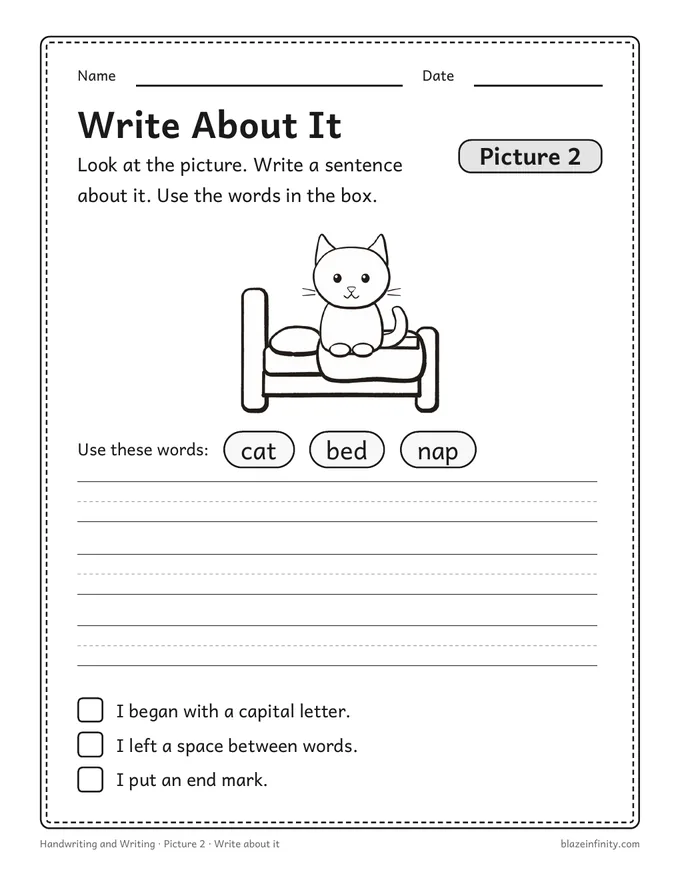
Use that page the day before the dream writing, as a warm-up. It is not about Dr. King, but it practices the same steps the dream page needs: look at the picture, think of a sentence, use the word box, write it on the lines. If your class is still building pencil control, our guide to kindergarten handwriting covers what to expect.
5. A kindness and service project
Teaches: that everyone can help their communityYou need: paper, crayons, and a plan for one small project20 to 30 minutes
In 1994 Congress made the King holiday a national day of service, often called "a day on, not a day off." A class project shows children that Dr. King's dream is something people do, not just something they remember.
Choose one project the class can finish in a single session:
- Thank-you cards for the custodians, cafeteria staff, bus drivers or office staff.
- A helping hands chain: each child traces a hand, writes or draws one way they will help, and the hands are linked down the hallway.
- A clean-up walk around the classroom or playground, with gloves and a grown-up in charge.
Say: "Dr. King asked people to help each other. Today we are helping too."
Why we skip activities that make children feel unfair treatment
Some ideas online split children by eye color and treat one group worse, or crack open a brown egg and a white egg to show they are the same inside. Leave these out. Learning for Justice advises against simulations that can cause emotional harm and against grouping children by traits tied to real unfair treatment, such as race. Young children feel a pretend unfairness as real, and the hurt can fall hardest on children who already face it outside school. The egg lesson compares people to eggs, and five-year-olds tend to remember the eggs, not the point. Talk, true stories and kind acts teach the same lesson without singling anyone out.
MLK Day activities for preschool and first grade
For preschool (ages 3 and 4): keep it to two ideas: "Dr. King wanted everyone to be treated fairly, and he used kind words, not fists." Skip the fair or unfair sort, or make it three situations with thumbs up and thumbs down. Same and different works well with a mirror and a friend. The dream page becomes a drawing of "something kind I can do," and you write down the words the child tells you.
For first grade: add a little more history. Children can learn that after Rosa Parks was arrested for not giving up her bus seat, Dr. King helped lead a bus boycott in Montgomery, Alabama, where people stopped riding the city buses for more than a year until the rules changed, and that he won the Nobel Peace Prize in 1964. The dream writing can grow to two or three sentences: one dream, one reason, one way to help. Our list of early finisher activities for first grade has more for the rest of the week.
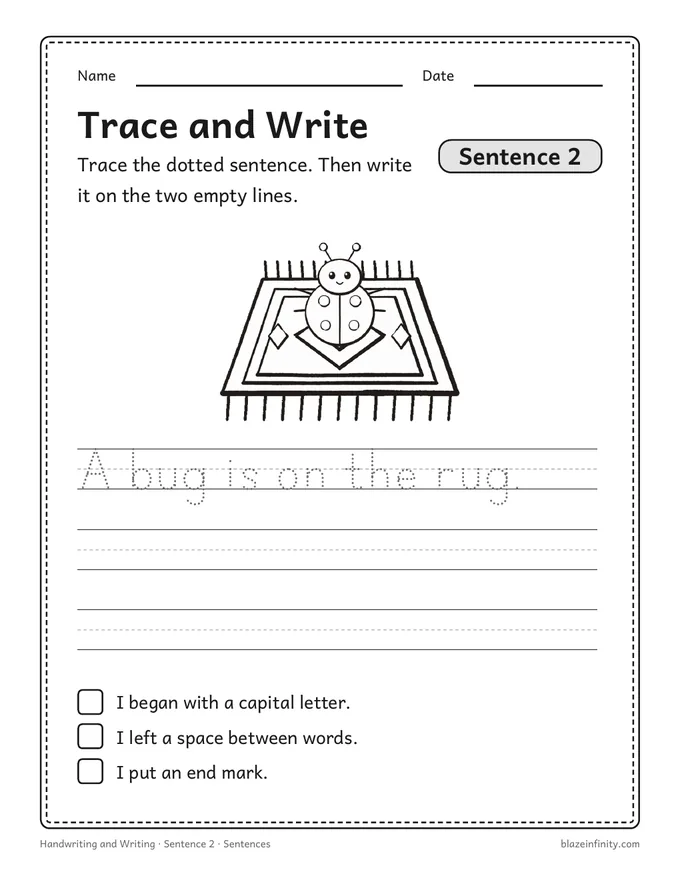
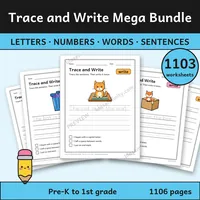
Give this sheet to children not yet ready to write a sentence of their own. Tracing a sentence, then writing it on the lines, builds the steadiness the dream page needs. It is general handwriting practice, not an MLK Day page.
What to say when a child asks a hard question
Children ask honest questions on this topic, and they deserve honest answers. Keep your voice calm and your answer short. If you do not know, "That is a good question. Let's find out together" is a fine answer.
| If a child asks | You can say |
|---|---|
| "Is Dr. King still alive?" | "No. He died in 1968, a long time ago, long before you were born." |
| "How did he die?" | "A man who did not like what he was working for shot him, and he died. That was a long time ago. People are still working on his dream today." |
| "Are the unfair laws still here?" | "Those laws were changed. That happened because many people worked hard and peacefully. People are still working to make sure everyone is treated fairly." |
| "Would I have been allowed in this school?" | "Back then, in many places, children were sent to different schools because of the color of their skin. That was unfair, and it changed. Today this is your school, and every one of you belongs here." |
| "Was it only Dr. King?" | "No. Many, many people worked with him: grown-ups, teenagers and even children. He was one leader of a lot of brave people." |
| "Why were people mean like that?" | "Some people believed something that was not true: that skin color makes a person better or worse. It does not. What matters is how we treat each other." |
If a child asks how he died, give that answer and stop there, with no added detail. If a child seems worried, bring them back to the present: "You are safe here. In our class, we treat everyone fairly." Send a short note home the day before saying what you will read, and tell families if his death came up, so they can continue the conversation in their own way.
A simple plan for the Friday before MLK Day
Morning: the four-step explanation, then the read-aloud with questions. After a break: the fair or unfair sort. Afternoon: the dream writing, with a few pages shared aloud. End by making thank-you cards for one school helper and delivering them together.
Neither of our writing sets has MLK Day pages, but both build the skills the dream page uses. Handwriting and Writing (kindergarten and first grade) has every letter and number, 60 pictured words, 20 traced sentences and 20 picture writing prompts. Directed Drawing and Writing (kindergarten and first grade) has 58 directed drawing and writing pages, each with step pictures, a drawing box and a sentence to finish with a word box. More free pages are on our free worksheets page, and our winter activities for kindergarten and 100th day of school activities carry you through the season.
What the research says
- Dr. King was born in Atlanta, Georgia, on January 15, 1929, entered the Christian ministry, was the architect of the non-violent strategy for the Montgomery bus boycott that followed the arrest of Rosa Parks, and received the Nobel Peace Prize in 1964. [1]
- Dr. King served as spokesman for the Montgomery Bus Boycott from 1955, won the Nobel Peace Prize in 1964 at age 35, and was assassinated on April 4, 1968, at the Lorraine Motel in Memphis, Tennessee. [2]
- The Montgomery bus boycott ran from December 5, 1955, to December 20, 1956, a 13-month protest that ended after the U.S. Supreme Court ruled bus segregation unconstitutional. [3]
- Quote, word for word: "I have a dream that my four little children will one day live in a nation where they will not be judged by the color of their skin but by the content of their character." Delivered at the March on Washington on August 28, 1963. [4]
- Dr. King delivered the 1963 "I Have a Dream" speech from the upper landing of the Lincoln Memorial steps during the March on Washington. [5]
- The federal holiday Birthday of Martin Luther King, Jr. falls on Monday, January 18, 2027. [6]
- In 1994, Congress designated the Martin Luther King Jr. Federal Holiday as a national day of service, a "day on, not a day off." [7]
- Martin's Big Words: The Life of Dr. Martin Luther King, Jr. is by Doreen Rappaport, illustrated by Bryan Collier, a 2002 Caldecott Honor book. [8]
- Christine King Farris (born 1927) was the elder sister of Martin Luther King Jr. and wrote the children's book My Brother Martin (2003). [9]
- Learning for Justice advises avoiding simulations that can trigger emotional traumas and not grouping students by characteristics that represent real-life oppression, such as race. [10]
Sources
- National Park Service, Martin Luther King, Jr. Memorial, People
- The King Center, About Dr. King
- Martin Luther King, Jr. Research and Education Institute, Stanford University, Montgomery Bus Boycott
- National Park Service, Little Rock Central High School NHS, I Have a Dream speech text (lesson plan handout)
- National Park Service, Lincoln Memorial Steps
- U.S. Office of Personnel Management, Federal Holidays
- U.S. Army, About Martin Luther King, Jr. Day of Service
- American Library Association, award winner record
- Wikipedia, Christine King Farris
- Learning for Justice, Classroom Simulations: Proceed With Caution (2008)
Common questions
- How do I explain Martin Luther King Jr. to a kindergartner?
- Use four short ideas: long ago some laws kept people apart because of skin color, and that was unfair; Dr. King believed everyone should be treated fairly; he and many others used peaceful ways to change the laws. Then add that he dreamed children would be judged by how they act, not by their skin color.
- When is MLK Day 2027?
- Monday, January 18, 2027, the third Monday of January. Many schools are closed, so classes often learn about Dr. King on Friday, January 15, which is his birthday.
- What MLK Day activities work for preschool?
- Keep it to two ideas: Dr. King wanted everyone treated fairly, and he used kind words, not fists. Try a same and different talk with a friend and a drawing of one kind thing the child can do.
- Should I do the brown egg and white egg activity or an eye color activity?
- No. Activities that treat some children worse on purpose can hurt, especially children who already face unfair treatment. Talk about fairness, read true stories and do kind things together instead.
- What do I say if a child asks how Dr. King died?
- Keep it short and calm: "A man who did not like what he was working for shot him, and he died. That was a long time ago. People are still working on his dream today." Then stop, listen, and let families know the question came up.

The full set for this skill
Handwriting and Writing
Letters and numbers, pictured words, traced sentences and picture prompts. Every tracing line is a single row of dots on a three-line rule.
- Trace and write every letter, Aa to Zz
- Numbers 0 to 9
- 60 short vowel words beside their pictures
- 20 sentences to trace and copy, each with a matching picture
- 20 picture prompts with a word box