



















One More One Less Activities from Kindergarten to 1st Grade
One more one less in four stages, from within 10 in kindergarten to ten more ten less in first grade, with a model and a quick game for each.
In short
- One more is the next number when you count; one less is the number just before it.
- Teach it in four stages: within 10, within 20, to 100, then ten more and ten less.
- Crossing a ten (39 to 40, 40 to 39) is the hardest part. Practice it on purpose.
- Ten more changes only the tens digit. One more can change both digits.
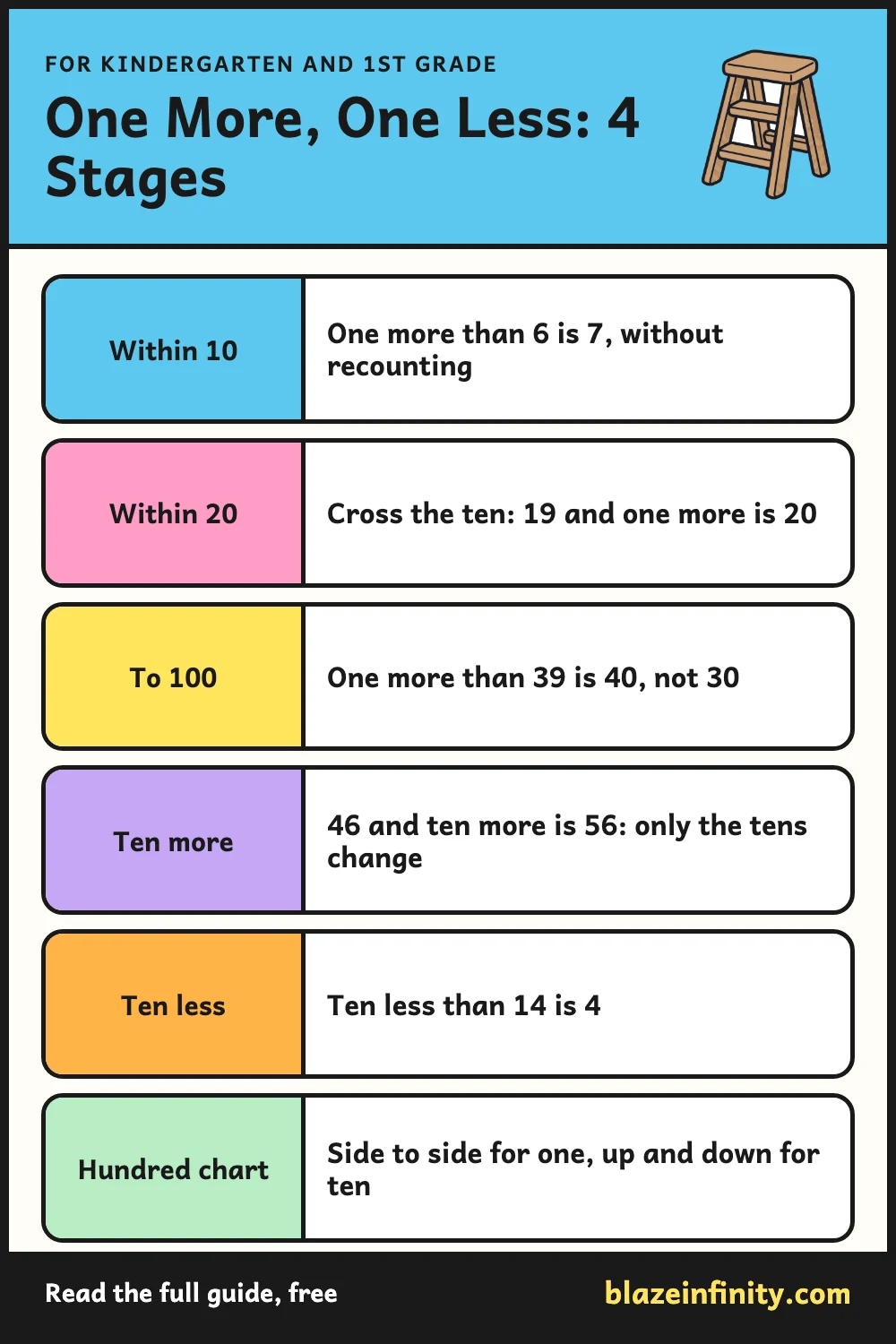
One more is the number that comes next when you count. One less is the number just before it. One more than 7 is 8, and one less than 7 is 6. That takes ten seconds to explain. What takes two school years is the reach: from 7 to 17, then to 39, and finally to knowing that ten more than 46 is 56 without counting at all.
Below, the skill is split into four stages, from the start of kindergarten to the end of first grade. Each has what the child should be able to do, a model to show it, and one quick game. Then come one more and ten more side by side, and the mistakes that show where a child is stuck.
The four stages at a glance
K, fall
One more, one less within 10
Says the number after and before any number to 10 without counting from one. Shows it with counters.K, spring
Within 20
Crosses from 9 to 10 and from 19 to 20, both ways. Sees 14 as ten and 4 more.1st, fall
Within 100
Finds one more and one less than any two-digit number, including the hard ones like 39 and 40.1st, spring
Ten more, ten less
Finds ten more and ten less in their head and can say why only the tens digit changed.
The seasons are a suggestion; the standards set the end points. Common Core asks kindergartners to understand “that each successive number name refers to a quantity that is one larger.” Texas names the skill for kindergarten: one more or one less “up to at least 20.” In first grade, Common Core asks children to “mentally find 10 more or 10 less” than a two-digit number “without having to count.” Move a child on when the stage before is quick, whatever the month.
Stage 1: one more and one less within 10
By the end of this stage, the child can
- Add one counter to a group and say the new number without recounting from one
- Take one away and say the new number
- Say the number that comes after and before any number from 1 to 10
A ten frame does a lot of the work here. One more fills the next empty box. One less takes away the last counter. Because the boxes always fill in the same order, a child sees 7 as a full row and two more.
Under the Cup
Teaches: One more and one less without recountingYou need: A paper cup and 10 counters5 minutes (suggested)
A child who still counts every dot on a ten frame is not ready for one more yet. Warm up with ten frames to count first.
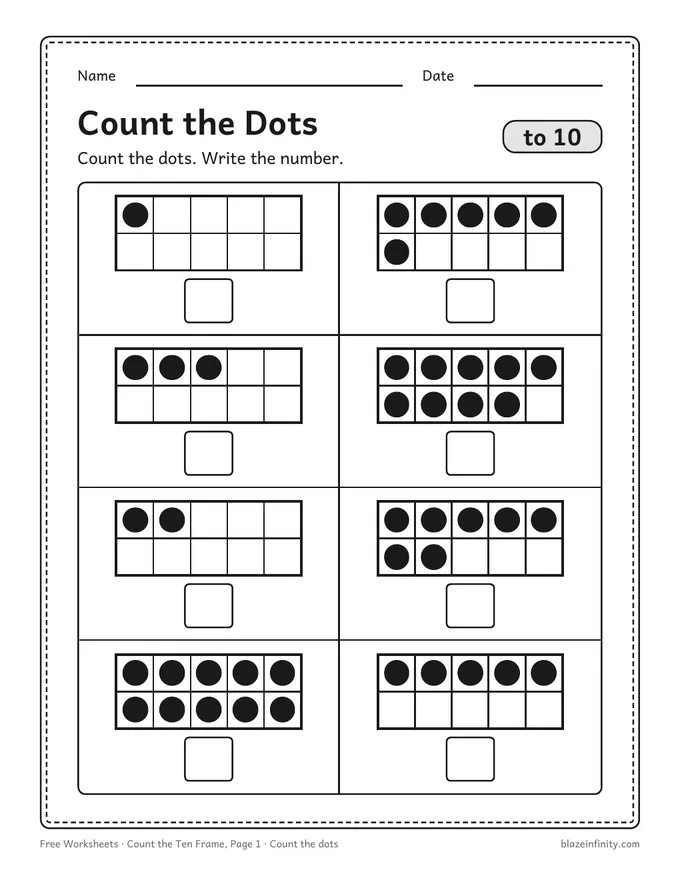
Stage 2: within 20
By the end of this stage, the child can
- Say one more and one less than any number from 1 to 19
- Cross a ten both ways: 9 to 10, 10 to 9, 19 to 20 and 20 to 19
- Say that one less than 1 is 0
A number line shows that one more is one hop forward and one less is one hop back. The child’s finger starts on the number, not on zero.
For teen numbers, put a full ten frame beside a second frame. One more is one more counter on the second frame, and the ten never moves.
Who Are My Neighbors?
Teaches: One more and one less within 20You need: Number cards 0 to 20, one per child5 to 10 minutes (suggested)
On this page, watch the rows for 1 and 19: one less than 1 is 0, and one more than 19 is 20.

Stage 3: first grade, one more and one less to 100
By the end of this stage, the child can
- Say one more and one less than any number to 100 without counting up from a smaller number
- Cross a ten both ways: 39 and one more is 40, and 40 and one less is 39
- Say which digit changed
Common Core asks first graders to count to 120 “starting at any number less than 120,” so once 100 is easy, keep going to 120.
The hundred chart is the model for this stage. One more is one square to the right and one less is one square to the left.
Show one thing before children lean on the chart. On a 1 to 100 chart every row ends with a ten, so one more than 39 is right next door, but one more than 40 is at the start of the next row. Trace that jump with a finger once. Our free hundred chart worksheets have charts to fill in.
Mystery Number
Teaches: One more and one less to 100You need: A hundred chart and whiteboards5 minutes (suggested)
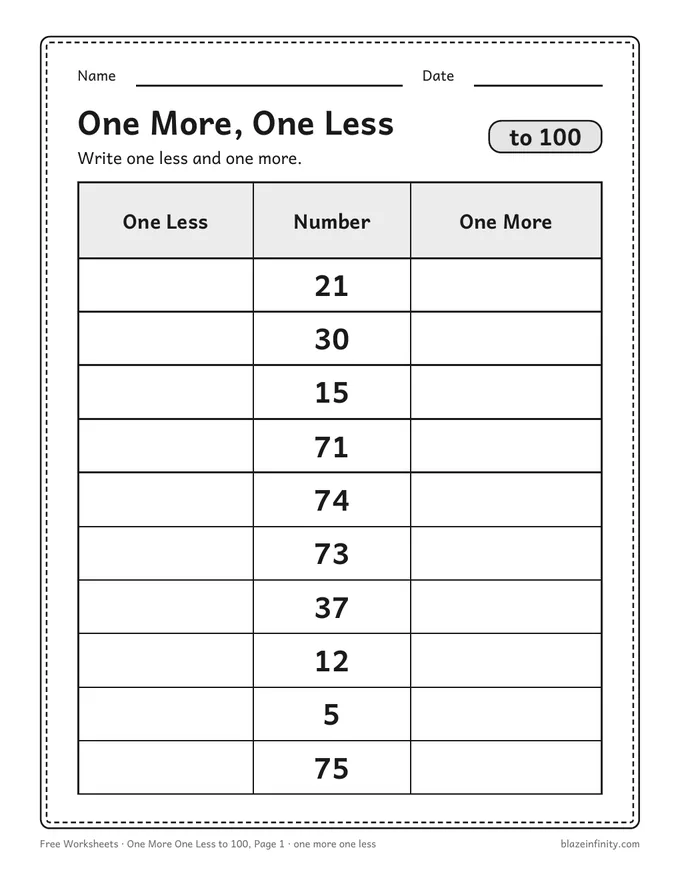
A page at this stage should jump around so the child cannot copy a pattern down the column. This one does. Its row for 30 crosses a ten going back, so one less is 29, and its rows for 21 and 71 land on a ten: one less is 20 and 70.
Stage 4: ten more and ten less
By the end of this stage, the child can
- Find ten more and ten less than a two-digit number in their head
- Explain it: the tens digit goes up or down by one, and the ones digit stays the same
- Say that ten less than 14 is 4, a number with one digit
First, a child should be able to build a two-digit number from tens and ones (our place value guide covers that). Then ten more is simply one more ten.
On the hundred chart, ten more is one square straight down and ten less is one square straight up. One more and one less still go side to side.
Try one yourself before you open the answer.
Fill in the four empty squares around 58. (tap to check)
Flip and Build
Teaches: Ten more and ten lessYou need: Base-ten blocks or bundles of ten straws, and a coin10 minutes (suggested)
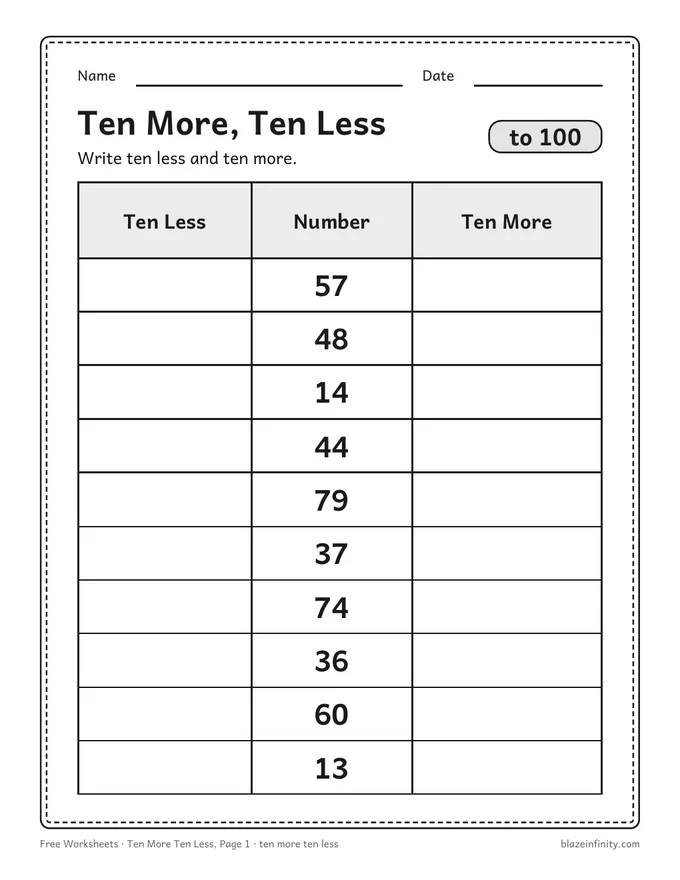
This page mixes in 14 and 13, where ten less leaves a one-digit number, and 60, where the ones digit is a zero that has to stay a zero.
One more and ten more, side by side
| One more, one less | Ten more, ten less | |
|---|---|---|
| Example | 47 becomes 48 or 46 | 47 becomes 57 or 37 |
| Digit that changes | The ones digit, by one | The tens digit, by one |
| Digit that stays | Usually the tens. Not when you cross a ten: 39 to 40 changes both digits | The ones digit, every time |
| On a hundred chart | One square right or left | One square down or up |
| With base-ten blocks | Add or take away one cube | Add or take away one ten |
| Watch for | 39 to 40, 40 to 39, 19 to 20, 1 to 0 | Ten less than a teen number (14 to 4); ten more than a number in the 90s goes past 100 |
Once ten more is easy, mix one more and ten more questions, so the child has to listen for which one you asked.
Mistakes that show where a child is stuck
If you see
Counts the whole pile from one to find one more.
The child does not yet trust that the next number is one more. This is Stage 1.
Try this
If you see
Says one more than 39 is 30, or “thirty-ten.”
The child changed only the ones digit and does not know which ten comes next.
Try this
If you see
Says one less than 40 is 49 or 30.
Going back across a ten is harder than going forward.
Try this
If you see
Gives one more when you asked for one less.
The child hears “one” and adds.
Try this
If you see
Says ten more than 46 is 47.
The child added a one, not a ten.
Try this
If you see
Gets stuck on ten less than 14, or says there is no answer.
The child expects every answer to have two digits.
Try this
A minute a day
Short, frequent questions do more than one long lesson. At the door: “Line up when you can tell me one less than 20.” At calendar: “Tomorrow is one more. What date will it be?” At home, use page numbers in a bedtime book or steps on the stairs.
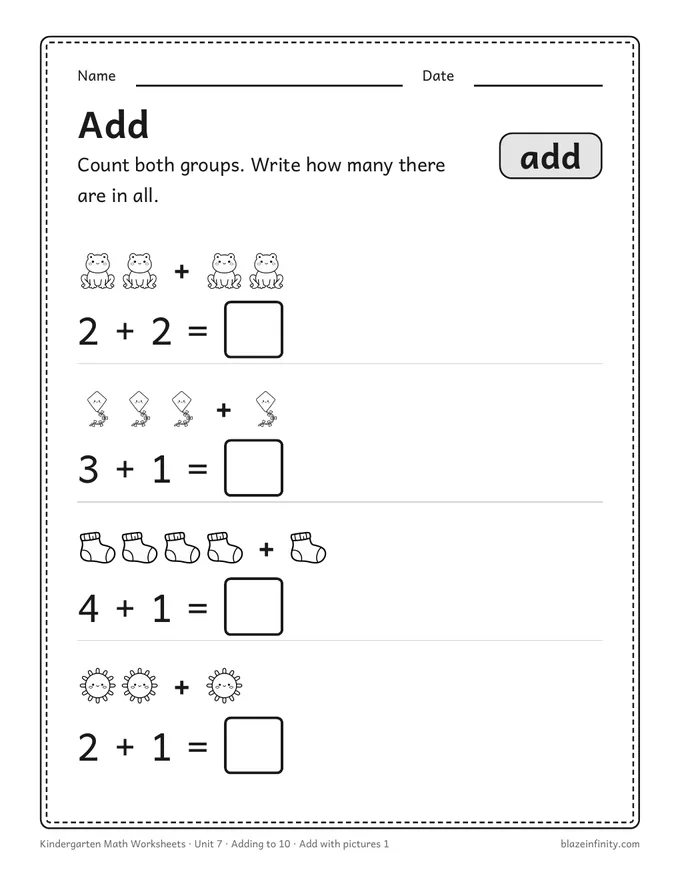
Counting on and counting back grow straight out of this skill; our guides on addition strategies and subtraction strategies pick it up from there. For ready pages for the kindergarten year, the Kindergarten Math Worksheets set has a unit on more and less, with answer keys. Like every unit in the set, it starts with pictures, moves to ten frames and number lines, and ends with numbers on their own.
What the research says
- Kindergarten: “Count forward beginning from a given number within the known sequence” and “Understand that each successive number name refers to a quantity that is one larger.” [1]
- First grade: count to 120 “starting at any number less than 120”; “mentally find 10 more or 10 less than the number, without having to count.” [2]
- Texas kindergarten: “generate a number that is one more than or one less than another number up to at least 20.” [3]
Sources
- Common Core State Standards for Mathematics, K.CC.A.2 and K.CC.B.4c
- Common Core State Standards for Mathematics, 1.NBT.A.1 and 1.NBT.C.5
- 19 Tex. Admin. Code § 111.2(b)(2)(F)
Common questions
- How do you explain one more and one less to a child?
- Use objects first. Show a group, add one and ask how many now without recounting, then take one away. Then tie it to counting: one more is the number that comes next, and one less is the number just before.
- Is one more one less a kindergarten skill?
- Yes. It starts in kindergarten with numbers to 10 and then to 20. In first grade children use it with numbers to 100 and 120, and add ten more and ten less.
- What is ten more and ten less?
- Ten more is the number you get when you add a ten, and ten less is the number you get when you take a ten away. Only the tens digit changes: ten more than 46 is 56, and ten less is 36.
- What is one more than 39?
- One more than 39 is 40. Both digits change, because the ones run out at 9 and the count moves on to the next ten. Children often say 30, so it is worth practicing on purpose.
- How do you use a hundred chart for one more one less?
- One more is one square to the right and one less is one square to the left. Ten more is one square down and ten less is one square up.
The full set for this skill
Kindergarten Math Worksheets
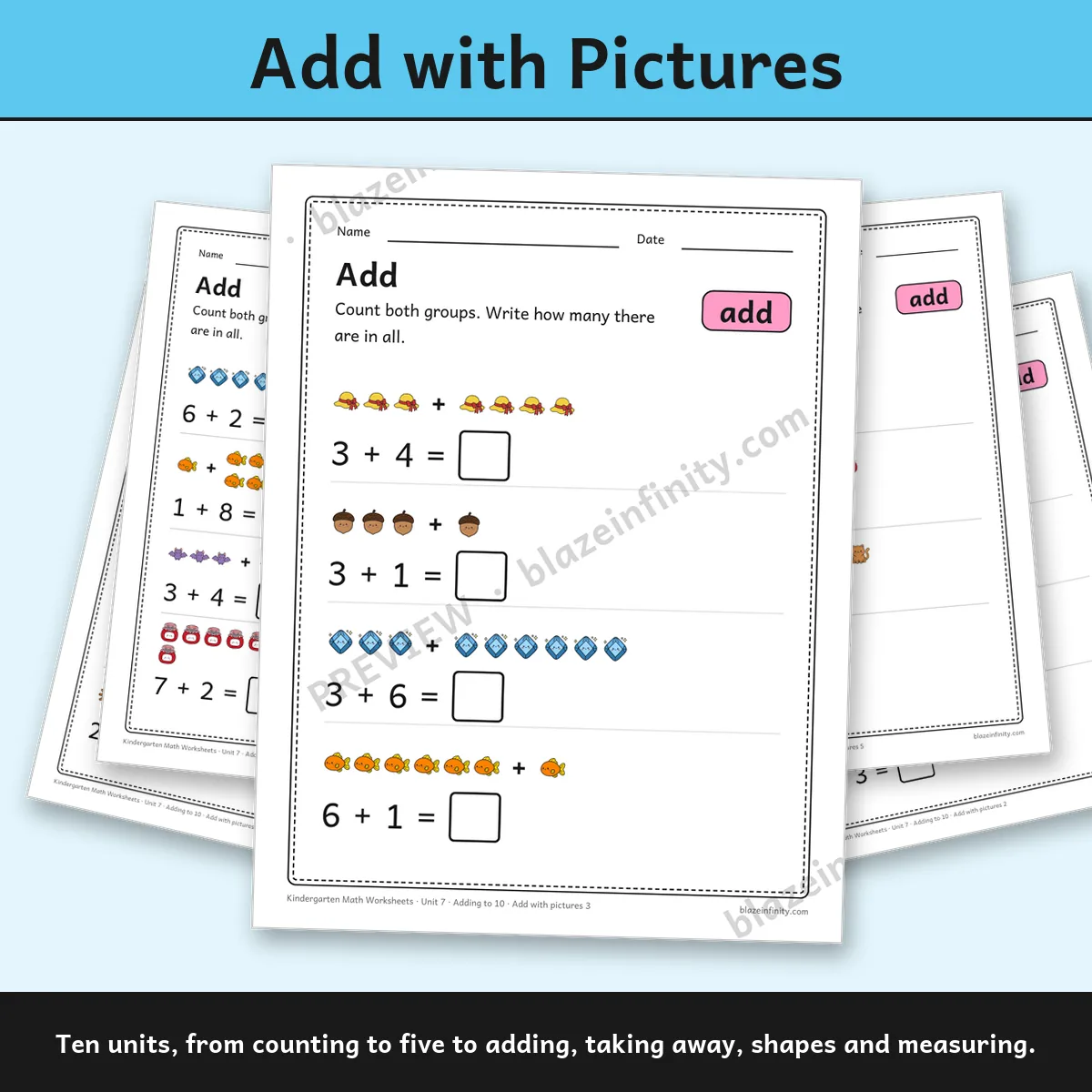
300 worksheets in ten units. Every unit goes in steps: pictures first, then ten frames and number lines, then numbers on their own. Each unit ends with mixed review and two check-ups.
- 300 worksheets in 10 units, with answer keys
- Steps in every unit: pictures, ten frames, number lines, then numbers
- Story problems for adding and taking away
- Mixed review and two check-ups in every unit
- A progress record for each child