









Snowman Activities for Kindergarten: Math, Literacy and STEM
Snowman activities for kindergarten sorted by skill, with a melting snowman investigation, a build-a-snowman dice game and changes for Pre-K and 1st grade.
In short
- Pick snowman activities by the skill they practice: math, literacy, science and STEM, or fine motor.
- A melting snowman becomes science when children predict first, keep the test fair and record what they see.
- In Build a Snowman to 10, children say how many more they need after every roll.
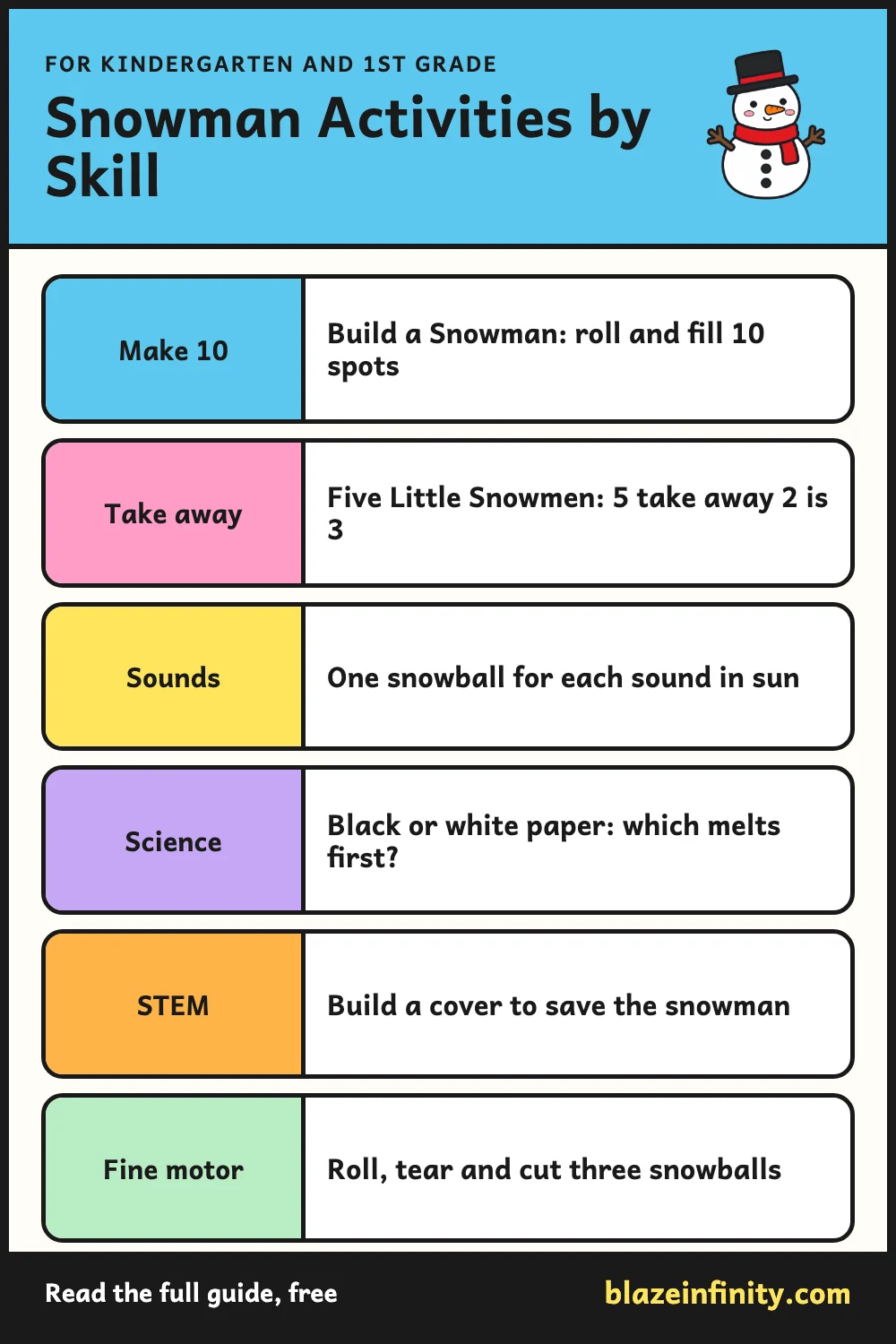
Every child in your class already knows what a snowman is made of: three balls, a face, a hat and a few buttons. That shape does a lot of teaching. Ten coal spots are a number to fill, three snowballs in a row are three sounds in a word, and a snowman in a sunny window is a science question. Here are nine snowman activities sorted by skill, none of which needs food, with changes for preschool and first grade at the end. Wider ideas such as mitten matching and the salt and ice experiment are in our winter activities for kindergarten guide.
Snowman activities at a glance
| Skill | Activity | Time | When it fits |
|---|---|---|---|
| Math | Build a Snowman to 10 | 15 minutes | Math centers, once you have started making 10 |
| Math | Five Little Snowmen | 10 minutes | Whole group on the rug |
| Literacy | Snowman Sound Strip | 5 minutes | Phonics warm-up |
| Literacy | Snowmen at Night writing | 30 minutes | Writing block, after the read-aloud |
| Science | The melting snowman investigation | 20 minutes, then checks for an hour | The first sunny morning |
| STEM | Save the Snowman | 40 minutes, then checks for an hour | The day after the investigation |
| Fine motor | Roll a Snowman | 10 minutes | Morning tubs |
| Fine motor | Tear and Glue Snowman | 15 minutes | Centers |
| Fine motor | Cut Three Circles | 15 minutes | Centers |
Snowman math activities
Both games practice counting out a set of objects, a kindergarten standard (K.CC.B.5), and the first adds the question behind making 10: how many more do I need?
Build a Snowman to 10
Teaches: counting on and how many more make 10You need: a snowman mat with 10 empty circles per child; 10 counters each; one dot die per pair15 minutes
Draw a snowman with ten empty circles: two eyes, five for the smile and three buttons. Players take turns rolling the die and covering that many circles with counters. After every turn the child says two sentences: "I have 6. I need 4 more." To finish, a player must roll exactly the number they need; if the roll is too big, they pass. The first snowman with all ten circles covered wins.
What to watch for: children who count every circle from one after each turn. Say: "You had 4. Touch the last one. Now keep counting." Keep the exact-roll rule: waiting for the right roll is when children work out how many more they need. If a pair keeps passing near the end, tape over the die faces to make 1, 2, 3, 1, 2, 3.
When a child cannot say how many more, lay their counters on a ten frame and count the empty boxes. Our ten frame activities guide has more make 10 games.
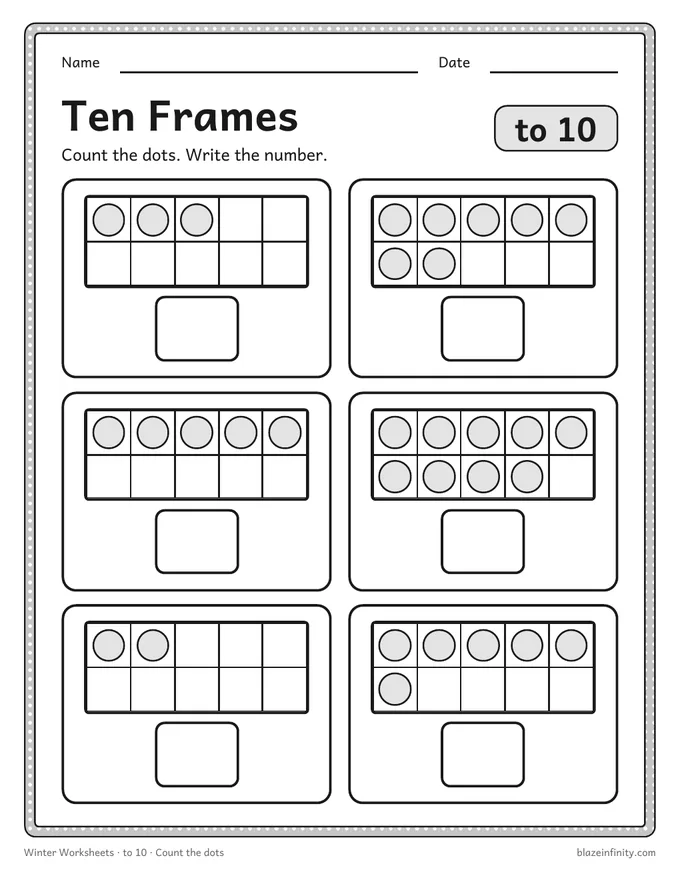
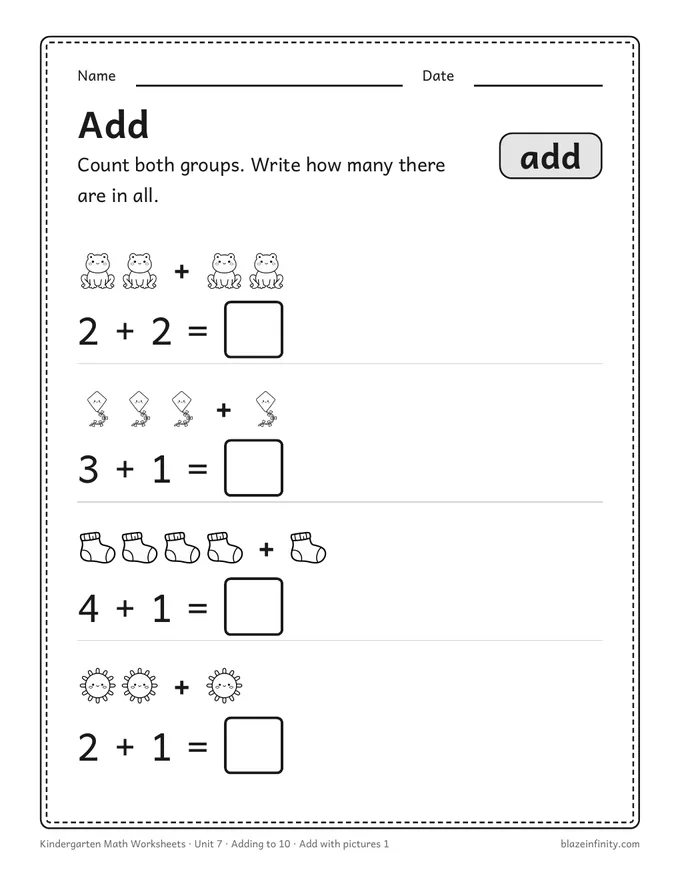
Use that page the day after the first game: children count the dots on each ten frame and write the number.
Five Little Snowmen
Teaches: taking away as a storyYou need: five paper snowmen and tape for the board; five counters per child10 minutes
Tape five paper snowmen in a row on the board and tell a story: "Five snowmen stood in the yard. The sun came out and two of them melted." Take two down while the children push two counters away from their row. Ask: "How many snowmen are still standing?" Write 5 − 2 = 3 and read it as "five take away two is three." Put the snowmen back and melt a different number.
What to watch for: children who give the number that melted instead of the number left. Point to the gap: "These melted. Count only the ones still standing." When five is easy, use eight, then ten.
Snowman literacy activities
Snowman Sound Strip
Teaches: hearing each sound in a three-sound wordYou need: a paper strip with three snowballs drawn in a row; three counters per child5 minutes
Say a word slowly, such as sun. Children push one counter into a snowball for each sound, /s/, /u/, /n/, then sweep a finger under the strip and say the word fast: "sun." Three or four words a day is enough.
What to watch for: children who push a counter for each letter name, or push all three while saying the word once. Say the sounds with them, one push per sound. Pick words with exactly three sounds: ship has four letters but three sounds, so it fits; stop has four sounds, so it does not.
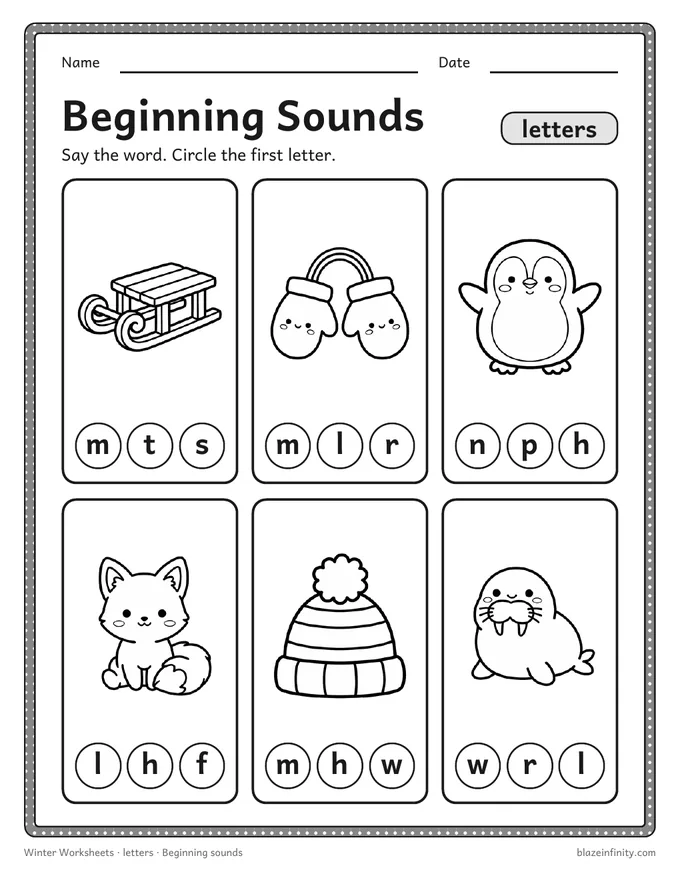
Use that page after a week of the sound strip. Children say each picture's name and circle its first letter, joining the sound they hear to a letter.
Snowmen at Night writing
Teaches: turning a spoken idea into a written sentenceYou need: the picture book Snowmen at Night by Caralyn Buehner; drawing paper with a sentence line30 minutes with the read-aloud
Read the book once for the story. On the second read, stop where the snowmen start to play and ask: "What would your snowman do at night while we are asleep?" Children tell a partner first, then draw their snowman and finish the sentence: "At night my snowman ___."
What to watch for: a full drawing with one word under it, or a sentence copied from a neighbor. Talking first fixes most of both: a child who has said "My snowman goes sledding" out loud has a sentence ready. Help them write the sounds they hear; spelling does not need to be right, and our kindergarten handwriting guide covers the letters. For a second book, Raymond Briggs's The Snowman has no words, so children tell what happens on each page before anyone writes.
If your class likes to draw first, the Directed Drawing and Writing pages follow the same order: step pictures to copy, a drawing box, then a sentence to finish with a word box for spelling help.
The melting snowman experiment: predict, test fairly, record
A melting snowman becomes an investigation, not a demonstration, when children predict first, keep the test fair and record what they see. It fits the kindergarten science standard about the effect of sunlight on Earth's surface (NGSS K-PS3-1). The question: in the sun, will a snowman in black paper melt faster than one in white paper?
You need: a sunny window; two clear plastic cups of the same size; one sheet each of black and white construction paper; tape; snow packed into the same scoop twice, or six ice cubes if you have no snow; a recording sheet folded into four boxes for each child. No hot water is used at any point.
- 1
Ask, then predict
Show the two papers: "We will put a snowman in each one, in the sunny window. Will one melt faster, or will they melt the same?" Each child puts a name sticky note in one of three columns: black, white or the same. Do this before anything is set up, so it is a prediction and not a guess from watching. - 2
Make the test fair
Ask: "What has to be the same for both snowmen?" Guide children to three answers: the same size snowman, the same sunny spot and the same start time. Pack one scoop of snow, or three ice cubes, into each cup. Wrap one cup in black paper and stand it on black paper; do the same in white. Only the color changes. - 3
Observe and record
Check every 15 minutes for an hour. Children peek in from the top and draw both snowmen in a box each time. Give them the words bigger, smaller, the same and more water. No thermometer is needed at this age. - 4
Compare the water
At the end, slide the paper off and stand the cups side by side: the one with less snow and more water melted more. Ask: "Which snowman melted more? Look at your sticky note. Was your prediction right?" - 5
Explain what happened
If the black cup melted more, give the reason in one sentence: dark colors take in more sunlight and warm up faster, and light colors bounce more of it away. Then ask: "Have you ever sat on a dark car seat on a sunny day? How did it feel?" If there was no clear difference, use the box below.
If you bring snow in from outside, remind children that snow and meltwater are for looking at, not tasting, and have everyone wash their hands after the last check.
Snowman STEM activities: save the snowman from the sun
Save the Snowman
Teaches: designing and testing a solution to a problemYou need: snowmen in clear cups, no paper this time; paper, foil, craft sticks, tape, paper cups and fabric scraps; a sunny window40 minutes, then checks for an hour
The day after the investigation, ask: "The sun melted our snowman. What could we build to keep the sun off it?" That is close to the kindergarten standard word for word: build a structure that reduces the warming effect of sunlight on an area (NGSS K-PS3-2). Each group draws a plan, then builds a cover from the materials table. One rule: the cover cannot touch the snow.
Put each group's snowman in the sunny window, with one snowman left uncovered beside them. Check after 30 minutes and after an hour. Groups compare their snowman with the uncovered one and with each other's, which is the K to 2 engineering standard for comparing two designs (K-2-ETS1-3).
What to watch for: covers that look like a little house but leave the snowman in the sun, because window light comes in from the side. Before testing, have a child hold a hand between the window and the snowman: if the snowman sits in the hand's shadow, a cover in that spot will work.
Snowman fine motor activities
Roll a Snowman
Teaches: hand strength and ordering by sizeYou need: white playdough; short pieces of pipe cleaner with the ends folded over; a little orange playdough10 minutes
Children roll a big, a middle and a small ball of white playdough and stack them. Ask: "Which ball goes on the bottom? Why?" Pipe cleaner pieces become arms and a pinch of orange playdough a nose. It replaces the marshmallow snowmen online with no food in the room. Most playdough contains wheat, so use a wheat-free dough if a child has a wheat allergy.
What to watch for: children who press the dough flat instead of rolling it. Show the roll between two flat palms. If the stack topples, press the bottom ball on the table to flatten its base.
- Tear and Glue Snowman: children tear one-inch strips of white paper into thumbnail-size pieces and glue them inside a snowman outline. Tearing works the pinch used on a pencil. If a child rips with a fist, show the pinch: both thumbs on top, one hand pulling toward you and one pushing away.
- Cut Three Circles: print three circles of different sizes with thick lines. Children cut them out, order them biggest to smallest and glue them up dark paper as a snowman. If they twist the scissors on the curve, say: "Thumb on top, turn the paper, not the scissors." A lumpy circle is fine.
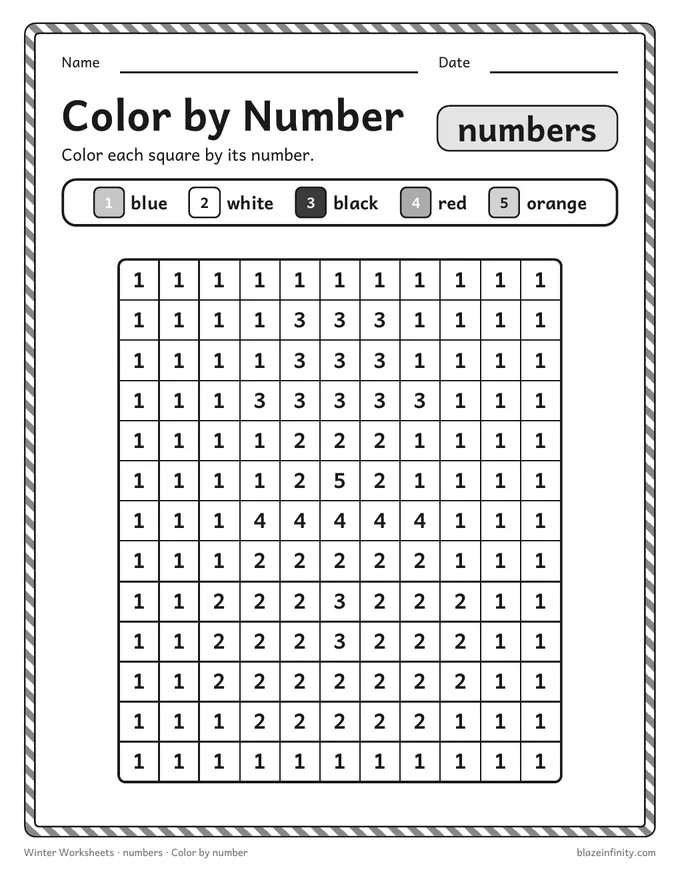
Use that page as a quiet finish or for early finishers: coloring each square by its number is more control practice.
Snowman activities for preschoolers and first grade
Every activity above works from Pre-K to first grade. What changes is the size of the numbers, how much children write and how much you set up.
| Activity | Preschool | First grade |
|---|---|---|
| Build a Snowman to 10 | Five circles (two eyes, three buttons) and a die marked 1, 2, 3; no exact-roll rule | Two snowmen with 20 circles and two dice; say the total as ten and some more |
| Five Little Snowmen | Three snowmen, acted out by children who sit down when they melt | Missing-part stories: 9 snowmen, some melted, 4 are left. How many melted? |
| Snowman Sound Strip | Clap the two parts of snowman instead of single sounds | Four-sound words on a strip with a fourth snowball |
| Snowmen at Night writing | The child tells the idea and you write it down | Three sentences: what the snowman did first, next and last |
| Melting investigation | Predict and look at the start and the end; draw one picture | Add a third color and put all three in order by how much melted |
| Save the Snowman | You build two covers; children predict which works, then test both | Label the plan, then improve the design and test it again |
| Fine motor | Rolling and tearing; cut straight strips before circles | Cut a hat and scarf too, and label the parts |
Planning a snowman week
You do not need all nine. A good snowman week is one math game played on three or four days; one literacy activity; the investigation on the first sunny morning, with Save the Snowman the day after; and the fine motor tubs out all week. If you have time for only one, make it the investigation.
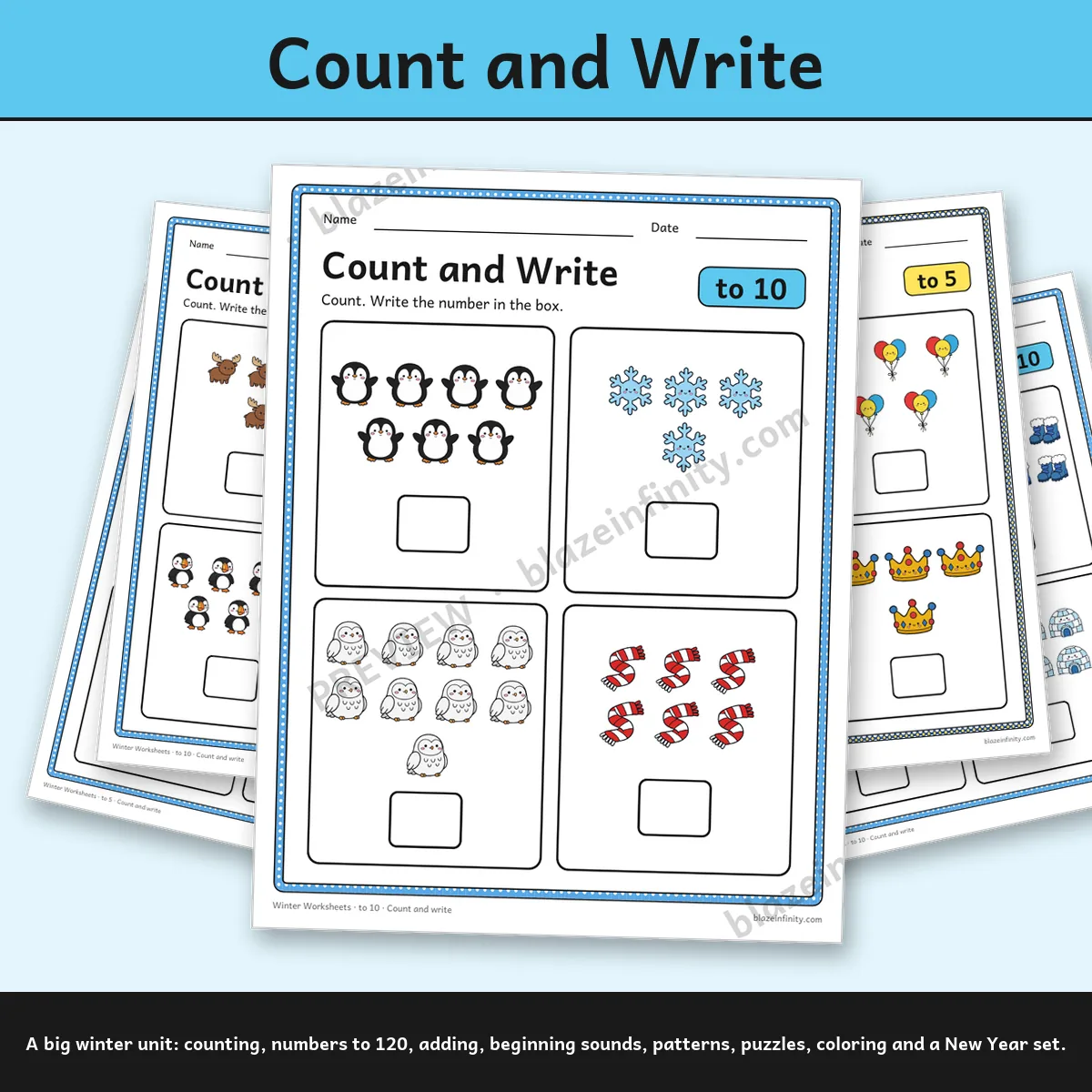
For printed practice, Winter Worksheets has more than 140 winter and New Year worksheets for Pre-K to first grade: counting, ten frames, skip counting, tens and ones, adding and taking away, beginning sounds, mazes, word searches, color by number and coloring pages, with answer keys and a black-and-white edition. For single pages to print today, see our free worksheets.
What the research says
- Kindergarten: make observations to determine the effect of sunlight on Earth's surface (K-PS3-1; assessment of temperature is limited to relative measures such as warmer/cooler), and use tools and materials to design and build a structure that will reduce the warming effect of sunlight on an area (K-PS3-2). [1]
- K to 2 engineering: analyze data from tests of two objects designed to solve the same problem to compare the strengths and weaknesses of how each performs (K-2-ETS1-3). [2]
- Darker colors absorb more sunlight than lighter colors and get warmer more quickly in sunlight; lighter colors reflect more of the sun's energy. The grade 1 activity puts ice cubes in white, yellow, red and black paper boxes in the sun. [3]
- Kindergarten: count to answer how many questions about as many as 20 things, and given a number from 1 to 20, count out that many objects (K.CC.B.5). [4]
Sources
- Next Generation Science Standards, Kindergarten, PS3 Energy.
- Next Generation Science Standards, K-2 Engineering Design.
- TeachEngineering (University of Colorado Boulder), Do Different Colors Absorb Heat Better?
- Common Core State Standards for Mathematics, Kindergarten, Counting and Cardinality.
Common questions
- What are some snowman activities for kindergarten?
- A dice game to fill ten spots on a snowman, take-away stories with paper snowmen, a sound strip with one snowball per sound, a writing prompt after Snowmen at Night, a melting snowman investigation, a design challenge to shade a snowman from the sun, and playdough, tearing and cutting snowmen for fine motor work.
- How do you do a melting snowman experiment in kindergarten?
- Put two snowmen of the same size in clear cups, wrap one cup in black paper and one in white, and stand both in the same sunny window. Children predict which will melt faster, draw both every 15 minutes for an hour, then compare the water. The one in black paper usually melts faster because dark colors take in more sunlight.
- What is a good snowman STEM activity for kindergarten?
- Save the Snowman: groups design and build a cover that keeps the sun off a snowman in a sunny window, then compare it with an uncovered snowman after 30 minutes and an hour. It matches the kindergarten standard about building a structure that reduces the warming effect of sunlight.
- Can I do snowman activities without marshmallows or other food?
- Yes. Use playdough and folded pipe cleaner pieces instead of marshmallows and pretzels, counters or paper circles for buttons, and paper for everything else. None of the activities in this guide needs food.
- How do I change snowman activities for preschool or first grade?
- For preschool, use smaller numbers, large pieces and talking instead of writing. For first grade, use numbers to 20, ask how many more or how many are missing, and ask for more written sentences.
The full set for this skill
Winter Worksheets
146 winter worksheets for Pre-K to 1st grade in eight sets: counting and ten frames, numbers to 120, adding and taking away within 10, winter words and beginning sounds, patterns and line tracing, mazes, word searches and codes, coloring and writing pages, and a New Year set with a countdown, clocks and goal pages. The pictures are snowmen, mittens, arctic animals and New Year party things, so it works all January and February.
- 24 counting pages: count and write, count and color, graphs, I spy and ten frames to 20
- 13 number pages: counting to 120, skip counting by 2s, 5s and 10s, tens and ones, number charts and measuring
- 21 adding and taking away pages: pictures, number bonds, number lines, facts and story problems within 10
- 10 word pages: beginning sounds, trace and write, read and match
- 10 pattern, line tracing and cut-and-paste pages